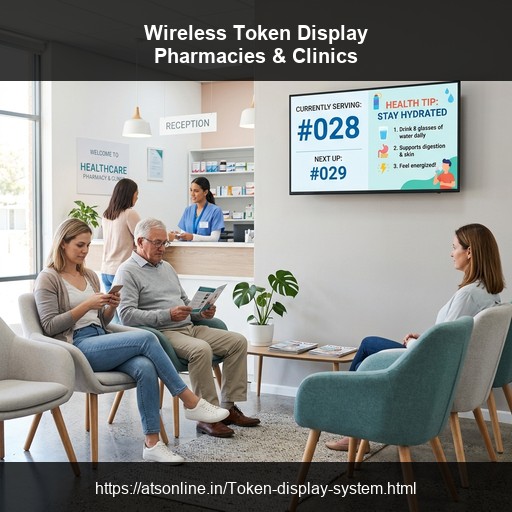
Step into any busy pharmacy or clinic in India and you will find the same problem — patients crowding the counter, calling out their names, arguing over who arrived first, and the dispensing staff constantly interrupted by queue management instead of focusing on dispensing medicines or attending to patients.
A wireless token display system for pharmacies and clinics solves this completely — and unlike traditional wired token machines, it requires no electrician, no wall-mounted LED board, no proprietary hardware, and no IT team. Just a browser, a screen, and an internet connection.
This guide covers everything pharmacy owners, clinic administrators, and healthcare managers in India need to know about choosing and setting up the right wireless token display system.
1. Why Pharmacies and Clinics Have Unique Queue Management Challenges
Pharmacies and clinics face queue challenges that are distinct from banks, restaurants, or government offices:
- Patient vulnerability: Patients may be unwell, in pain, or elderly, demanding a calm, clear, and stress-reducing system.
- High counter pressure: Peak periods create dangerous crowding at a dispensing counter where pharmacists need to concentrate.
- Multiple service types: Separate queues for prescription dispensing, OTC purchases, billing, and doctor consultation are needed.
- Prescription errors: Reducing interruptions for pharmacists directly reduces dispensing errors.
- Elderly and hearing-impaired patients: Require clear visual display and voice announcements.
- Space constraints: Most small clinics have limited space. A wireless system running on a TV avoids bulky LED boards and wiring.
2. What Is a Wireless Token Display System?
A wireless token display system is a cloud-based queue management solution where every component connects over the internet rather than through physical wiring.
What you need: An existing Smart TV (or Android box), a stable internet connection, and any smartphone or computer for the pharmacist to call tokens. You do NOT need an electrician, cable installations, or dedicated LED caller units.
3. How It Works in a Pharmacy or Clinic
- Patient arrives and receives a token from the receptionist or dispensing counter.
- Patient waits and watches the display on the waiting area TV.
- Pharmacist calls the next token by tapping "Next" on their phone or counter computer.
- Voice announcement alerts the patient through the TV speakers.
- Manager monitors remotely from any device to see daily patient flow reports.
4. Key Benefits for Pharmacies
- Pharmacist Focus on Dispensing: Reduces interruptions and errors.
- Faster Counter Throughput: Zero gap time between one patient leaving and the next approaching.
- Reduced Crowding: Keeps the counter area clear, clean, and safe from cross-infection.
- Promotional Revenue: The TV acts as digital signage for OTC promotions, supplements, and health campaigns while patients wait.
5. Key Benefits for Clinics and Polyclinics
- Organised Multi-Doctor Queues: Each doctor's cabin has its own token queue running simultaneously on one TV grid.
- Reduced Patient Anxiety: Seeing "3 patients ahead of me" is calmer than waiting without information.
- NABH Accreditation Support: Cloud-based systems provide the daily documentation required for patient flow management criteria.
6. Display Modes Best Suited for Pharmacies and Clinics
The ATS Token Display System offers multiple display modes:
- Mode 1 — Standard Multi-Input: Best for single-counter pharmacies. One large token number.
- Mode 2 — Media Split: Best for pharmacies wanting promotional revenue. Shows rotating health slides on 60% of the screen.
- Mode 3 — Location Grid: Best for polyclinics. Shows all active doctor queues simultaneously in a grid.
- Mode 4 — Thermal Print: Best for high-volume hospital pharmacies printing token slips automatically.
7. Cost of a Wireless Token Display System
The ATS Wireless Token Display System costs exactly ₹2,950 per counter per year + GST. There are no setup fees, no AMC, and no hidden charges.
| Setup Type | Counters | Annual Cost (ex-GST) | Annual Cost (incl. GST) |
|---|---|---|---|
| Single-counter pharmacy | 1 | ₹2,950 | ₹3,481 |
| Pharmacy with billing counter | 2 | ₹5,900 | ₹6,962 |
| Small clinic (1 doctor + reception) | 2 | ₹5,900 | ₹6,962 |
| Polyclinic (3 doctors + pharmacy) | 4 | ₹11,800 | ₹13,924 |
Compare this to a traditional wired single-counter token machine at ₹18,000–₹30,000 for hardware alone. The wireless system saves ₹20,000–₹40,000 over the first three years.
8. Conclusion
A wireless token display system for pharmacies and clinics is the single highest-impact operational improvement healthcare businesses in India can make — at the lowest cost and with the least disruption. No wiring. No hardware. No IT team. Just a browser, your existing TV, and an internet connection.
Related Reading:
- Token Display System Price Guide
- Token Display System for Hospitals
- How to Set Up on Your TV
- Cost Comparison: Traditional vs Cloud
- Token Display System for Banks
- Queue Management for Restaurants
Transform Your Pharmacy or Clinic Waiting Area Today
Contact ATSonline to set up your zero-hardware Token Display System in under 10 minutes.
📞 Call us at +91 9810078010
✉️ Email us at ats.fnb@gmail.com