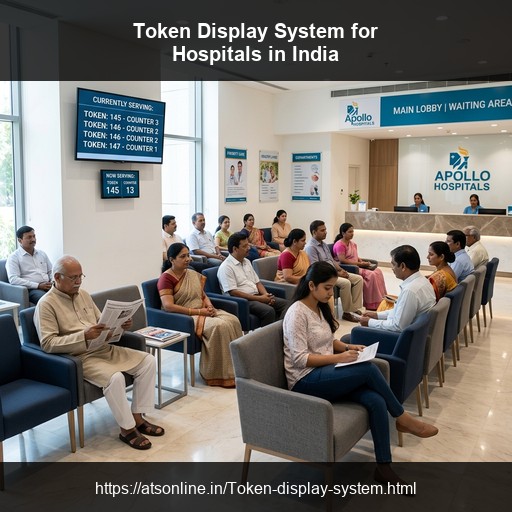
Every hospital administrator in India knows the scene: patients crowding the OPD corridor, arguing at the counter, missing their turn, or simply leaving in frustration. A disorganised queue does not just cause inconvenience — it affects patient care, staff efficiency, and the hospital's reputation.
A token display system for hospitals solves this problem completely. In this comprehensive guide, we cover everything you need to know — what it is, how it works, the benefits, what to look for, and how Indian hospitals are using it today.
1. What Is a Token Display System for Hospitals?
A token display system is a queue management solution that assigns numbered tokens to patients and displays the current token being served on a screen — typically a TV monitor or digital display in the waiting area. When a doctor or staff member is ready for the next patient, they call the next token number, which appears on screen and is announced via audio.
In a hospital context, the system manages patient flow across:
- OPD (Outpatient Department) registration counters
- Pharmacy and billing counters
- Diagnostic and lab collection counters
- Specialist doctor cabins
- Emergency and triage areas
Modern cloud-based token display systems go a step further — they require no dedicated hardware, run directly on any Smart TV or monitor through a browser, and can be managed from any phone or computer.
2. How Does It Work?
A modern hospital token display system works in four simple steps:
Step 1 — Patient receives a token
At registration, the front-desk staff issues a token number. This can be a printed slip from a thermal printer (e.g., "OPD-47") or simply a verbal number.
Step 2 — Token appears on the display
The waiting area TV or monitor shows which token is currently being served at which counter or doctor's cabin.
Step 3 — Staff calls the next token
When a counter is free, the staff member clicks a button on their phone or computer to call the next token number. The display updates instantly.
Step 4 — Voice announcement alerts the patient
A voice announcement ("Token number 47, please proceed to Counter 3") is played automatically through the TV or connected speakers. Patients no longer need to watch the screen constantly.
This entire system runs on a standard internet connection. No wiring, no dedicated machines, no IT team needed.
3. Why Indian Hospitals Need It
Indian hospitals — from large multi-speciality chains to mid-size private hospitals and government facilities — face unique challenges that make queue management critical:
High patient volumes: India's doctor-to-patient ratio is among the lowest in the world. Busy OPDs routinely handle 200–500 patients daily. Without a systematic queue, chaos is inevitable.
Multi-counter complexity: A typical hospital has registration, billing, pharmacy, labs, and multiple specialist OPDs — all running simultaneously. Patients often don't know which counter to go to or when their turn is.
Staff overwhelm: Receptionists and front-desk staff spend significant time managing queues manually — telling patients to wait, calling names, handling complaints — instead of focusing on service.
Patient dissatisfaction: Long, disorganised waits are the number one complaint in hospital feedback forms across India. Patient experience directly affects reputation, referrals, and ratings on Google and Practo.
Regulatory push: NABH (National Accreditation Board for Hospitals) guidelines increasingly emphasise patient experience and flow management as part of accreditation criteria.
4. Key Benefits for Hospitals
Organised, Stress-Free Waiting Area
Patients know their token number and can see exactly how many people are ahead of them. This alone dramatically reduces anxiety, complaints, and crowding at counters.
Reduced Staff Burden
Instead of constantly calling names or managing an unruly crowd, staff simply press a button to call the next token. Counter staff can focus on the patient in front of them.
Voice Announcements in Any Language
Modern systems include text-to-speech voice announcements that call out token numbers automatically. This is especially valuable in hospitals serving patients from diverse linguistic backgrounds — the message is clear, consistent, and requires no staff effort.
Digital Display on Existing TVs
You do not need to buy specialised LED token boards. A cloud-based system runs on any Smart TV, Android TV box, or even a laptop — using screens you likely already have.
Promotional Content During Waiting
The waiting area display can show health tips, department information, doctor schedules, vaccination reminders, or hospital promotional content alongside the token number. Idle screen time becomes an engagement and communication opportunity.
Real-Time Monitoring and Reports
Managers and administrators can see queue status in real time from anywhere. End-of-day reports show tokens served, average wait times per counter, and peak hours — valuable data for staffing decisions.
Works for All Departments
The same system handles OPD queues, pharmacy counters, billing, lab collection, and specialist cabins — with separate counters, different token prefixes (OPD, LAB, BIL), and independent queues all running simultaneously.
Scalable Without Hardware Costs
Adding a new counter or department is a matter of adding a location in the software settings — not buying new hardware or calling a technician.
5. Traditional LED Token Machines vs. Cloud-Based Systems
Many hospitals in India still use traditional wired LED token display boards. Here is how they compare to modern cloud-based systems:
| Aspect | Traditional LED System | Cloud-Based System |
|---|---|---|
| Hardware Cost | ₹25,000 – ₹1,50,000 | ₹0 (use existing screens) |
| Installation | 2–3 days, requires electrician | Under 10 minutes, no IT needed |
| Maintenance | Annual AMC, technician visits | Zero — cloud-hosted, auto-updated |
| Digital Signage | Separate system required | Built-in — videos, images, ticker |
| Voice Announcements | Expensive add-on module | Free — built into every plan |
| Remote Management | Not possible | Manage from any device, anywhere |
| Reports | Manual counting | One-click PDF download |
| Scalability | Buy more hardware | Add a location in Settings |
| Staff Training | Hours of training + manuals | 2 minutes — open URL, call tokens |
6. What to Look for When Choosing a System
Not all token display systems are equal. Here is what hospital administrators should evaluate:
- Multi-counter and multi-department support: The system must handle separate queues simultaneously.
- Alphanumeric token support: Issue tokens like "OPD-47" or "LAB-12".
- Voice announcement: Non-negotiable for a busy hospital.
- Runs on standard screens: Should work on any Smart TV or monitor via a browser.
- No login required for staff terminals: Staff should be able to call tokens with a single tap.
- Thermal printing support: Essential for generating physical token slips.
- Digital signage capability: The display should double as a communication channel.
- Cloud-hosted with remote management: Monitor queues remotely.
- Simple pricing, no hidden costs: Avoid per-feature charges or installation fees.
7. Use Cases by Hospital Department
OPD Registration Counter
The busiest touchpoint. Token display ensures orderly queuing. Recommended setup: Thermal-printed token slips, counter-wise display, voice announcement.
Pharmacy Counter
Eliminates the scramble at the counter, allowing patients to wait comfortably while prescriptions are prepared.
Billing and Cashier Counters
Keeps patients calm during longer interactions like insurance verification and payment processing.
Diagnostic and Lab Collection
Brings clarity and order to lab waiting areas where patients wait for sample collection.
Specialist OPD Cabins
Each doctor's cabin can have its own queue displayed outside, so patients know exactly when to enter.
Government Hospitals and PHCs
Ideal for high patient volumes and limited staff. No wiring or hardware procurement process needed.
8. Cost of a Token Display System in India
Traditional LED Token Machines
For a hospital with 5 counters, traditional hardware, installation, AMC, and signage can result in a 3-year cost of ₹1,20,000 – ₹3,50,000+.
Cloud-Based Token Display System (ATS)
The ATS Token Display System is priced at ₹2,950 per counter per year (GST extra). For a 5-counter hospital, the total 3-year cost is just ₹44,250 + GST, with no hardware or installation fees and all features included.
9. How to Set One Up in Under 10 Minutes
- Register — Create your account with hospital details.
- Configure — Choose display mode and set department prefixes.
- Add locations — Define your counters (OPD, Pharmacy, etc.).
- Open the display — Open the URL on your waiting area Smart TV.
- Start serving — Staff access their keypad URL on any phone or PC to call tokens.
10. Frequently Asked Questions
Does the system work on a regular TV?
Yes. Any Smart TV or Android box will work via a browser URL.
Can multiple departments run separate queues simultaneously?
Yes. Each counter has its own independent queue.
What happens if the internet goes down?
An active internet connection is required. A backup 4G dongle is recommended.
Can we print token slips for patients?
Yes. The system supports 58mm thermal printers.
Is there a voice announcement in Hindi or regional languages?
Yes, it uses browser-native text-to-speech which supports multiple Indian languages.
11. Conclusion
A token display system for hospitals is an operational necessity. Cloud-based systems like the ATS Token Display System make this accessible to every hospital in India — at a fraction of the cost of traditional machines, with zero hardware investment.
Transform Your Hospital's Waiting Area Today
Contact ATSonline to set up your zero-hardware Token Display System in under 10 minutes.
📞 Call us at +91 9810078010
✉️ Email us at ats.fnb@gmail.com