Identification Standards: Comparative Analysis of Barcodes & RFID
July 8, 2026 in Cashless School & Campus
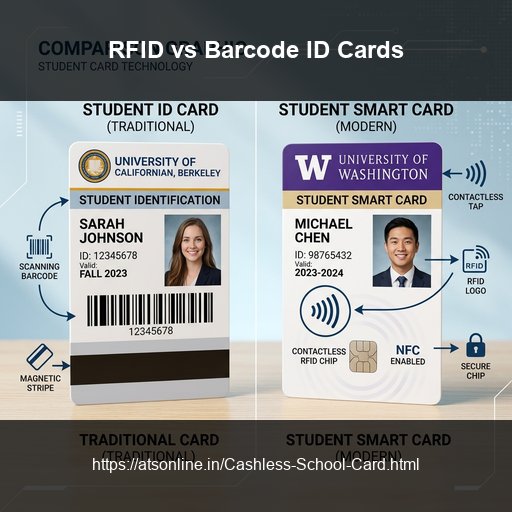
Educational institutions selecting student identification and payment technology are frequently faced with a choice between two main standards: traditional barcode ID cards and modern RFID smart cards. While barcodes represent a mature, low-cost scanning method, RFID (Radio Frequency Identification) smart cards offer contactless data transfer that dramatically improves campus security, attendance tracking, and school canteen throughput.
This post compares RFID and barcode technology across transaction speed, data security, durability, and total cost of ownership to help school administrators make an informed choice.
Technical Overview: How Barcodes and RFID Differ
To understand their operational differences on campus, it is helpful to look at how each technology reads and writes data:
- Barcode ID Cards operate on optical scanning. A scanner emits a laser or light beam that reads the light-and-dark pattern of black lines printed on the card. This requires a direct line of sight between the scanner and the card, and physical alignment at a specific angle. Barcodes are read-only; once printed, the ID number cannot be changed.
- RFID Smart Cards operate on radio frequency waves. An internal microchip and antenna embedded in the card communicate wirelessly with a card reader. The card does not need to be aligned or exposed — it can be read through wallets, pockets, or bags within a range of a few centimeters. RFID cards can be read-and-write, allowing data (like prepaid balances or permission flags) to be updated dynamically.
Operational Comparison: RFID vs. Barcode ID Cards
| Feature | Barcode ID Cards | RFID Smart Cards |
|---|---|---|
| Line of Sight Required | Yes (Physical card must face scanner) | No (Reads through bags, wallets, pockets) |
| Transaction Speed | Moderate (4 - 8 seconds per student) | Instant (Under 1 second tap-to-pay) |
| Durability | Low (Scratches or dirt prevent scanning) | High (Embedded chip is protected from wear) |
| Prepaid Payment Support | Limited (Read-only ID needs active database connection) | Excellent (Closed-loop secure prepaid balances) |
| Attendance Logging | Slow (Students must align cards individually) | Lightning Fast (Rapid tap-to-pass at gates) |
| Data Security & Fraud | Poor (Easily photocopied or duplicated) | High (Encrypted chips prevent counterfeiting) |
| Initial Card Cost | Very Low (Standard PVC printing) | Moderate (PVC with embedded microchip) |
Key Differences in School Settings
1. Canteen and POS Throughput
Recess and lunch breaks present the most severe operational test for any campus payment card.
With barcode ID cards, the canteen cashier must physically take the student's card, align the barcode under the red laser scanner, wait for the beep, and hand the card back. If the card is smudged, scratched, or held at an incorrect angle, the scan fails, forcing manual code entry. This optical alignment bottleneck keeps transaction times at 6 to 10 seconds.
RFID smart cards reduce this to a single contactless tap. The student holds their card or wallet near the reader, and the transaction is processed instantly in under 1 second. High throughput is essential for canteens serving hundreds of students in a 20-minute break window.
2. Campus Security and Gate Attendance
Managing student entry and logging morning attendance requires a high-volume scanning process at school gates.
Using barcode scanners at entrance gates causes long queues. Students must halt, locate their card, pull it out, align it with the reader, and wait for confirmation. During peak arrival times, this creates a major safety hazard near gates.
RFID gates allow students to pass rapidly. By simply tapping their card on a turnstile or walking past a short-range gate reader, attendance is logged in a fraction of a second, sending immediate automated SMS notifications to parents.
3. Card Durability and Replacement Rates
School ID cards are subjected to daily wear and tear by students who carry them loose in bags or play with them on playgrounds.
Barcodes are printed on the card's surface. Scratches, dirt, moisture, and fading quickly degrade the optical contrast of the printed lines, rendering the barcode unreadable. Schools using barcodes report replacement rates of 20% to 30% annually.
RFID chips and antennas are sealed inside the PVC card body. The card surface can be heavily scratched, dirty, or drawn on, and the radio signal will pass through unaffected. RFID cards regularly last for a student's entire school career without needing replacement.
Frequently Asked Questions
Which system is cheaper to implement initially?
Barcode ID cards are cheaper to implement initially because they do not require special smart card stock — any standard PVC card printer can print a barcode. Barcode scanners are also generally less expensive than RFID readers. However, when factoring in high annual card replacement rates and manual labor costs from slow transaction queues, RFID smart cards frequently offer a lower total cost of ownership over a 3-year period.
Can barcode student ID cards support cashless canteen payments?
Yes, but with limitations. A barcode ID card only contains a static number. The POS system must scan this number and query a centralized cloud database to verify the student's prepaid balance. This requires a continuous, active internet connection. If the school's internet goes down, barcode payments stop working. RFID cards, by contrast, can store balance data directly on the card chip, enabling offline billing.
Are RFID smart cards safe for students?
Yes. RFID cards are passive devices that have no battery and emit no electromagnetic radiation. They only activate briefly when placed in the immediate field of a secure RFID reader. The data on the card is encrypted and contains only a secure registration identifier, protecting student privacy.
How easy is it for barcode ID cards to be counterfeited?
Very easy. Since a barcode is just a printed image of black lines, a student can easily photocopy the card, print a copy, or display a photo of the barcode on a smartphone screen to scan it. This makes barcode systems highly vulnerable to fraud. RFID cards are encrypted and cannot be duplicated or photocopied.
Can we upgrade our existing barcode ID cards to RFID?
Yes. Upgrading is straightforward. The school transitions to RFID card stock (which can still have barcodes printed on them for backward compatibility during the transition) and installs RFID reader terminals at canteen counters and library desks. The student database accounts remain the same; only the identifier linked to each student is updated.
Ready to Upgrade to an RFID Student Smart Card System?
ATS Online provides end-to-end RFID smart card POS solutions for schools and colleges across India — streamlining gate attendance, canteen payments, and library management under a single cashless card.
Or call us directly at: +91-9810078010
Conclusion
By implementing a secure, closed-loop RFID campus card POS system, schools and universities protect their revenue, optimize break-time efficiency, and build a modern, high-hygiene food service environment that parents trust.
Switch to cashless school canteen cards and secure your cafeteria operations. Visit www.atsonline.in, call us at +91-9810078010, or email ats.fnb@gmail.com to explore our school POS solutions.