Educational Guide: Closed-Loop Digital Wallets vs Open-Loop UPI Payments
June 30, 2026 in Cashless Event Payments — Education
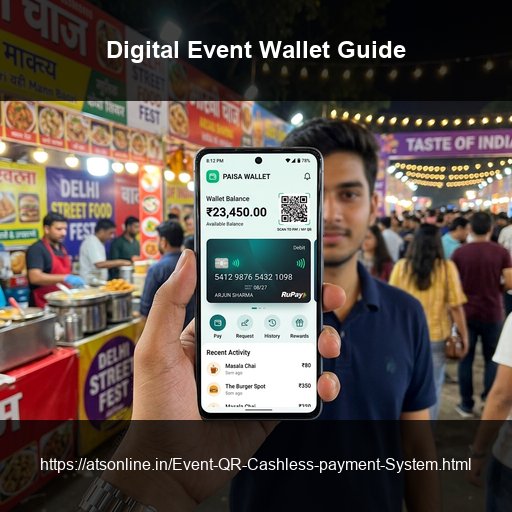
A digital event wallet is a closed-loop prepaid balance, linked to a unique QR code or other digital identifier, that attendees use to pay for goods and services exclusively within a specific event. Unlike a UPI app or bank account, a digital event wallet only works within the event's payment ecosystem — it cannot be used outside the venue, and it exists only for the duration of the event (or, in some cases, across multiple editions of a recurring event). Attendees load money into the wallet at a top-up counter, spend it at vendor stalls by presenting their QR for a scan, and receive any unspent balance back as a refund when they leave.
This explainer covers everything an event organizer needs to know about digital event wallets — what they are, how they differ from other payment methods, how the full lifecycle works for both attendees and organizers, and how a properly secured wallet system like WalletQrPay protects against fraud.
Definition: What Is a Digital Event Wallet?
A digital event wallet is a software-based, prepaid account created specifically for use within a single event or event series. It functions similarly to a prepaid card or a closed-loop gift card, but exists entirely in software — there is no physical card, chip, or token required.
The wallet is identified by a unique code, most commonly a QR code, that is issued to the attendee at entry. This code is the attendee's access point to their balance: presenting it at a vendor stall authorizes a deduction; scanning it themselves shows their current balance; presenting it at a top-up counter allows them to add funds.
The defining characteristic of a digital event wallet is that it is "closed-loop" — meaning the balance can only be spent within the specific event ecosystem it was created for. This is different from an "open-loop" payment method like UPI or a credit card, which can be used anywhere that accepts that payment network.
This closed-loop design is deliberate, not a limitation. It gives the event organizer complete financial visibility and control over every transaction that happens within their event — something that is structurally impossible with an open-loop payment method where transactions happen on third-party rails outside the organizer's view.
How Is a Digital Event Wallet Different From UPI, Credit Cards, and Paper Coupons?
It is worth being precise about how a digital event wallet differs from the other payment methods organizers may be considering.
Digital Event Wallet vs UPI
UPI is an open-loop, real-time payment network that allows direct bank-to-bank transfers between any two parties with a UPI-enabled account. When an attendee pays a vendor directly via UPI (for example, scanning the vendor's personal UPI QR code), the transaction happens entirely outside any system the event organizer controls. The organizer has no visibility into that transaction, no ability to verify it occurred, and no way to include it in their financial reporting or settlement process.
A digital event wallet uses UPI as a top-up mechanism — the attendee loads money into their wallet via UPI — but the actual spending at vendor stalls happens within the closed-loop wallet system, which the organizer fully controls and can report on. This distinction is the entire reason event-specific digital wallets exist: to capture the convenience of UPI for the attendee while preserving complete financial visibility for the organizer.
Digital Event Wallet vs Credit/Debit Cards
A credit or debit card transaction at a vendor stall requires a card machine (POS terminal) at every stall, a per-transaction processing fee, and creates a transaction record that is split across the vendor's individual merchant account rather than aggregated for the organizer. Vendors using independent card machines also create a fragmented settlement picture — the organizer has no single, unified view of total event revenue unless every vendor's individual card terminal data is manually compiled.
A digital event wallet aggregates every transaction — regardless of which vendor stall it occurred at — into a single organizer dashboard and a single settlement system.
Digital Event Wallet vs Paper Coupons
Paper coupons are a physical, closed-loop token system — conceptually similar to a digital wallet in that they only work within the event, but implemented with paper instead of software. The critical difference is fraud resistance and data visibility. Paper coupons can be counterfeited, duplicated, or reused with basic printing equipment, and they generate zero digital transaction record — the organizer has no way to know how many coupons were actually redeemed at each stall except by physically collecting and counting them after the fact.
A digital event wallet, properly secured, cannot be duplicated (each QR is cryptographically unique) and generates a complete, real-time transaction record automatically.
How Attendees Use a Digital Wallet at an Event (Step by Step)
For an attendee, the digital event wallet experience follows a simple four-step lifecycle.
1. Receive the wallet. At entry, the attendee is issued their unique QR code — either as a printed slip or delivered to their phone via WhatsApp or SMS. This is their wallet identifier for the duration of the event.
2. Load money (top-up). The attendee visits a top-up counter (or, in some deployments, tops up directly at a vendor stall) and adds money to their wallet using UPI, card, or cash. The balance is reflected instantly.
3. Spend at vendor stalls. At any participating stall, the attendee presents their QR for the vendor to scan. The transaction amount is deducted from their wallet balance in real time — typically confirmed in under one second.
4. Refund unspent balance. At the end of the event, or whenever the attendee chooses to exit, any remaining wallet balance is refunded — via UPI transfer or cash — and the wallet session is closed.
Throughout this lifecycle, the attendee can check their balance at any time by scanning their own QR with their personal phone camera, without needing to queue at any counter.
How Organizers Manage Wallets: Issuance, Top-Up, Balance Tracking, Refund
From the organizer's side, managing a fleet of digital event wallets across potentially thousands of attendees involves four operational functions, all handled through a single cloud platform like WalletQrPay.
Issuance
The organizer's entry counter team generates and assigns a unique wallet to each attendee as they arrive. This can be done as a fully manual process at the gate, or pre-assigned in advance for attendees who registered online before the event — meaning their wallet QR can be delivered to their phone before they even arrive at the venue.
Top-Up Management
Top-up stations — staffed counters where attendees load funds — are configured by the organizer and positioned strategically near the entry zone. The organizer determines accepted payment methods (UPI, card, cash) and can monitor top-up volume and pace in real time to identify if additional stations are needed during the event.
Balance Tracking and Real-Time Visibility
This is the function that distinguishes a digital wallet system from any analog alternative. The organizer has a live dashboard showing every wallet's current balance, every vendor's running sales, and the aggregate event revenue — updated continuously as transactions occur. This visibility extends to identifying anomalies: a wallet with unusually rapid spending, a vendor stall with no recorded transactions for an extended period, or a top-up counter that is underperforming relative to footfall.
Refund Processing
At event close (or at any point an attendee wishes to exit with remaining balance), the organizer's exit counter team processes the refund — instantly via UPI or as cash from a designated float. For attendees who leave without claiming their refund, the organizer typically holds the unclaimed balance for a defined post-event window (commonly 7 days) during which the attendee can claim it via a mobile number lookup.
Types of Digital Event Wallets: QR-Code Wallets vs RFID-Linked Wallets
Digital event wallets are not exclusively QR-based. The underlying concept — a closed-loop prepaid balance tracked digitally — can be implemented through different identification mechanisms.
QR-code wallets (like WalletQrPay) identify the wallet through a unique QR code, scanned by a vendor's smartphone camera. This requires no proprietary hardware — any standard smartphone can issue, scan, and process transactions against a QR-linked wallet.
RFID-linked wallets identify the wallet through a physical chip embedded in a wristband or card, read by a dedicated RFID reader device. This requires proprietary hardware at every transaction point but offers the advantage of offline transaction processing in environments without reliable internet.
Both approaches create the same fundamental experience for the attendee — a balance they can load, spend, and have refunded — but differ significantly in deployment cost, setup time, and hardware dependency. For most Indian events, the zero-hardware advantage of a QR-code wallet outweighs the offline-capability advantage of an RFID-linked wallet. The full comparison is covered in QR Code Payments vs RFID Cards at Events — Which is Better for India in 2026?
Why WalletQrPay's Cloud-Native Wallet Is Secure Against Screenshot Fraud
A common concern among event organizers evaluating QR-based digital wallets is whether the QR code itself can be duplicated or shared fraudulently — for example, if one attendee screenshots their QR and shares it with a friend, attempting to let two people spend from the same balance simultaneously.
WalletQrPay's security architecture is specifically designed to prevent this. Each wallet's QR code is generated with a unique, cryptographically encrypted token that is tied to a single active session in the cloud — not to the visible image of the QR code itself. This distinction matters: a screenshot of the QR image captures only the visual pattern, but the underlying session validation happens against the cloud-stored token, which cannot be replicated by copying the image.
If two devices attempt to scan the same QR code in quick succession or simultaneously — as would happen if a screenshot were shared — the cloud security engine detects the duplicate session attempt and rejects the second scan within under one second. The vendor attempting the duplicate scan receives an immediate rejection notice, preventing the fraudulent transaction from completing.
This is fundamentally different from a paper coupon, which has no underlying digital validation and can be photocopied with no detection mechanism whatsoever, or from a simple static QR code without session-level security, which could in principle be screenshotted and reused if the underlying system does not implement duplicate-detection logic.
Frequently Asked Questions
Can a digital event wallet expire?
Yes, typically. Most digital event wallets are configured to remain active for the duration of the event (including multi-day events, where the balance carries over between days) and for a defined post-event window — commonly 7 days — during which any unclaimed balance can still be refunded. After this window, the organizer's terms and conditions determine how unclaimed balances are handled, which is communicated to attendees at the time of wallet issuance.
What happens to unspent balance in a digital event wallet?
Unspent balance is refunded to the attendee, either at an exit counter during the event (via instant UPI transfer or cash) or, for attendees who do not claim their refund on-site, through a post-event refund process using their registered mobile number. A well-designed digital event wallet system, like WalletQrPay, makes this refund process simple and fast specifically because attendees who trust they can get their money back are willing to top up more generously, which benefits both their experience and the event's overall commerce volume.
Is a digital event wallet the same as a prepaid card?
Conceptually, yes — both are closed-loop prepaid balances usable only within a specific ecosystem. The difference is implementation. A prepaid card requires a physical card and a card reader at every transaction point. A digital event wallet, when implemented as a QR-code system, requires no physical card and no proprietary reader — any smartphone camera can process the transaction.
Do attendees need to download an app to use a digital event wallet?
With WalletQrPay, no. Attendees do not need to install any app. Their wallet exists as a QR code — either printed or delivered via WhatsApp/SMS — and they interact with it by presenting it for vendors to scan, or by scanning it themselves with their own phone's camera to check balance. The only app installation required in the WalletQrPay system is on the vendor side, where stall operators install the vendor app to process payments.
Can multiple events share the same digital wallet?
This depends on the event organizer's configuration. For recurring multi-edition events run by the same organizer, wallets can in some cases be configured to persist across editions, though most deployments treat each event as an independent wallet session for simplicity and clarity. Contact ATS Online to discuss persistent wallet configurations for recurring event series.
How is a digital event wallet different from a loyalty point system?
A loyalty point system typically tracks non-monetary points earned through purchases or engagement, redeemable for rewards, and usually has no real cash value or refund mechanism. A digital event wallet holds actual prepaid money that the attendee has deposited and is entitled to have refunded if unspent. The two serve different purposes and are not interchangeable, although some event organizers layer a loyalty or rewards program on top of a digital wallet system for additional attendee engagement.
Considering a Digital Event Wallet for Your Next Event?
WalletQrPay by ATS Online is a cloud-native, QR-based digital event wallet platform built specifically for the Indian event market — zero hardware, under-30-minute setup, and UPI-native top-up.
Or call us directly at: +91-9810078010
Conclusion
By moving to a secure, software-defined QR cashless wallet setup, organizers and businesses protect their event margins, eliminate manual reconciliation delays, and deliver a frictionless transaction experience aligned with India's UPI-first payment behaviors.
Switch to UPI-native QR payments and protect your margins. Visit www.atsonline.in, call us at +91-9810078010, or email ats.fnb@gmail.com to explore WalletQrPay.