Cashless Formats Compared: From Zero-Hardware QR to Dedicated Chip Terminals
June 29, 2026 in Cashless Event Payments
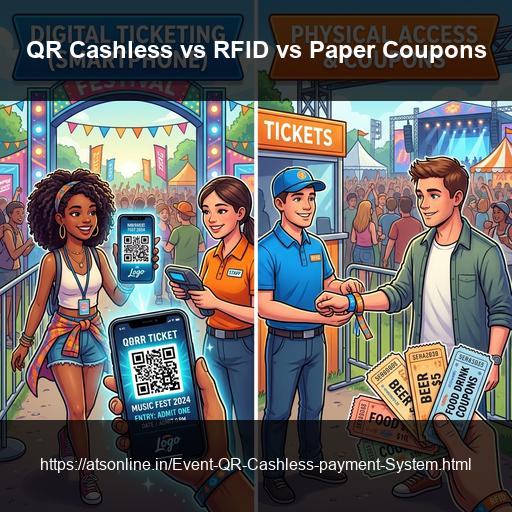
For most Indian events — food festivals, exhibitions, nightclubs, corporate fairs, and college fests — a QR-based cashless system like WalletQrPay is the clear winner. It requires zero hardware, deploys in under 30 minutes, uses UPI for top-ups, and generates automated vendor settlement reports. RFID wristbands are a viable alternative only for very large outdoor festivals in remote locations. Paper coupons, while still widely used, introduce significant fraud and reconciliation risk that no serious event organizer can afford to ignore. This post gives you an honest, dimension-by-dimension breakdown of all three systems — and a clear scenario guide to help you choose the right one for your event.
The Three Systems at a Glance
QR Cashless — WalletQrPay
A cloud-based digital wallet platform where each attendee is issued a unique QR code at entry. They top up their wallet using UPI, card, or cash, then pay at vendor stalls by having their QR scanned. Every transaction is recorded in real time. The event organizer has live visibility from a central dashboard. Vendor settlement is automated at close of event. No proprietary hardware is required — every participating device is a standard smartphone or tablet.
RFID Wristbands / Cards
Each attendee receives a physical wristband or card embedded with an RFID chip. They preload money onto the chip at a designated top-up terminal. At vendor stalls, they tap their wristband on an RFID reader to pay. Requires dedicated RFID card readers at every payment point, chip encoders for top-up stations, and compatible POS hardware throughout the venue. Setup is hardware-intensive and typically takes several hours before event opening.
Paper Coupons / Tokens
The oldest format in Indian events. Attendees buy physical coupon booklets or individual tokens at a central counter, then exchange them at stalls. No technology is required. Extremely prone to counterfeiting, over-issuance, duplicate use, and manual reconciliation errors. Settlement requires physical counting of collected coupons after the event, a process that frequently runs into early morning and still produces disputes.
8-Dimension Comparison
1. Hardware Cost
WalletQrPay (QR): Zero. Vendors use their own smartphones. The organizer uses a laptop or tablet for the dashboard. There are no card readers, encoders, chip cards, or proprietary terminals to purchase or rent.
RFID: High. Every payment point requires an RFID reader. Top-up stations require chip encoders. The event may also need compatible POS terminals. Hardware rental for a medium-scale event (40 stalls) can cost anywhere from ₹50,000 to ₹3,00,000 depending on the provider and duration.
Paper Coupons: Medium. Printing costs for coupon booklets, security paper, serial numbering, and collection pouches. The cost per unit is low but the volume required for a large event adds up.
2. Setup Time
WalletQrPay (QR): Under 30 minutes. Vendor app installation, top-up counter configuration, dashboard access, and wallet issuance workflow are all activated through the cloud. No physical infrastructure is deployed.
RFID: Hours. Readers must be placed at every stall, tested for range and connectivity, synced to the central system, and calibrated. Wristband or card stock must be encoded ahead of the event.
Paper Coupons: Days. Design, print, serial number, bundle, and distribute coupon booklets before the event.
3. Balance Inquiry
WalletQrPay (QR): Attendees scan their own QR code with their personal smartphone camera at any time to see their live balance, top-up history, and transaction log. No queuing required. Real-time accuracy guaranteed.
RFID: Requires a dedicated balance-inquiry terminal or a tap on a reader device. Attendees cannot check their balance independently — they must find a staffed kiosk or ask a vendor.
Paper Coupons: No balance inquiry is possible. Attendees manually count remaining coupon slips.
4. Fraud and Leakage Risk
WalletQrPay (QR): Near zero. Each QR code is uniquely encrypted and dynamically tied to a single user session. Screenshot fraud is rejected in under one second by the cloud security engine.
RFID: Low. Physical chips are harder to duplicate than paper, though card cloning is technically possible with the right equipment. Physical loss of the wristband/card is a more common problem.
Paper Coupons: Extremely high. Paper coupons can be photocopied, duplicate-printed by insiders, reused after a vendor fails to destroy them, or counterfeited with basic printing equipment.
5. Vendor Settlement
WalletQrPay (QR): Fully automated. At the end of the event, WalletQrPay generates a counter settlement report for each vendor showing total transaction count, total value, and a time-wise breakdown. Payouts happen in minutes.
RFID: Fast but requires terminal sync. RFID readers log transactions locally, which must be synced to the central system at close. If a reader had connectivity issues during the event, its transaction log may be incomplete.
Paper Coupons: Manual and dispute-heavy. Collected coupons from each stall must be physically counted, sorted, and reconciled against the stall's declared float and sales. This process routinely takes 3 to 6 hours after event close.
6. Offline Capability
WalletQrPay (QR): Requires active internet. Cloud connectivity is necessary for real-time transaction validation, duplicate-scan rejection, and live dashboard updates. For offline support at massive venues, check our RFID Cashless Event Cards.
RFID: Can operate in offline mode. RFID readers store transaction data locally and sync when connectivity is restored. This is RFID's most meaningful structural advantage for remote outdoor venues.
Paper Coupons: Fully offline. Works anywhere with no technology dependency.
7. Attendee Experience
WalletQrPay (QR): Familiar and frictionless. Indians use QR codes and UPI every day. The attendee experience mirrors what they already do at restaurants and shops. Top-up uses their existing UPI app.
RFID: Good, but dependent on hardware quality. A well-deployed RFID tap is fast, but dead readers, range issues, and physical card damage can create friction.
Paper Coupons: Poor. Counting slips, managing multiple denominations, and queuing for change all create friction that slows down vendor throughput.
8. Scalability
WalletQrPay (QR): Linearly scalable. Adding 10 more vendors to the system means 10 more phones with the app installed — a 5-minute task. The cloud dashboard handles any number of concurrent transactions.
RFID: Hardware-bound scalability. Every additional vendor stall requires an additional RFID reader. Scaling up at the last minute requires sourcing additional hardware, which is often impossible on short notice.
Paper Coupons: Scales at the cost of more print runs and more counting at the end.
Summary Scorecard
| Dimension | QR (WalletQrPay) | RFID | Paper Coupons |
|---|---|---|---|
| Hardware cost | ✅ Zero | ❌ High | ⚠️ Medium |
| Setup time | ✅ Under 30 min | ❌ Hours | ❌ Days |
| Balance inquiry | ✅ Self-serve, real-time | ⚠️ Terminal needed | ❌ Not possible |
| Fraud / leakage risk | ✅ Near zero | ✅ Low | ❌ Extremely high |
| Vendor settlement | ✅ Instant, automated | ⚠️ Fast, needs sync | ❌ Manual, hours |
| Offline capability | ⚠️ Needs internet | ✅ Offline capable | ✅ Fully offline |
| Attendee experience | ✅ UPI-native, frictionless | ✅ Good with hardware | ❌ Poor |
| Scalability | ✅ Unlimited, software-defined | ⚠️ Hardware-bound | ⚠️ Fraud scales too |
| Overall Score | 7/8 | 4/8 | 1/8 |
Scenario Guide: Which System Should You Choose?
- Food Festival (1-5 days, 20-80 stalls): Choose QR (WalletQrPay). Zero hardware, fast vendor onboarding, automated settlement, and a UPI-native attendee experience make this the obvious choice.
- Nightclub or Bar Night: Choose QR (WalletQrPay). The cloud-native audit trail — every transaction logged by device, counter, and timestamp — is the most effective anti-pilferage tool.
- Consumer Exhibition (3-7 days, 50-200 stalls): Choose QR (WalletQrPay). The exhibition format rewards the same zero-hardware, fast-deployment advantages.
- College Fest or Campus Carnival (1-2 days): Choose QR (WalletQrPay). Zero hardware cost and a sub-30-minute setup make this the only system that makes economic sense.
- Large Remote Music Festival (No Internet): Consider RFID or a QR-RFID hybrid. RFID's offline mode is its genuine advantage here.
Frequently Asked Questions
Is RFID better than QR for large festivals in India?
Not for most large festivals. RFID's only structural advantage over QR is offline capability — the ability to process transactions without internet connectivity. For events at venues with reliable 4G or wifi (which includes the majority of large festivals in Delhi NCR, Mumbai, Bengaluru, and Goa), this advantage disappears. In all other dimensions — hardware cost, setup speed, attendee experience, vendor settlement, and scalability — QR cashless outperforms RFID significantly.
Can I switch from paper coupons to QR cashless easily?
Yes. The transition from paper coupons to WalletQrPay is the easiest migration in this comparison. There is no hardware to return or infrastructure to dismantle — you simply stop printing coupon booklets and activate WalletQrPay instead. The vendor workflow (scan, enter amount, confirm) takes approximately 5 minutes to learn. Most events make the switch between editions with no disruption to vendor operations.
Do attendees need to install a separate app to use QR cashless?
No. Attendees do not install any app. Their event wallet QR code is issued at entry as a printout or sent to their phone via WhatsApp or SMS. They top up using their existing UPI app, which every Indian smartphone user already has. They pay by presenting the QR for a vendor to scan. The entire attendee experience runs on technology they already have and already use.
What happens if a vendor's phone dies during the event?
Any replacement phone with the WalletQrPay vendor app installed can take over immediately. Because the system is cloud-native, there is no locally stored session data that would be lost. The vendor logs into the app on the replacement device and continues processing transactions within seconds.
Is QR payment secure enough for large-value event wallets?
Yes. WalletQrPay's QR security is session-level encrypted. Each QR code is uniquely tied to a single cloud session and cannot be duplicated, forwarded, or screenshot-reused. Duplicate scan attempts are rejected in under one second. For attendees carrying high-value event wallets (₹5,000–₹20,000 top-ups are common at premium food festivals), this security level is equivalent to or better than a physical card.
Can I use WalletQrPay alongside RFID for a hybrid setup?
This is technically possible and may be appropriate for very large multi-day events with mixed connectivity zones. Contact the ATS Online team to discuss a hybrid deployment. For the vast majority of events, a pure WalletQrPay deployment is simpler, cheaper, and more reliable than a hybrid.
Conclusion
For most Indian events, a cloud-native, zero-hardware QR payment system like WalletQrPay outperforms hardware-heavy RFID and manual coupons in speed, cost, and security.
Audit vendor entries and eliminate cash errors. Visit www.atsonline.in, call us at +91-9810078010, or email ats.fnb@gmail.com to explore WalletQrPay.