Expert Review: The Economics of Commission-Free Ticketing
June 28, 2026 in Event Ticketing Solutions
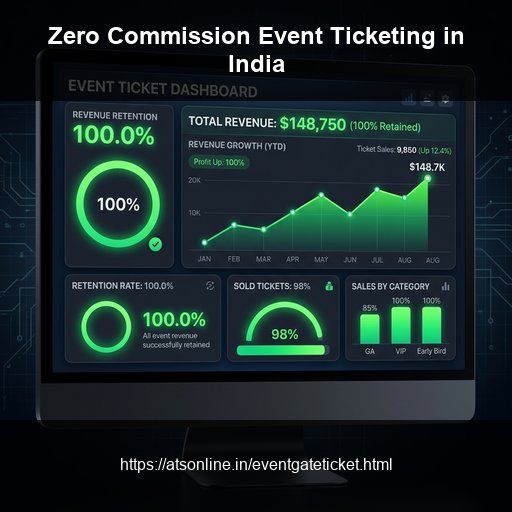
Every event organizer knows the frustration: you spend months planning, marketing, and negotiating — and then a ticketing platform quietly takes 5% to 10% of every rupee your attendees pay. On a mid-sized event, that number quietly becomes your single largest line-item cost, more than your sound system, more than your décor. Zero commission ticketing changes that equation entirely. But what does the term actually mean, how does it work, and is it too good to be true? This guide breaks it all down.
What Is Zero Commission Ticketing?
Zero commission ticketing means the ticketing platform does not charge a percentage of your ticket revenue. You set your ticket price. Your attendee pays that price. Every rupee collected lands in your bank account — the platform earns nothing from your sales.
This is in contrast to the traditional model used by most large ticketing platforms, which charges:
- A percentage fee per ticket (typically 2%–10% of the face value).
- A flat convenience fee passed to the buyer (reducing willingness to pay).
- An organizer subscription on top of both.
Zero commission platforms instead recover their costs through a different mechanism — usually a flat per-ticket credit charge or a setup fee — which gives organizers total predictability over their cost structure.
Why Commission-Based Ticketing Is Expensive at Scale
The math is straightforward, but it compounds quickly. Let's compare the costs for an event selling 1,000 tickets at ₹500 per ticket:
| Platform Type | Commission Rate / Pricing | Amount Lost / Cost |
|---|---|---|
| Commission-based (high tier) | 10% | ₹50,000 |
| Commission-based (low tier) | 4% | ₹20,000 |
| Zero commission (EventGateTicket) | ₹7–₹9 per ticket credit | ₹7,000–₹9,000 |
At scale, the difference between a commission model and a credit-based zero commission model is not marginal — it's the difference between a profitable event and a break-even one. For college fests, independent music nights, food festivals, and corporate conferences where margins are already thin, this matters enormously.
How Zero Commission Ticketing Actually Works
If the platform isn't taking a cut of your revenue, how does it sustain itself? There are two common models:
1. Pay-Per-Credit (Flat Fee Per Ticket)
You buy a pack of ticket credits upfront. Each credit is consumed when one ticket is generated. The credit cost is flat — ₹6, ₹7, or ₹9 depending on volume — regardless of what price you set for the ticket. This is the model used by EventGateTicket by ATS Online. A ₹200 ticket and a ₹2,000 ticket both consume exactly one credit. The organizer's cost is fully predictable.
2. Subscription / SaaS Fee
Some platforms charge a monthly or annual fee for the software itself, with zero per-ticket commission. This works better for frequent organizers running multiple events per month.
3. Buyer-Side Convenience Fee
Some platforms declare themselves "zero commission for organizers" while adding a convenience fee on top of the ticket price for the buyer. The organizer sees no cut taken, but the buyer pays more, which can reduce conversions on your page. EventGateTicket does not add buyer-side convenience fees — attendees pay exactly the price you set.
What You Still Pay For (and What You Don't)
Zero commission does not mean zero cost. Here's a clear breakdown:
You pay for:
- Ticket credits (flat rate, predictable).
- Payment gateway processing fees (charged directly by Razorpay, PayU, or Stripe).
- GST on ticket credit purchases.
You don't pay for:
- Any percentage of your ticket revenue.
- Monthly platform subscriptions or rentals.
- Convenience fees added for buyers.
- App downloads or scanner hardware.
Zero Commission vs. Free Ticketing Platforms
It's worth separating two terms that often get confused:
"Free" ticketing platforms often mean free for free events — as soon as you charge money, commissions kick in. The "free" label refers to account setup, not the revenue model.
Zero commission ticketing means the platform genuinely earns nothing from your paid ticket sales, regardless of ticket price. The organizer's cost is capped at a flat credit charge.
Who Benefits Most From Zero Commission Ticketing?
- Independent Promoters: High ticket volumes at moderate prices (₹300–₹800) make percentage commission painful. Flat credits improve economics.
- College Fest Committees: Budget-constrained committees frequently run events where ₹50,000 lost to ticketing fees is unworkable.
- Corporate Event Managers: High-value tickets (₹2,000–₹10,000) benefit most — a 5% cut on a ₹5,000 ticket is ₹250 per head, which multiplies fast.
- Food and Cultural Festivals: Multi-day events with separate session tickets benefit from pricing flexibility without calculating commission impacts on every tier.
Is Zero Commission Ticketing Available in India?
Yes, though options are limited. EventGateTicket by ATS Online is one of the few India-built platforms offering genuine zero commission ticketing with:
- INR-native pricing and GST invoice compliance.
- Direct integration with Indian payment gateways (Razorpay, PayU).
- Local support in Delhi NCR, Mumbai, Bangalore, Goa, Pune, and Hyderabad.
- Offline scanning fallback for festival environments.
Frequently Asked Questions
Does zero commission mean the ticketing software is free?
Not necessarily. Most zero commission platforms earn revenue through flat per-ticket charges, credit packs, or subscriptions. The key distinction is that they don't take a percentage of your revenue.
Are payment gateway fees included in zero commission?
No. Payment gateway processing fees (typically 1.5%–2.5%) are charged by your gateway (Razorpay, PayU, Stripe) and are separate from the ticketing platform's own charges. This applies to all ticketing platforms regardless of their commission model.
Can I pass the ticket credit cost to my attendees?
Yes. You can factor the per-credit cost into your ticket price. At ₹7–₹9 per ticket, this is a negligible addition to any ticket price above ₹100.
What's the minimum commitment for EventGateTicket?
New organizers receive 10 free credits immediately on registration. The smallest paid pack is 300 credits. There is no minimum monthly spend or subscription.
Is zero commission ticketing legitimate for high-volume events?
Yes. EventGateTicket's cloud infrastructure scales dynamically with no system cap on ticket volume. Custom credit packs are available for events exceeding 2,500 attendees.
Conclusion
Zero commission ticketing is a straightforward business model where the platform's revenue is decoupled from your ticket revenue. For event organizers in India who are running paid events with real margins at stake, the difference between a 5% commission platform and a flat-credit zero commission system can mean tens of thousands of rupees per event.
Optimize your event checkouts and keep 100% of your earnings. Visit www.atsonline.in, call us at +91-9810078010, or email ats.fnb@gmail.com to explore EventGateTicket.