Event Performance Audit: Identifying Structural Cash and Coupon Leakages
June 30, 2026 in Cashless Event Payments
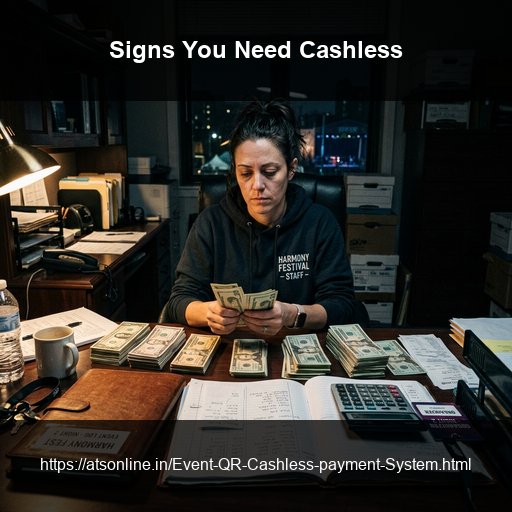
If you recognize more than two or three of the seven signs below, your event is very likely losing meaningful revenue to cash leakage, pilferage, or settlement inefficiency — and a QR cashless system like WalletQrPay would pay for itself at your very next event. These signs are drawn from the recurring pain points reported by Indian event organizers running food festivals, exhibitions, nightclubs, and multi-vendor fairs, and every one of them has a clear, structural cause that cashless payment eliminates.
Read through the list. If your event experience matches what's described, the fix is more straightforward than you might think.
Sign 1: You're Still Counting Cash at 2 AM After the Event
If your event team is sitting in a back office at 1 or 2 in the morning, bundling cash, double-checking counts, and waiting on vendor cash collections to be brought in one by one — this is the most visible symptom of a cash-dependent payment system, and it is entirely avoidable.
Manual cash counting after a multi-vendor event routinely takes 5 to 8 hours for a mid-sized food festival or exhibition. Staff who have already worked a full event day are kept late into the night. The process is exhausting, error-prone, and — because it happens when everyone is tired and eager to finish — more likely to produce counting mistakes that then need to be re-checked.
A QR cashless system eliminates this entirely. There is no cash to count because no cash changed hands at any vendor stall. Settlement reports are generated automatically from the cloud transaction log the moment the event session closes — typically within minutes, not hours. For more on exactly how this works, see How Automated Vendor Settlement Works at Cashless Events.
Sign 2: Your Vendor Payouts Are Always Disputed
If post-event conversations with vendors regularly turn into negotiations — where the vendor believes they sold more than your cash count shows, and there is no independent record to settle the disagreement — this is a structural problem with cash-based settlement, not a vendor relationship problem.
In a cash system, the organizer only knows what cash was physically handed over. The vendor only knows what they believe they sold, based on memory or informal tracking. Neither figure is independently verifiable, which means every disagreement is an unresolvable he-said-she-said situation that damages the relationship you need for next year's event.
A cashless system removes the disagreement because both parties see the same data: a cloud-recorded transaction log that neither side can alter. Settlement becomes a matter of reading a report, not negotiating a dispute. The mechanics of this shift are covered fully in How to Stop Cash Leakage and Revenue Pilferage at Events.
Sign 3: You've Found Counterfeit or Duplicate Coupons in the Pile
If your event uses paper coupon booklets and you have ever found coupons in the collection pile that look slightly off — a different paper weight, a faded print, a serial number that does not match your sequence — you have already experienced coupon fraud, even if you were never able to prove who was responsible.
Paper coupons are the easiest payment instrument in any event to counterfeit. Basic printing equipment and access to the original design file is all it takes to produce a convincing duplicate, and detection requires a level of per-coupon scrutiny that no stall operator can realistically apply during a busy peak hour.
This vulnerability simply does not exist in a properly secured QR cashless system. Each wallet QR is cryptographically encrypted and tied to a single cloud session — it cannot be duplicated, photocopied, or reused. Screenshot attempts are rejected by the system within under one second. There is no physical token to counterfeit in the first place.
Sign 4: You Can't Tell Which Stall Sold the Most — Until Days Later
If your only way of knowing which vendor performed best, which zone drove the most footfall, or how your event's commerce actually played out is to wait for vendors to self-report after the fact — you are running your event financially blind while it is actually happening.
This matters for more than curiosity. Real-time sales visibility allows an organizer to make operational decisions while the event is still running: redirecting staff to an underperforming or struggling stall, opening an additional top-up counter when demand spikes, or identifying a connectivity issue at a specific vendor before it costs them an hour of lost sales.
A QR cashless system's live dashboard shows exactly this — per-vendor sales, updated in real time, visible from any device. The difference between knowing this during your event versus three days after it closes is the difference between being able to act on the information and merely documenting what already happened.
Sign 5: Queues at Your F&B Counters Are 10+ Minutes Long
If attendees are regularly waiting 10 minutes or more at your busiest food or bar stations — particularly during predictable peak windows like lunch hour or the first hour after gates open — the bottleneck is very likely the payment step, not the food preparation step.
Cash transactions, with change counting and handover, typically take 25 to 40 seconds each. At a stall processing high volume during peak hour, this payment-step delay compounds into exactly the kind of queue length that frustrates attendees, reduces the number of transactions a stall can process in a given window, and ultimately caps your event's total commerce potential regardless of how much demand exists.
A QR cashless system reduces the payment step to under one second. The bottleneck shifts to where it should be — order preparation time — rather than the payment mechanics. This alone has been shown to allow vendors to serve up to 3 times more customers per hour, directly translating into shorter queues and higher per-stall revenue.
Sign 6: You Suspect Staff Pilferage but Can't Prove It
If you have a nagging sense that a particular stall, bar station, or counter is generating less revenue than its visible footfall and queue length would suggest — but you have no way to prove it, investigate it, or even identify which specific staff member might be responsible — this is one of the most financially damaging and emotionally frustrating positions an event organizer can be in.
Cash transactions are, by design, anonymous and untraceable to a specific individual or moment. In a busy bar or food stall, staff who choose to skim cash, give short change deliberately, or process unrecorded "no-bill" transactions are operating in an environment with essentially zero detection risk. This is particularly severe at nightclubs and bars, where the combination of darkness, noise, and high transaction velocity makes cash pilferage almost impossible to catch in real time — a problem covered in detail in Cashless Payment System for Nightclubs and Bars in India.
A QR cashless system creates exactly the audit trail that cash cannot. Every transaction is logged against a specific device, with a timestamp. If a particular station's transaction pattern looks anomalous relative to its visible activity, that anomaly is immediately visible on the organizer's dashboard — not discovered weeks later through inference and suspicion.
Sign 7: Refunds Take Days and Attendees Complain
If attendees who leave your event with unspent coupon credits, wristband balances, or token leftovers regularly complain about not being able to get their money back — or if your refund process requires them to submit a request and wait days for resolution — this is actively damaging your event's reputation and discouraging attendees from spending more freely during the event itself.
This is a more significant problem than it might initially appear. Attendees who are uncertain whether they will get unspent money back tend to top up conservatively, which directly suppresses your event's total commerce. A clean, fast, trusted refund process does the opposite — it encourages attendees to load a larger initial balance, because they know any unspent amount comes back to them easily.
A well-implemented QR cashless system processes refunds instantly at an exit counter — via UPI transfer or cash — with the wallet closed on the spot. There is no waiting period, no refund request form, and no days-long resolution process. For attendees who leave without claiming a refund, a clear post-event claim window (typically 7 days, via mobile number lookup) ensures no one loses money simply because they did not have time to visit the exit counter.
What These Seven Signs Have in Common
Every one of these signs traces back to the same root cause: a cash-based or paper-based payment system that creates no independent, real-time, tamper-proof record of what is actually happening at your event. Each sign describes a different symptom of that single underlying problem — slow settlement, vendor disputes, fraud, lack of visibility, slow transactions, unprovable pilferage, and refund friction are all downstream consequences of the same structural gap.
A QR cashless system like WalletQrPay closes that gap directly. Every transaction is recorded the moment it happens, attributed to a specific vendor and device, visible in real time, and immutable once logged. This single architectural change is what eliminates all seven symptoms simultaneously — not as seven separate fixes, but as one structural correction to how your event's money moves.
For the complete breakdown of the underlying benefits, see Top 5 Benefits of Going Cashless at Your Event in India and The Complete Guide to QR Cashless Event Payment Systems in India (2026).
Frequently Asked Questions
How many of these 7 signs does my event need to show before going cashless makes sense?
There is no strict threshold, but organizers who recognize even two or three of these signs typically find that the cost of a cashless deployment is recovered many times over by the leakage and inefficiency it eliminates at a single event. If your event shows most or all seven signs, the case for switching is very strong.
Is it expensive to switch from cash or paper coupons to a QR cashless system?
WalletQrPay requires zero hardware investment, which makes the switch significantly more affordable than RFID alternatives. Costs depend on your specific event scale — footfall, number of vendor stalls, and duration. Contact ATS Online for a quote tailored to your event.
Can I switch to cashless for just one trial event before committing long-term?
Yes. Many organizers run a single event as a pilot to evaluate the impact on revenue, settlement time, and attendee experience before adopting cashless payments as their standard infrastructure across future editions.
What if my vendors are resistant to switching from cash?
Vendor resistance is common before the first cashless event and typically dissolves quickly once vendors see their own settlement report — an accurate, automated, dispute-free figure that often exceeds what they were able to declare and defend under a cash system. A structured vendor orientation, covered in our setup checklist, addresses most resistance before it becomes an issue on event day.
Does this apply to small events too, or only large festivals and exhibitions?
These seven signs apply at any scale, though the absolute financial impact grows with event size and transaction volume. Even a modest event with 10 to 15 vendor stalls can experience meaningful leakage and settlement inefficiency that a cashless system resolves.
Stop Losing Money at Your Next Event
WalletQrPay by ATS Online eliminates all seven of these problems with zero hardware cost and setup in under 30 minutes.
Or call us directly at: +91-9810078010
Conclusion
By moving to a secure, software-defined QR cashless wallet setup, organizers and businesses protect their event margins, eliminate manual reconciliation delays, and deliver a frictionless transaction experience aligned with India's UPI-first payment behaviors.
Switch to UPI-native QR payments and protect your margins. Visit www.atsonline.in, call us at +91-9810078010, or email ats.fnb@gmail.com to explore WalletQrPay.