Food Court Infrastructure: Eliminating Paper Coupons & Internet Downtime
August 5, 2026 in Cashless Food Court & Canteen
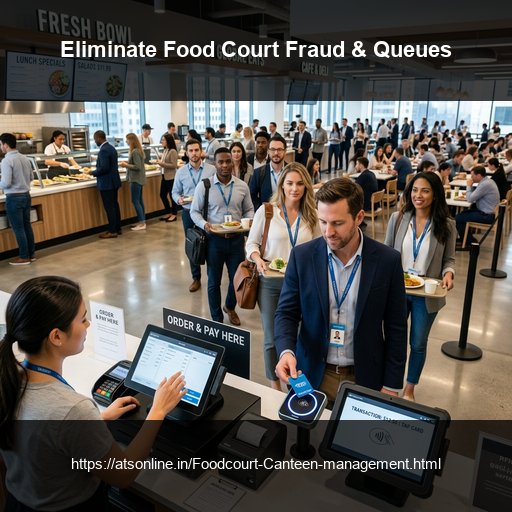
High-volume food courts in IT parks, shopping malls, corporate headquarters, and university campuses face intense customer rushes during peak lunch hours. Traditionally, operators have relied on paper coupons, plastic tokens, or cash billing counters. However, these legacy methods create major operational vulnerabilities: counterfeit paper coupons, manual cashier theft, slow cash change calculations, and total business disruption whenever internet connections drop.
Deploying an offline-first RFID smart card POS system solves these challenges completely. This article details how offline RFID technology eliminates coupon fraud, clears peak queues, and ensures 100% billing uptime for food court managers and vendors.
The Hidden Costs of Paper Coupons and Cash Counters
Operating a food court with paper coupons or cash counters introduces several structural risks:
1. Counterfeit Coupon Fraud and Re-use
Paper coupons are easily photocopied, duplicated, or stolen from collection bins for re-use. Food court management loses thousands of rupees monthly when vendors submit fake or reused coupons for reimbursement.
2. Congested Billing Counters and Lost Sales
During peak lunch hours (12:30 PM to 2:00 PM), customers spend 10 to 15 minutes waiting in queue just to buy paper tokens, followed by a second queue at the food stall. Long wait times frustrate customers and limit the total order volume vendors can process.
3. Vulnerability to Internet Outages
Online-only cloud POS systems freeze as soon as Wi-Fi or cellular connections drop. When billing counters freeze during peak hours, queues spill into corridors, sales stop, and revenue is lost.
How Offline RFID Card POS Systems Solve Food Court Challenges
An RFID smart card system replaces paper tokens and cash counters with a closed-loop digital wallet. Here is how it transforms food court operations:
1. 100% Offline Billing Uptime
The ATS Online food court POS system operates on an offline-first architecture. Each billing terminal and vendor counter POS operates independently of the internet. Transactions write encrypted balance updates directly to the RFID card chip sectors in under 1 second, guaranteeing zero downtime during network outages.
2. Elimination of Coupon Fraud and Skimming
Because payments are transferred digitally from the customer's prepaid card to the vendor's POS terminal, physical coupons and cash floats are completely eliminated. Every transaction creates an encrypted cloud audit log, making coupon fraud and cashier skimming impossible.
3. High Throughput Tap-to-Pay Counters
Customers load funds onto an RFID card at a central recharge desk or online portal. At food stalls, customers simply tap their card on the vendor's terminal. The item amount is deducted in under 1 second, eliminating paper token exchanges and clearing queues rapidly.
4. Automated Vendor Settlements and Revenue Splits
At the end of the day, food court management can export instant vendor settlement reports. The software automatically calculates commission splits, rental deductions, and net vendor payouts with 100% accounting accuracy.
Comparison: Paper Coupons vs. Offline RFID Smart Cards
| Feature | Paper Coupons & Cash | Offline RFID POS System |
|---|---|---|
| System Uptime | Vulnerable to manual errors | 100% Offline Uptime (Zero internet dependency) |
| Coupon Fraud & Re-use | High Risk (Photocopies & stolen slips) | Zero Risk (Encrypted digital chip transactions) |
| Average Checkout Speed | Slow (30 - 45 seconds per order) | Instant (Under 1 second tap-to-pay) |
| Vendor Reconciliation | Manual (Hours counting paper slips) | Automated (Instant cloud settlement reports) |
| Hygiene Standard | Low (Paper slips handled near food) | High (100% contactless digital payment) |
| Breakage Revenue | Lost to unredeemed paper slips | Retained centrally by management |
Frequently Asked Questions
Why is offline capability so important for food court POS systems?
Peak lunch rush involves hundreds of concurrent transactions per minute. If a POS system relies on external internet servers, a minor network lag stops billing, causing massive queue backups. An offline-first POS processes transactions locally on the card chip in real time, ensuring billing never stops.
How are remaining balances handled for temporary food court guests?
Guests can return their RFID card to the central recharge counter at any time to receive a full refund of their remaining prepaid balance and card deposit.
Can the system handle multiple food stalls with different menus?
Yes. The software supports unlimited vendor stalls, each with its own customized menu, pricing, and tax structures. Sales are tracked separately for each stall under a single master management portal.
Is the RFID card reusable?
Yes. The PVC smart cards are built with durable embedded chips designed to withstand thousands of taps. Cards returned by short-term visitors can be wiped and re-issued immediately to new guests.
Upgrade Your Food Court with an Offline RFID POS System
ATS Online provides industry-leading offline RFID card POS solutions for food courts, corporate canteens, and IT park cafeterias across India.
Or call us directly at: +91-9810078010
Conclusion
Deploying an offline-first RFID food court POS system protects management revenue, eliminates paper coupon fraud, and ensures fast, uninterrupted billing during peak lunch hours.
Switch to cashless RFID POS solutions and secure your operations. Visit www.atsonline.in, call us at +91-9810078010, or email ats.fnb@gmail.com to explore our POS solutions.