Digital Transformation: How Closed-Loop QR Wallets Connect with India's UPI Growth
June 30, 2026 in Cashless Event Payments — Trends
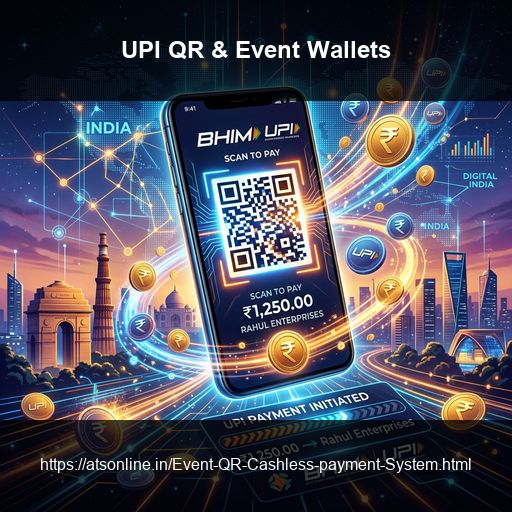
India's UPI ecosystem processed over 23 billion transactions worth nearly ₹30 trillion in a single month as of mid-2026 — a scale of real-time digital payment adoption unmatched anywhere in the world, and the single biggest reason QR-based event wallets like WalletQrPay have become the natural default for cashless events in India. Live events are simply catching up to a payment behaviour that hundreds of millions of Indians already practice every day, at every kirana store, every auto-rickshaw, and every roadside stall across the country.
This post traces the connection between India's broader digital payment transformation and the specific shift happening in event payment infrastructure — and what it means for organizers deciding how to build their cashless system.
India's Digital Payment Explosion: The Numbers Behind the Revolution
To understand why QR-based event wallets are winning in India, it is worth understanding the scale of the underlying payment behaviour they are built on.
According to NPCI data, UPI processed 23.2 billion transactions worth Rs 29.9 trillion in May 2026, equivalent to 737.79 million transactions per day. This is not a niche payment method serving a tech-savvy minority — UPI now accounts for around 90% of India's total digital retail payment volume, with over 839 million active users. The top two apps alone — PhonePe at approximately 48% market share and Google Pay at around 37% — collectively process over 85% of all UPI transactions, reflecting a highly adopted and deeply trusted system.
The growth trajectory is equally striking. UPI annual transaction volume expanded from just 2 crore transactions in FY 2016-17 to over 24,162 crore transactions in FY 2025-26 — an almost 12,000-fold surge in under a decade. What began as a fintech initiative accelerated by the 2016 demonetisation push has become the default infrastructure layer for virtually all retail commerce in India.
Critically for event organizers: person-to-merchant (P2M) transactions account for 63% of total UPI volume, with 86% of P2M transactions below ₹500 — exactly the transaction profile of a food stall purchase, a merchandise sale, or a drink at an event bar. India's consumers are not merely comfortable with UPI for occasional large transfers; they default to it for the small, high-frequency purchases that define event commerce.
How UPI Changed Consumer Behaviour — and What It Means for Live Events
The behavioural shift UPI has driven goes beyond payment convenience. It has fundamentally changed what Indian consumers expect a payment interaction to feel like: fast, app-based, requiring no physical token, and instantly confirmed.
Before UPI's widespread adoption, an Indian consumer paying for a small purchase had essentially two options: cash, or a cumbersome card transaction requiring a POS terminal, PIN entry, and a printed receipt. UPI collapsed this into a single gesture — open the app, scan a QR code, confirm the amount, done — completed in under 10 seconds.
This is the exact gesture that event organizers are now replicating inside their closed-loop wallet systems. When WalletQrPay asks an attendee to scan a QR code to pay at a food stall, it is not introducing a new behaviour. It is extending a behaviour the attendee already performs dozens of times a week into a new, closed-loop event context.
This matters enormously for adoption speed. A payment system that requires attendees to learn an unfamiliar interaction — tapping an RFID wristband, navigating a proprietary terminal — faces an adoption curve that a QR-scan system simply does not. Indian event attendees in 2026 do not need to be taught how to use a QR-based event wallet. They already know the gesture from every other transaction in their daily life.
The Natural Fit: Why QR-Based Event Wallets Work in a UPI-Native Market
The structural alignment between India's UPI ecosystem and QR-based event wallets is not coincidental — it is the direct consequence of building event payment infrastructure on top of, rather than parallel to, the payment behaviour that already dominates the market.
Top-up uses the exact gesture attendees already know. When a WalletQrPay attendee tops up their event wallet, they are scanning a QR code and confirming a payment through their existing UPI app — the identical action they perform at a grocery store, a petrol pump, or a roadside vendor. There is no new mental model to learn.
QR infrastructure is universally understood across demographics. Unlike RFID, which requires consumers to understand an unfamiliar tap-based interaction with a physical chip, QR scanning is a payment gesture that the vast majority of India's smartphone-owning population — across income levels, geographies, and age groups — already performs routinely.
Merchant-side QR acceptance mirrors the event vendor experience. Just as any Indian street vendor accepts UPI payments by displaying a QR code for customers to scan, a WalletQrPay event vendor accepts wallet payments by scanning the attendee's QR code with their own phone. The same fundamental payment topology, applied within the event's closed-loop wallet system.
Consumer trust in QR-based transactions is deeply established. A decade of UPI's reliability — a 99.2% transaction success rate across billions of monthly transactions — has built profound consumer trust in QR-and-app-based payment as a category. Event wallets benefit directly from this trust; attendees are not being asked to trust a novel technology, only to apply an already-trusted gesture in a new context.
Why Paper Coupons and RFID Are Lagging Behind India's Payment Culture
Against the backdrop of UPI's scale and behavioural dominance, both principal alternatives to QR-based event wallets face a structural mismatch with where India's payment culture has moved.
Paper coupons represent a pre-digital payment paradigm that consumer behaviour has already left behind. An attendee who uses UPI dozens of times a week is, at a paper-coupon event, asked to step backward into a method — physical tokens, manual denomination counting, no digital record — that does not exist anywhere else in their economic life. This mismatch is not merely an inconvenience; it actively signals that the event's payment infrastructure is out of step with the attendee's everyday expectations.
RFID, while genuinely digital, was not built around India's specific payment culture. RFID event payment technology was largely developed and refined in markets — Western festivals, theme parks, stadiums — where QR-and-app payment had not yet achieved the dominance it has in India. Importing this hardware-centric model into the Indian market means asking attendees to learn an interaction (tap a physical wristband) that is unfamiliar relative to the QR-scan model they already use daily, while requiring organizers to bear a hardware cost structure that does not reflect India's smartphone-first payment reality.
Both alternatives ask the Indian event attendee and the Indian event organizer to operate out of step with where the country's payment behaviour has already moved. QR-based event wallets, by contrast, are simply an extension of existing behaviour into a new closed-loop context — which is precisely why adoption at WalletQrPay-powered events is consistently smooth and immediate, even among attendees experiencing a cashless event for the first time.
What WalletQrPay's UPI-Native Top-Up Flow Means for Organizers
For event organizers, the alignment between UPI's national dominance and WalletQrPay's QR-based architecture produces several concrete operational advantages.
Faster top-up adoption with minimal explanation required. Because attendees are performing a gesture they already know, top-up counter staff spend dramatically less time explaining the process than they would introducing an unfamiliar RFID or proprietary card system — directly reducing queue length and entry friction.
Lower barrier to first-time cashless adoption. Organizers running their first cashless event consistently report that attendee resistance and confusion is minimal, specifically because the underlying payment gesture is not new — only the closed-loop event context is new.
Payment infrastructure that scales with India's continuing digital adoption curve. As UPI penetration continues to grow — active user numbers are projected to exceed 1 billion by late 2026 — a QR-based event wallet system becomes more frictionless over time as an ever-higher proportion of attendees arrive already fluent in QR-and-app-based payment.
Reduced dependency on cash handling at top-up counters. With the majority of attendees topping up via UPI rather than cash, organizers can meaningfully reduce the cash float, security staffing, and reconciliation overhead associated with handling physical currency at event gates.
The Future: What Cashless Events Will Look Like in India by 2028
Extrapolating from the trajectory of India's digital payment adoption, several developments are likely to shape event payment infrastructure over the next two years.
Cashless will become the attendee expectation, not the exception. As UPI penetration deepens across smaller cities and towns, event attendees are increasingly likely to expect a cashless option as standard — making cash-only events the outlier rather than the historical norm.
Pre-event wallet assignment will become standard for ticketed events. As online ticketing integrates more tightly with payment infrastructure, a growing share of events will pre-assign digital wallets to registered attendees before arrival — eliminating the entry-counter issuance step entirely. This integration is already available between WalletQrPay and ATS Online's EventGateTicket platform.
Deeper integration between event wallets and UPI rails. As UPI's capabilities continue to expand — including cross-platform interoperability and programmable payment initiatives — event-specific wallet systems are likely to integrate more directly with national UPI infrastructure, potentially enabling features like instant settlement directly to vendor bank accounts.
RFID's remaining use cases will continue to narrow. As QR-based systems continue to close the gap on RFID's primary advantage — offline transaction capability — through improved connectivity and hybrid deployment models, RFID's relevance in the Indian event market will narrow further toward its genuinely defensible niche: very large outdoor festivals in remote, connectivity-poor locations.
The throughline across all of these developments is consistent: India's event payment infrastructure is converging with, rather than diverging from, the broader national digital payment ecosystem that UPI has built. Organizers who align their cashless strategy with this trajectory — rather than importing hardware-centric models designed for other markets — are positioned to benefit from every further improvement in UPI penetration, connectivity infrastructure, and consumer digital fluency that India's continuing payment revolution delivers.
Frequently Asked Questions
Is UPI itself used directly for event payments, or does WalletQrPay work differently?
WalletQrPay uses UPI specifically as the top-up mechanism — attendees load money into their closed-loop event wallet using their existing UPI app. The actual spending at vendor stalls happens within WalletQrPay's closed-loop system, not as direct UPI transactions to each vendor. This is what gives the organizer complete financial visibility, settlement automation, and fraud protection that direct UPI-to-vendor payments cannot provide.
Why doesn't WalletQrPay simply let attendees pay vendors directly via UPI?
If attendees paid vendors directly via their own UPI apps, the organizer would have zero visibility into those transactions. Every sale would happen entirely outside the organizer's system — no aggregated reporting, no settlement automation, no duplicate-scan protection, and no way to generate vendor settlement reports. The closed-loop wallet captures UPI's convenience at the top-up stage while preserving the organizer's complete transactional control.
How does India's UPI growth specifically benefit event organizers using WalletQrPay?
As UPI adoption continues to grow, an increasing proportion of event attendees arrive already fluent in QR-and-app-based payment, reducing the explanation and friction at entry and top-up counters. This trend has been consistently positive for cashless event adoption and is expected to continue as UPI's active user base approaches and exceeds one billion.
Will RFID become completely obsolete for events in India?
Not completely. RFID retains genuine advantages for very large outdoor festivals in remote locations with genuinely unreliable internet connectivity, where offline transaction processing remains valuable. For the vast majority of Indian events — occurring in urban or semi-urban locations with reliable 4G coverage — QR-based systems are increasingly the more practical and cost-effective choice, and RFID's relevant use cases are continuing to narrow.
Does India's UPI fraud rate affect the security of WalletQrPay event wallets?
WalletQrPay's closed-loop wallet security operates independently of broader UPI fraud patterns. The QR codes used for in-event transactions are cryptographically encrypted and session-specific to the WalletQrPay platform — they are not exposed to the broader UPI network's fraud surface. UPI itself maintains a 99.2% transaction success rate, but event wallet security within WalletQrPay is a dedicated layer specific to the closed-loop system.
Build Your Event's Payment System on India's Digital Payment Future
WalletQrPay by ATS Online is built specifically around India's UPI-native payment culture — giving organizers a cashless system that attendees already know how to use.
Or call us directly at: +91-9810078010
Conclusion
By moving to a secure, software-defined QR cashless wallet setup, organizers and businesses protect their event margins, eliminate manual reconciliation delays, and deliver a frictionless transaction experience aligned with India's UPI-first payment behaviors.
Switch to UPI-native QR payments and protect your margins. Visit www.atsonline.in, call us at +91-9810078010, or email ats.fnb@gmail.com to explore WalletQrPay.