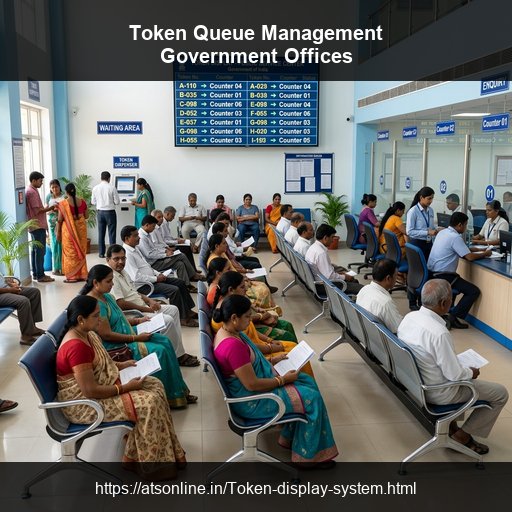
If you have ever visited a government office in India — an RTO, a tehsil office, a municipal corporation counter, a passport office, or a ration shop — you know what unmanaged citizen queues look like. People standing in long lines since early morning, no visibility into how much longer they will wait, frustrated citizens arguing at counters, and overwhelmed staff trying to serve hundreds of people while simultaneously managing the crowd.
A token queue management system for government offices changes this completely. It brings order, transparency, and dignity to citizen service — while reducing the burden on government staff, improving throughput, and generating the documentation that modern public administration demands.
This guide covers everything government administrators, district collectors, municipal commissioners, and office managers in India need to know about implementing a token queue management system — how it works, what it costs, which government office types need it most, and how to get it running without a complex procurement process.
1. The State of Government Office Queues in India — and Why It Must Change
India's government offices collectively serve hundreds of millions of citizen visits every year. In most offices, these citizens are served through an informal system that has not changed meaningfully in decades: arrive early, stand in line, and hope you reach the counter before it closes.
The human cost of this system is significant:
- Wasted citizen time: A citizen taking a day off work to visit a government office loses not just time but income.
- Physical hardship for vulnerable citizens: Elderly citizens, pregnant women, and people with disabilities frequently have to stand in the same queue with no mechanism for priority service.
- Counter staff overwhelm and error: The constant pressure of a physical crowd at the counter leads to errors and shortened transaction quality.
- Corruption and queue jumping: Unmanaged queues create opportunities for queue jumping — sometimes facilitated by agents. A systematic token queue eliminates this entirely.
- No accountability or measurement: Without a system, there is no data on how many citizens were served or which counters were bottlenecks.
- Reputational damage: Chaotic government office queues are a persistent source of citizen frustration.
2. What Is a Token Queue Management System for Government Offices?
A token queue management system for a government office is a cloud-based software solution that organises citizen service queues using numbered tokens — displayed on a standard TV screen, managed from any phone or computer, and announced via voice.
Unlike traditional wired LED token machines, a modern cloud-based system:
- Runs entirely in a browser — on any existing Smart TV, monitor, or laptop
- Requires no dedicated hardware — no LED boards, no wired caller units
- Is managed wirelessly — counter staff use any phone or computer as their keypad
- Generates automatic daily PDF reports
- Issues printed token slips via a standard 58mm thermal printer
- Deploys in under 10 minutes
3. How It Works in a Government Office Setting
- Citizen arrives and receives a token from the reception desk or security guard via thermal printer.
- Citizen waits in the seating area watching the waiting hall TV which displays which token number is currently being served.
- Counter staff calls the next token by tapping "Next" on their phone or computer keypad.
- Voice announcement directs the citizen through the hall speakers.
- Priority tokens are given to eligible citizens like senior citizens and called ahead of the regular queue.
- Supervisor monitors all counters in real time from any device.
- Daily report is generated for accountability and RTI responses.
4. Display Modes Best Suited for Government Offices
Mode 3 — Location Grid (Primary Recommendation)
Shows all active service counters displayed simultaneously in a grid. Best for multi-service offices like tehsils.
Mode 4 — Thermal Print (For High-Volume Offices)
Auto-sequential token numbers paired with printed physical slips issued at entry. Best for busy RTOs or passport offices processing 300+ citizens daily.
Mode 2 — Media Split (For Citizen Communication)
60% of the screen shows government scheme information or awareness content, while 40% shows the queue. Reduces counter queries dramatically.
5. Token Queue Management for Different Government Office Types
- Regional Transport Office (RTO): Requires high-volume thermal printing and multi-service token series (DL-, REG-). Recommended: Mode 4 + Mode 3 display.
- Tehsil and Sub-District Office: Handles 100–300 citizens across 4–8 counters. Recommended: Mode 3 (Location Grid).
- Municipal Corporation: Requires service-specific token series for tax, birth certificates, etc.
- District Social Welfare Office: Requires strong priority queue management for elderly/disabled and large text display. Recommended: Mode 3 + Mode 2.
6. Thermal Token Slip Printing for Government Compliance
Printed token slips are critical in government offices to serve as documentary proof of visit and position, provide reference numbers for multi-visit services, and offer clear accessibility for low-literacy citizens. The system supports standard 58mm thermal printing directly from the browser.
7. Reporting and Accountability
The ATS system generates a downloadable PDF report each day showing total tokens issued and served per counter, peak hour data, priority tokens, and recalled tokens. This is invaluable for:
- Performance accountability for section heads
- Staffing and resource planning
- RTI (Right to Information) responses
- CAG and departmental audit support
8. Cost of Token Queue Management for Government Offices
The ATS Token Display System costs exactly ₹2,950 per counter per year + GST (18%).
| Office Type | Typical Counters | Annual Cost (ex-GST) | Annual Cost (incl. GST) |
|---|---|---|---|
| Gram panchayat office | 2 | ₹5,900 | ₹6,962 |
| Small tehsil office | 4 | ₹11,800 | ₹13,924 |
| Standard tehsil / Municipal branch | 6 | ₹17,700 | ₹20,886 |
| RTO (Regional Transport Office) | 10 | ₹29,500 | ₹34,810 |
A district deploying this across 12 tehsil offices (averaging 5 counters each) would pay around ₹2,08,860 annually, compared to over ₹14 Lakhs in hardware and AMC costs for traditional LED systems.
9. Conclusion
A token queue management system for government offices is a practical, affordable, immediately deployable solution to one of the most persistent failures of citizen service delivery in India. At ₹2,950 per counter per year — with no hardware cost, no installation complexity, and automatic daily reports — it is accessible to every government office.
Related Reading:
- Token Display System Price Guide
- Token Display System for Hospitals
- How to Set Up on Your TV
- Cost Comparison: Traditional vs Cloud
- Token Display System for Banks
- Wireless Token Display for Pharmacies
- Queue Management for Restaurants
Transform Citizen Service at Your Office Today
Contact ATSonline to set up your zero-hardware Token Queue Management System in under 10 minutes.
📞 Call us at +91 9810078010
✉️ Email us at ats.fnb@gmail.com