Carnival & Fair Operations: Digital Token Systems Across Rides, Food, and Games
June 30, 2026 in Cashless Event Payments — Use Cases
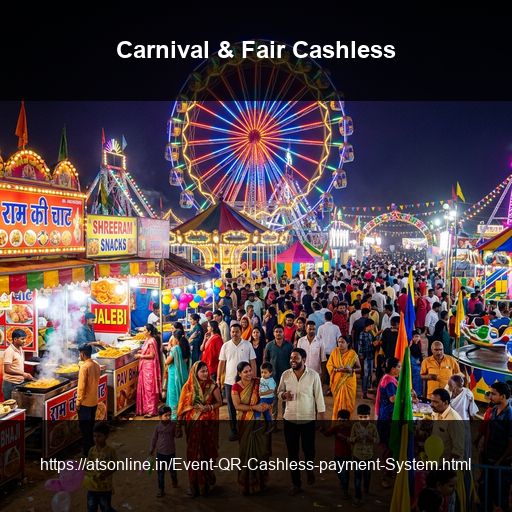
A QR cashless payment system is the most practical upgrade available to Indian carnival and fair organizers — replacing the token booth queues, counterfeit token risk, and hours-long post-fair cash counting with a single QR wallet that works across every ride, food stall, game, and merchandise counter on the fairground. WalletQrPay deploys at any outdoor fair or carnival venue in under 30 minutes with zero hardware, and generates automated per-stall, per-zone, and per-day settlement reports the moment the event closes.
This post covers the full operational picture for carnival and fair organizers in India — from why cash and physical tokens fail at this format, to exactly how WalletQrPay works across the specific activity types a fair hosts, to how settlement is handled at the end of a multi-day run.
The Carnival Payment Problem: Tokens, Cash, and Pilferage
India's carnival and mela circuit — spanning everything from large-format annual melas with hundreds of stalls to branded consumer carnivals at urban fairgrounds, amusement parks, and outdoor event grounds — has historically run on one of two payment systems: physical cash handed directly to stall operators and ride managers, or paper token booklets purchased at a central booth and exchanged at each attraction.
Both systems have the same structural problems that plague cash and paper coupon payments across the Indian event industry, but carnivals and fairs have a unique set of features that make these problems particularly acute.
Multi-zone, multi-activity complexity. A typical Indian carnival or mela combines rides, food stalls, games, live entertainment, and merchandise under a single admission — but with separate payment points at each attraction. This means cash or tokens are changing hands across dozens or hundreds of independent operators simultaneously, with no central transaction record and no way for the organizer to know what is actually being collected at any point during the fair.
Long operating hours and multi-shift staffing. Carnival operations routinely span 8 to 12 hours per day, often with staff rotating across shifts. In a cash or token environment, cash float discrepancies at shift handover are common and almost impossible to attribute to a specific person or time window — the same pilferage vulnerability that affects nightclubs, but extended over a much longer operating day.
Extended duration. Major melas and carnivals in India frequently run for 5 to 10 days, sometimes longer. At cash-based events running this long, cumulative pilferage and reconciliation drift can produce very large aggregate losses — a small per-day shortfall at 50 stalls compounds into a significant figure over a 7-day run.
Token counterfeiting at scale. Paper token booklets at large melas are routinely counterfeited by local printers familiar with the token design. Unlike a 2-day food festival where the counterfeiting window is short, a 7-day carnival gives counterfeiters significant time to produce and circulate duplicates — particularly when security staff are managing physical crowd control and cannot dedicate attention to per-token verification at each attraction.
Attendee inconvenience from multiple currencies. At many Indian carnivals, different token denominations, different ride coupon systems, and separate food stall payment systems force attendees to manage multiple types of physical currency simultaneously — a frustrating experience that encourages spending less rather than more.
A QR cashless wallet solves every one of these problems at the infrastructure level. One wallet, all zones. Every transaction recorded. Settlement automated. Counterfeiting structurally impossible.
Why QR Cashless Is Perfect for Carnival and Mela Settings
The outdoor, multi-vendor, multi-day profile of a carnival or mela maps almost exactly to the conditions where WalletQrPay delivers its greatest operational advantage.
Zero hardware suits temporary fairground infrastructure. Carnivals and melas are built on temporary structures — tents, portable stages, prefabricated ride bases, and canvas-covered stalls that are assembled for the fair's duration and dismantled at close. A payment system that requires permanent-hardware installation at every point of sale is a logistical mismatch with this temporary, mobile infrastructure. WalletQrPay's smartphone-only model is completely indifferent to whether a stall is a permanent structure or a tent set up this morning.
Standard mobile connectivity covers most fair venues. Urban fairgrounds, exhibition grounds, and urban park venues that host India's commercial carnivals reliably have 4G coverage. For semi-urban and rural mela settings, the ATS Online team assesses connectivity during pre-event planning and can recommend portable hotspot backups where warranted — but the majority of fair venues at which commercial cashless deployment makes economic sense are well-covered by existing mobile networks.
Multi-day deployment with per-day settlement aligns with carnival operators' payout preferences. Many carnival and mela ride operators, game booth operators, and food stall vendors prefer daily cash-out rather than waiting for end-of-event settlement — a cash flow reality that WalletQrPay's daily settlement report generation directly accommodates.
A single wallet across every zone simplifies the attendee experience dramatically. Rather than asking attendees to manage separate tokens or coupons for rides, food, and games, WalletQrPay gives them a single QR wallet that works identically at every attraction on the fairground — dramatically simplifying the attendee experience and removing the friction that multi-token systems introduce.
WalletQrPay for Rides, Food Stalls, Games, and Merchandise
The four primary payment zones at a typical Indian carnival each have slightly different transaction characteristics, and WalletQrPay accommodates all of them within the same unified wallet system.
Rides and Amusement Attractions
Ride payment is characterised by fixed, standardised pricing (one ride = ₹50 or ₹100, for example) and high transaction volume during peak evening hours. WalletQrPay's preset menu feature is ideal here — the ride operator sets up a single-tap ₹50 or ₹100 charge in their vendor app, and each attendee transaction takes under 5 seconds: scan QR, tap preset amount, confirm. No change to give, no token to exchange, no cash to count at the end of the shift.
For ride attractions with per-seat pricing (paying per person per ride), the vendor app can accept multi-unit transaction entries — the operator scans the QR once and enters the total amount for the group.
Food Stalls
Food stall payments are covered in detail in the context of food festivals in our dedicated food festival cashless guide, and the same dynamics apply at carnival food zones. The key advantage in a carnival setting is that food stalls competing with nearby attractions benefit most from the queue-elimination effect of cashless payment — shorter payment queues at a busy food counter give attendees more time to explore other parts of the fairground, increasing overall dwell time and spending.
Games and Activity Booths
Game booth payments — pay-per-play carnival games, activity zones, skill contests — are another high-frequency, low-denomination transaction category that suits WalletQrPay's preset-menu model. A game booth charging ₹30 per play sets this as a single-tap entry, and the operator processes multiple attendees quickly without the change-counting friction that slows cash-based game booths.
For game booths with prize or redemption systems — where winning earns points or tickets that can be exchanged for prizes — the WalletQrPay payment step handles the entry fee only; prize management is handled separately by the operator on their own system.
Merchandise Counters
Merchandise and souvenir sales at carnivals cover a wider price range than the other zones — from ₹50 trinkets to ₹1,000+ branded items at large-format events. Open-value wallet transactions (rather than fixed preset denominations) handle this range naturally, with the operator entering the exact merchandise price for each transaction. Merchandise operators also benefit from the absence of change-giving, which is particularly cumbersome when handling multiple denominations for high-value items.
One QR Wallet for All Zones: How It Works Across Activity Types
The attendee experience in a WalletQrPay-powered carnival is designed around one principle: issue once, use everywhere.
At the entrance gate: The attendee receives their unique QR wallet — as a printed slip or via WhatsApp/SMS. This single wallet is their payment credential for every transaction at the fair.
At the top-up booth: The attendee loads their desired amount via UPI, card, or cash. Top-up booths are positioned near the entrance and at strategic points around the fairground.
At every stall, ride, and game: The attendee presents their QR. The operator scans and charges. Confirmation in under one second. No tokens to manage, no denominations to track, no change to give or receive.
Balance self-check: At any time, the attendee scans their own QR with their personal phone to see their remaining balance — no queuing at an information counter.
At exit: Unspent balance is refunded at the exit booth via UPI transfer or cash.
The attendee's movement through the fair is uninterrupted by payment friction. They move from ride to food stall to game booth and back without counting tokens, hunting for change, or worrying about losing track of physical currency. This uninterrupted flow is the single most frequently cited attendee experience benefit by carnival organizers who have made the switch.
Handling Large Crowds: Peak-Hour Throughput and Multi-Counter Support
Peak hours at Indian carnivals — typically the post-dinner evening window (7 PM to 10 PM on weekdays, extending later on weekends) — generate very high simultaneous transaction demand across every zone of the fairground. WalletQrPay handles this at scale in three ways.
Transaction confirmation under one second. The sub-second payment confirmation time means that even at a busy ride entrance processing 100+ attendees per hour, the payment step is never the queue bottleneck — only the ride's physical capacity limits throughput.
Multi-device scaling per operator. Any operator running a high-volume attraction can add a second or third scanning device — simply another phone logged into the same stall account — without any additional configuration or hardware. A busy ride entrance during peak hour can run two simultaneous scan points, doubling payment throughput with a single additional smartphone.
Live dashboard alerts for top-up demand. The organizer's dashboard shows real-time top-up volume and alerts when specific top-up stations are approaching their capacity. This allows the organizer to open additional pop-up top-up points — a roving tablet, a temporarily expanded counter — before a queue forms rather than after.
Settlement for Fair Organizers: Per-Stall, Per-Zone, Per-Day Reports
Post-fair settlement is where WalletQrPay delivers its most operationally transformative advantage for carnival organizers — particularly those running large melas where settling accounts with 50 to 200 independent operators at the end of a multi-day run is a major undertaking.
Per-stall settlement reports show each operator's exact transaction count and total sales value, generated automatically from the cloud audit log. Available immediately at session close, for every operator simultaneously. No manual counting. No declaration matching.
Per-zone settlement reports aggregate all stalls within a specific zone — the food zone, the rides zone, the games zone — giving the organizer visibility into which parts of the fairground drove the most commerce and how zone revenue compared against any contractual guarantees or minimum performance levels.
Per-day settlement reports are available at the end of each operating day for multi-day events, allowing organizers who have agreed to daily payouts with their operators to process settlement and disbursements each evening rather than accumulating to a single end-of-fair settlement. This is the most common payout structure for multi-day melas where independent operators have their own working capital needs.
Master event settlement report aggregates the full fair's financial picture — total top-up volume, total spend across all zones, total refunds, and net position — providing the organizer with a complete financial summary that would otherwise take days to compile from manual cash counts.
Frequently Asked Questions
Can one QR wallet really work at rides, food stalls, games, and merchandise at the same carnival?
Yes. WalletQrPay's closed-loop wallet is activity-type agnostic — it works identically at any scan point in the event, regardless of whether the operator is a ride manager, a food stall vendor, or a game booth operator. The attendee uses the same QR code at every attraction, and the organizer sees all transactions aggregated across the fair in the same dashboard.
How does WalletQrPay handle a ride operator who is not tech-comfortable?
The WalletQrPay vendor app is designed for simplicity — the core operation is one preset price tap and a QR scan. For operators who are genuinely uncomfortable with smartphone apps, an event staff member can be assigned to co-manage the payment step at that specific attraction for the first day, with the operator typically becoming self-sufficient quickly once they see the flow in practice. ATS Online can advise on the best onboarding approach for carnival vendor mixes with varying digital literacy.
Can game booths that award physical prize tickets use WalletQrPay for the payment step only?
Yes. WalletQrPay handles the entry fee payment; prize and redemption management is handled separately by the game operator using their existing system. There is no conflict between the two processes.
How does WalletQrPay handle a multi-day fair where different operators are present on different days?
Each operator maintains their own vendor account for the duration of the fair. Operators present only on specific days are simply inactive in the system on the days they are not operating — their account is not charged for inactivity. Settlement reports are generated per operator for the specific days they operated, making it straightforward to manage fairs with rotating or partial-week vendor participation.
What happens to top-up balances for attendees who visit across multiple days of a fair?
Wallet balances carry over between days for multi-day events — a returning attendee's balance on Day 3 is the same as they left it at the end of Day 2. They do not need to re-top-up unless they have spent their previous balance. This carry-over is one of the most appreciated features among multi-day carnival and mela attendees, who find it more convenient than daily token repurchase.
How far in advance should a carnival or mela organizer contact ATS Online?
For a standard carnival deployment (up to 50 operators, urban fairground venue), 2 weeks is sufficient lead time. For larger melas with 100+ operators or semi-urban venues requiring connectivity assessment, 3 weeks allows more comfortable preparation. Contact ATS Online as early as possible for very large or multi-week mela deployments to allow adequate operator onboarding time.
Ready to Transform Your Carnival or Mela With Cashless Payments?
ATS Online deploys WalletQrPay at carnivals, melas, and outdoor fairs across India — from urban fairground activations to multi-day traditional mela circuits.
Or call us directly at: +91-9810078010
Conclusion
By moving to a secure, software-defined QR cashless wallet setup, organizers and businesses protect their event margins, eliminate manual reconciliation delays, and deliver a frictionless transaction experience aligned with India's UPI-first payment behaviors.
Switch to UPI-native QR payments and protect your margins. Visit www.atsonline.in, call us at +91-9810078010, or email ats.fnb@gmail.com to explore WalletQrPay.