Mumbai Food Festivals: Zero-Hardware Closed-Loop Cashless Setup
June 30, 2026 in Cashless Event Payments — Geo
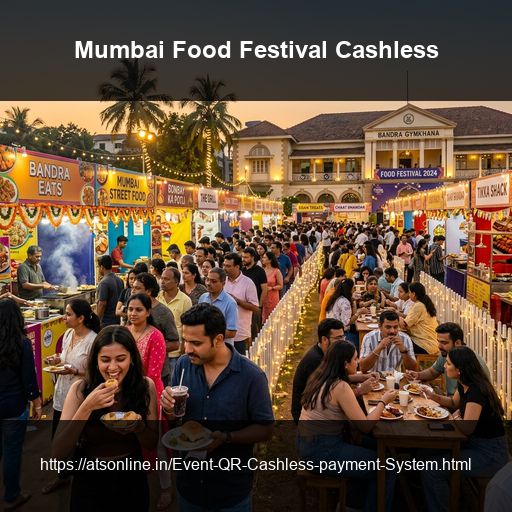
Mumbai's food festival circuit — from the seafood festivals curated by the city's Koli fishing communities to the multi-stall carnivals at Bandra Gymkhana, BKC's Jio World Garden, and grounds across Worli and Lower Parel — runs on exactly the kind of high-volume, multi-vendor, short-duration format that makes a zero-hardware QR cashless system the obvious operational choice. WalletQrPay deploys at any Mumbai food festival venue in under 30 minutes, with no card readers or proprietary terminals to transport through the city's notorious traffic, and a UPI-native top-up flow that matches how Mumbai's food festival attendees already pay for everything else in their daily lives.
This post covers what makes Mumbai's food festival market distinct, and exactly how to deploy WalletQrPay for a zero-cash event in the city.
Mumbai's Food Festival Boom — and Its Cash Problem
Few Indian cities have a food festival culture as dense or as commercially significant as Mumbai's. The city hosts a continuous calendar of culinary events — from heritage seafood festivals rooted in the city's Koli fishing community traditions, to large-scale multi-cuisine carnivals at venues like Bandra Gymkhana, to brand-driven food and drink activations across BKC, Worli, and Lower Parel that draw thousands of attendees over a single weekend.
This density creates a specific commercial reality: Mumbai food festival organizers run multiple events per year, often at different venues across the city, and need a payment infrastructure that can be redeployed quickly and cost-effectively at each new location — rather than a hardware-dependent system that requires fresh logistics planning every time.
It also creates a specific cash leakage profile. Mumbai food festivals typically run 2 to 3 days, with 30 to 100 vendor stalls representing a mix of established restaurant brands, home chefs, and independent food entrepreneurs — almost none of whom are the organizer's own staff. As detailed in How to Stop Cash Leakage and Revenue Pilferage at Events, this exact profile — independent vendors, high transaction volume, short event duration — is where cash and paper coupon leakage is most severe and hardest to detect.
Mumbai's notoriously tight venue turnaround windows compound the problem. Many of the city's premier outdoor event grounds — racecourses, gymkhanas, BKC lawns — operate on compressed setup schedules between bookings, leaving organizers with a narrow window to deploy any payment infrastructure before gates open. A system that takes hours to install is a genuine operational risk in this environment.
WalletQrPay for Mumbai Food Festivals: How It Fits the City's Event Culture
Mumbai's event culture has three characteristics that make WalletQrPay a particularly strong fit, beyond the general advantages that apply to food festivals across India.
Mumbai's UPI adoption is among the highest in the country. As India's financial capital, Mumbai's smartphone-owning population overwhelmingly uses UPI as their default payment method for daily transactions — street food, auto-rickshaws, retail, everything. WalletQrPay's UPI-native top-up flow requires zero explanation for the vast majority of Mumbai attendees, who are simply doing what they already do every day, just within the event's closed-loop wallet system.
Mumbai's traffic and venue logistics make hardware-light deployment genuinely valuable. Transporting RFID readers, encoders, and proprietary POS terminals across the city — often between venues in different parts of Mumbai within the same week — adds real cost and risk to an organizer's logistics chain. WalletQrPay's zero-hardware model means the entire payment deployment travels in the form of app installations on phones that vendors already carry.
Mumbai's food festival vendor base spans a wide spectrum of digital comfort. From established restaurant brands with their own POS systems to home chefs and first-time stall operators participating in a food festival for the first time, WalletQrPay's smartphone-based vendor app is accessible to the full range of this vendor base without requiring any of them to invest in or learn proprietary hardware.
Vendor Onboarding for Mumbai Street Food Festival Stalls
Mumbai food festivals frequently feature a distinctive mix of vendor types — from Koli community stall operators serving traditional seafood preparations, to home-chef entrepreneurs who may be running their first commercial stall, to established restaurant brands extending their presence into the festival circuit. Vendor onboarding needs to account for this range of prior experience.
For first-time stall operators and home chefs, a structured in-person orientation 1–2 days before the festival is essential. Cover app installation, login, preset menu setup for their specific dishes, and a live practice scan using a test wallet. Given that many home-chef vendors at Mumbai food festivals are managing their stall single-handedly or with minimal staff, simplicity in the scanning flow matters more here than at events with dedicated, trained vendor staff.
For established restaurant brands with existing POS experience, onboarding is typically faster — these vendors are often comfortable with digital payment interfaces from their regular restaurant operations and can complete orientation in a shorter session, sometimes via a group WhatsApp briefing rather than requiring individual in-person training.
For heritage and community-run stalls — such as those organized by Koli fishing community groups at Mumbai's traditional seafood festivals — it is worth allocating additional orientation time and, where possible, designating a tech-comfortable stall representative to manage the scanning device on behalf of the group, ensuring the payment system does not create friction for vendors whose primary expertise is culinary, not digital.
Across all vendor types, the standard WalletQrPay practice applies: a 5-to-10-minute orientation per stall, completed the day before or the morning of the festival, with a live test transaction confirmed before gates open.
How to Manage Top-Up Queues at High-Footfall Mumbai Venues
Mumbai food festivals at venues like Bandra Gymkhana or BKC lawns regularly draw 3,000 to 8,000+ daily attendees, with sharp footfall surges in the first two hours after gates open and during weekend evening peak hours. Managing top-up counter throughput at this scale requires deliberate planning.
Scale top-up stations to Mumbai's typical footfall patterns. Following the general guidance in our food festival setup guide, Mumbai's higher-footfall events should lean toward the upper end of the recommended station count — 4 to 6 top-up stations for festivals expecting 4,000 to 8,000 daily attendees, positioned near the entry zone so attendees can load their wallet before they reach the first stall.
Account for Mumbai's distinctive weekend evening surge. Unlike weekday corporate-adjacent events, Mumbai's weekend food festivals frequently see their sharpest footfall spike in the early evening as attendees arrive after work or for a planned evening outing. Staff top-up counters for this surge specifically, rather than spreading staffing evenly across the day.
Deploy roving top-up capability for large outdoor grounds. At expansive venues like racecourse grounds or large BKC lawns, attendees may be a significant walking distance from the nearest fixed top-up counter once they're deep in the stall zone. Enabling top-up capability on a few designated roving tablets — staffed by event team members who circulate through high-traffic zones — reduces the friction of attendees having to walk back to a fixed counter mid-festival.
Leverage UPI's speed advantage at Mumbai-scale events. Because the overwhelming majority of Mumbai attendees top up via UPI rather than cash, top-up transaction speed at well-run Mumbai deployments is typically faster than the citywide average — each UPI top-up taking well under a minute including QR scan, app confirmation, and balance update.
Settlement After a 3-Day Mumbai Food Carnival
A typical 3-day Mumbai food festival — spanning a Friday evening opening through a full weekend — generates a settlement workload that, in a cash-based system, would typically require the organizer's finance team to spend the better part of a day reconciling vendor declarations across 50 to 100 independent stalls.
With WalletQrPay, settlement after a 3-day Mumbai carnival follows the same automated process described in detail in How Automated Vendor Settlement Works at Cashless Events, with two practical considerations specific to the Mumbai food festival context.
Daily settlement for cash-flow-sensitive vendors. Many Mumbai food festival vendors — particularly home-chef entrepreneurs and smaller independent stalls — operate with tight working capital and prefer same-day or next-day payment rather than waiting until the full 3-day event closes. WalletQrPay supports interim daily settlement reports, allowing the organizer to process payouts at the end of each festival day if that arrangement has been agreed with vendors in advance.
Fast turnaround for venue handover. Mumbai's premier outdoor venues frequently have back-to-back bookings, meaning the organizer's team needs to clear the site and finalize accounts quickly after the festival closes. Automated settlement reports — generated within minutes of the event session closing, rather than the 5-to-8-hour manual reconciliation process typical of cash-based festivals — directly support the kind of fast venue turnaround that Mumbai's event calendar demands.
Frequently Asked Questions
Does WalletQrPay work at outdoor venues like racecourses and gymkhana grounds in Mumbai?
Yes. WalletQrPay requires only standard internet connectivity at each device, which is reliably available at Mumbai's major outdoor event venues, including racecourse grounds, gymkhana lawns, and BKC's outdoor spaces. There is no fixed infrastructure required, which makes the system equally deployable across the range of outdoor venue types common in Mumbai's food festival circuit.
How does WalletQrPay handle the mix of established restaurant brands and first-time home-chef vendors at the same festival?
The vendor app works identically for any vendor regardless of prior digital payment experience — the orientation time required simply varies based on how comfortable the individual vendor is with smartphone apps. Established restaurant brands typically onboard in minutes; first-time vendors benefit from the standard 10-minute in-person orientation. Both vendor types operate on the same underlying system and appear identically in the organizer's settlement reports.
Can vendors at a Mumbai food festival be paid out the same evening the event ends?
Yes, for single-day events or the final day of a multi-day festival, settlement reports are available within minutes of the event session closing, making same-evening payout entirely feasible — a significant advantage over cash-based settlement, which typically extends well into the night.
What if a Mumbai festival venue has unreliable internet connectivity?
ATS Online reviews venue connectivity as part of pre-event planning and can recommend a portable 4G hotspot backup for venues with known connectivity gaps. The majority of Mumbai's established food festival venues — including BKC, Worli, and South Mumbai locations — have reliable 4G coverage suitable for standard WalletQrPay deployment.
Is WalletQrPay suitable for a heritage or community-organized food festival, not just a commercially produced one?
Yes. WalletQrPay has been deployed at both commercially organized food carnivals and community or heritage-rooted food festivals. The system's zero-hardware, low-training-burden model is particularly well suited to community-organized events, where vendor stalls may be run by individuals or community groups without prior experience operating commercial payment infrastructure.
How far in advance should a Mumbai food festival organizer contact ATS Online to set up WalletQrPay?
Following the standard guidance in our setup checklist, 2 weeks before the event is the recommended lead time, allowing for vendor credential generation and orientation scheduling. For larger Mumbai festivals with 50+ vendors, a slightly longer lead time of 3 weeks helps ensure all vendors are fully onboarded before the event opens.
Ready to Run a Cashless Food Festival in Mumbai?
ATS Online supports food festival organizers across Mumbai with WalletQrPay deployment, vendor onboarding, and settlement support.
Or call us directly at: +91-9810078010
Conclusion
By moving to a secure, software-defined QR cashless wallet setup, organizers and businesses protect their event margins, eliminate manual reconciliation delays, and deliver a frictionless transaction experience aligned with India's UPI-first payment behaviors.
Switch to UPI-native QR payments and protect your margins. Visit www.atsonline.in, call us at +91-9810078010, or email ats.fnb@gmail.com to explore WalletQrPay.