Corporate Case Study: Departmental Budget Allocations, Subsidies, and Canteen Control
June 30, 2026 in Cashless Event Payments — Use Cases
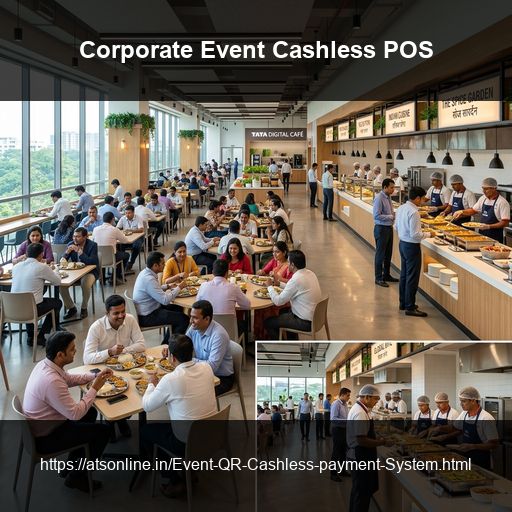
WalletQrPay extends beyond public events into corporate environments — powering cashless payments at corporate fairs, annual days, product launches, multi-day conferences, and even daily employee cafeteria and contractor canteen operations. The same zero-hardware, QR-based architecture that works for a food festival works equally well for a company's annual day F&B stalls or a 2,000-employee cafeteria, with added features specific to corporate use: pre-assigned wallet credits, subsidy management, and department-level spending reports.
This post covers how organizations across India are using WalletQrPay for both one-time corporate events and ongoing daily dining operations.
The Corporate Event Payment Problem
Corporate events differ from public consumer events in one critical respect: the organizer often wants to control or subsidize what attendees pay, rather than simply collecting revenue from them. A company hosting its annual day wants employees to enjoy free or subsidized F&B. A conference organizer wants delegates' meals covered by their registration fee. A product launch host wants VIP guests to have complimentary bar access without worrying about individual billing.
Cash and paper coupon systems handle this poorly. Free or subsidized access is typically managed through paper meal vouchers, wristband colour-coding, or a guest list checked manually at each stall — none of which create a usable record of what was actually consumed, by whom, or at what cost to the company.
This creates two specific problems for corporate event organizers and HR/admin teams:
No consumption visibility. If the company has agreed to cover F&B costs for 500 employees at an annual day, there is no way to know after the fact how much was actually consumed, by which departments, or whether the budget was exceeded — until the vendor presents a final bill based on their own (often inflated) estimate of how many people they served.
No accountability for free access. Comp wristbands, VIP lists, and verbal "they're with the company" authorizations are easily abused. Staff at F&B stalls have no reliable way to verify who is entitled to free service and who is not, and there is no record created when a free transaction occurs.
WalletQrPay solves both problems by treating corporate comp credits the same way it treats any prepaid wallet balance — fully tracked, fully reported, and fully auditable.
WalletQrPay for Corporate Fairs, Annual Days, and Product Launches
For one-time or periodic corporate events — annual days, product launches, employee appreciation events, brand activations — WalletQrPay deploys exactly as it would for a public food festival, with one key addition: pre-funded comp wallets for employees or guests whose spending is covered by the company.
How it works: Instead of (or in addition to) attendees topping up their own wallets, the organizer pre-loads a defined credit amount onto each attendee's wallet before the event. An employee at a company annual day might receive a ₹500 pre-loaded wallet covering their day's F&B. A conference delegate might receive a wallet pre-loaded with the value of their registered meal package. A VIP guest at a product launch might receive an uncapped or high-limit comp wallet for the duration of the event.
Attendee experience: From the attendee's perspective, the experience is identical to a standard cashless wallet — they present their QR at any stall, the vendor scans it, the transaction is deducted from their balance. The only difference is that the balance was pre-funded by the company rather than topped up by the attendee personally.
Top-up beyond the comp amount: If an employee wants to purchase something beyond their comp allowance — a premium item not covered by the standard package, for example — they can top up their own wallet with personal funds via UPI, and the system tracks comp-funded and self-funded spending separately in the settlement report.
Organizer visibility: The HR or events team running the annual day has complete real-time visibility into total comp spend, per-stall consumption, and — critically — exactly how much of the pre-allocated budget has been consumed at any point during the event. If consumption is running ahead of the allocated budget, the organizer can make an informed decision (top up the comp pool, set a cutoff, or notify employees of remaining balance) rather than discovering a budget overrun only when the final vendor bill arrives.
Industrial Cafeteria Use: Contractor Canteens and Employee Dining
Beyond one-time events, WalletQrPay is increasingly used for ongoing, daily cafeteria and canteen operations at corporate campuses, industrial facilities, and contractor sites across India.
The operational profile here is different from a single event — it is a continuous, daily deployment rather than a 1-to-7-day activation — but the underlying technology and benefits transfer directly.
Contractor and industrial canteens at manufacturing plants, construction sites, and industrial parks often serve hundreds or thousands of contract workers daily, with meal costs subsidized partially or fully by the employer or main contractor. Cash-based canteen operations face the same leakage and accountability problems as event-based cash systems — vendor under-declaration, unaccounted free meals, and disputes over headcount-based billing from the catering contractor.
With WalletQrPay, each worker is issued a persistent QR wallet (rather than a single-event wallet) that can be topped up by the employer with a daily or monthly meal allowance, or by the worker themselves for items beyond the subsidized allowance. Every meal transaction is logged, giving the employer or main contractor an exact, auditable record of how many meals were served, to whom, and at what subsidized or full cost — eliminating the dispute-prone headcount estimation that catering contractors typically rely on for billing.
Corporate employee cafeterias at office campuses use the same model — employees receive a persistent wallet (often linked to their employee ID) that can be topped up by the company as a benefit, by the employee personally via UPI, or both. Department-level spend tracking (covered below) gives finance and HR teams visibility into cafeteria subsidy utilization across the organization.
Features That Matter for Corporate Deployments
Pre-Assigned Wallet Credits
As described above, corporate deployments frequently require the organizer to pre-fund wallets rather than relying on attendees to top up their own balance. WalletQrPay supports bulk pre-assignment of wallet credits — for example, uploading a list of 500 employee mobile numbers with a defined credit amount each, which are then automatically issued as pre-funded wallets ahead of the event or as part of an ongoing cafeteria benefit program.
Subsidy Management
For cafeteria and canteen deployments where the employer subsidizes part of the meal cost (a common model in Indian industrial and corporate dining), WalletQrPay can be configured so that each transaction splits automatically between the subsidized portion (deducted from the employer-funded wallet segment) and the employee-paid portion (deducted from the employee's personal top-up balance, or charged directly via UPI at the point of sale). This automated split removes the manual subsidy reconciliation that many Indian corporate cafeterias currently handle through spreadsheets or manual coupon systems.
Department-Level Spending Reports
For corporate events and ongoing cafeteria deployments where multiple departments or cost centers need to be billed separately, WalletQrPay can tag wallets or transactions by department, allowing the finance team to generate spend reports broken down by department, team, or cost center. This is particularly valuable for large corporate annual days where different business units may have separate F&B budgets, or for ongoing cafeteria operations where departmental cost allocation is part of the internal accounting process.
Persistent vs Session-Based Wallets
Corporate deployments can choose between session-based wallets (active only for the duration of a single event, as with a public food festival) and persistent wallets (active on an ongoing basis, tied to an employee ID, for continuous cafeteria or canteen use). ATS Online configures the appropriate wallet type based on whether the deployment is a one-time event or an ongoing dining operation.
Case Scenario: Deploying WalletQrPay at a 500-Person Corporate Annual Conference
Consider a corporation hosting a 2-day annual conference for 500 employees and delegates, including a gala dinner, multiple F&B breaks, and an evening networking event with an open bar.
Pre-event setup: The HR/events team provides ATS Online with a list of 500 registered delegate mobile numbers. Each delegate is pre-assigned a wallet with a credit covering their registered package — for example, ₹1,500 covering all meals, breaks, and two complimentary drinks at the networking event.
Day 1: Delegates receive their QR wallet via WhatsApp before arrival, alongside their registration confirmation. At entry, this is confirmed against their badge. Throughout the day, delegates use their wallet at breakfast, lunch, and tea-break stalls — each transaction deducted automatically from their pre-funded balance.
Evening networking event: The open bar operates as a comp-funded zone — each drink served is logged against the delegate's wallet up to their two-drink allowance. Once the allowance is exhausted, delegates wishing to order more are prompted to top up personally via UPI, creating a clean separation between company-sponsored and self-funded consumption.
Day 2: Wallets carry over from Day 1 with remaining balance intact. The same flow continues through Day 2's sessions and the closing lunch.
Post-event reporting: The HR/events team receives a complete settlement report showing total F&B consumption, per-session breakdown (breakfast vs lunch vs networking event), comp-allowance utilization rate (what percentage of the pre-funded ₹1,500 was actually used per delegate, useful for right-sizing the budget for next year's conference), and any self-funded top-up activity at the bar.
This level of granular, auditable reporting is simply not available through a cash-based or voucher-based conference catering arrangement — and it gives the events team concrete data to negotiate next year's catering contract and budget more precisely.
Frequently Asked Questions
Can WalletQrPay distinguish between company-funded and employee-funded spending?
Yes. When an employee or delegate tops up their own wallet beyond the company-provided credit, WalletQrPay tracks this as a separate funding source within the same wallet. Settlement reports clearly distinguish comp-funded transactions from self-funded transactions, which is essential for accurate corporate expense accounting.
Is WalletQrPay suitable for a permanent cafeteria deployment, not just a one-time event?
Yes. WalletQrPay supports persistent, ongoing wallet deployments tied to employee IDs for continuous cafeteria and canteen operations, in addition to single-event session wallets. The underlying platform and dashboard work identically; the configuration simply changes from a time-limited event session to an ongoing operational deployment.
How does subsidy management work if the employer covers 50% of every meal?
WalletQrPay can be configured to automatically split each transaction at the point of sale — 50% deducted from an employer-funded subsidy wallet, 50% deducted from the employee's personal balance or charged via direct UPI. This automated split eliminates the need for manual subsidy reconciliation at the end of each billing period.
Can we issue wallets to contractor or daily-wage workers who may not have smartphones?
Yes. For workers without personal smartphones, wallets can be issued as printed QR slips rather than mobile-delivered codes, and balance top-ups (whether employer-subsidized or personal) can be managed by a designated counter at the canteen entrance. The transaction process at the serving counter remains the same — the worker presents their printed QR slip for scanning.
Can department-level reports be generated for a single event, or only for ongoing cafeteria deployments?
Department-level reporting is available for both. For a single corporate event with multiple business units attending, wallets can be tagged by department at the point of pre-assignment, and the post-event settlement report breaks down spending accordingly. For ongoing cafeteria deployments, the same tagging persists across the employment relationship for continuous departmental cost tracking.
What happens to unused comp credit at the end of a corporate event?
This depends on the organizer's policy. Unused comp credit is typically not refunded to the employee personally (since it was a company-funded benefit, not personal funds), and is instead simply expired at the close of the event session. This policy is configured by the organizing company and communicated to attendees as part of the event terms. Personal top-up balances (funds the employee added themselves) follow the standard refund policy and are returned to the employee.
Bring WalletQrPay to Your Corporate Event or Cafeteria
ATS Online configures WalletQrPay deployments for corporate events, conferences, and ongoing cafeteria operations across Indian corporate campuses and industrial sites.
Or call us directly at: +91-9810078010
Conclusion
By moving to a secure, software-defined QR cashless wallet setup, organizers and businesses protect their event margins, eliminate manual reconciliation delays, and deliver a frictionless transaction experience aligned with India's UPI-first payment behaviors.
Switch to UPI-native QR payments and protect your margins. Visit www.atsonline.in, call us at +91-9810078010, or email ats.fnb@gmail.com to explore WalletQrPay.