Campus Activations: Eliminating Coupon Fraud and Organizing Club-Level Revenue Splits
June 30, 2026 in Cashless Event Payments — Use Cases
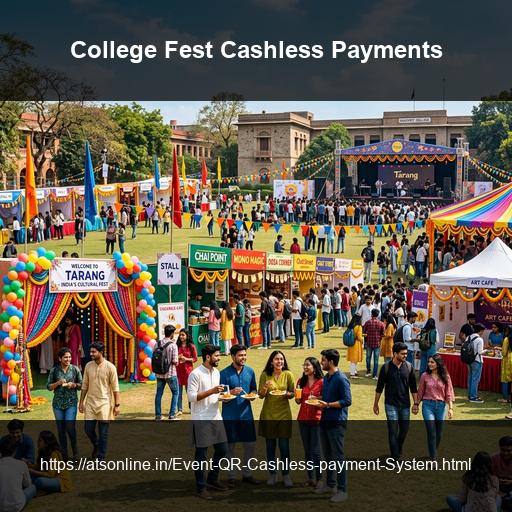
College fests in India are an ideal fit for QR cashless payment systems because they combine high attendee footfall with tight budgets and zero appetite for hardware investment — exactly the conditions WalletQrPay was built for. Student union committees can deploy a fully functional cashless system across food stalls, merchandise counters, gaming zones, and ticketed events in under 30 minutes, with zero hardware cost, using nothing more than the smartphones already in the pockets of student volunteers and stall vendors.
This post is written for student organizers, event committee heads, and college administration staff planning their next annual fest, cultural festival, or campus carnival.
Why College Fests Need a Cashless System (Not Paper Tokens)
Almost every college fest in India still runs on some version of the paper token or coupon system: students buy a token booklet at a central counter, then redeem tokens at food stalls, game counters, and merchandise tables run by different clubs and societies. This system has been the default for decades — and it has structural problems that grow worse as fests get bigger and more ambitious.
Token counterfeiting is rampant and almost impossible to prevent. College fests run on student volunteer labour, often without the institutional fraud-detection capacity that a professional event company would have. A token design photocopied or recreated by a student with basic design skills and a printer can pass undetected at a busy stall run by other students who are themselves volunteers, not trained cash handlers.
Club-level accounting is chaotic. Most college fests involve a dozen or more student clubs and societies running their own stalls — a coding club running a gaming zone, the dance society selling merchandise, the photography club running a print stall. Each club typically manages its own token collection and declares its own revenue at the end of the fest. With no independent verification, disputes between clubs and the central fest committee about revenue share or expense reimbursement are common and often unresolved by the time the academic year ends.
Volunteer turnover makes training repetitive every single year. Unlike a professional event company with a returning staff team, college fests are run by a new batch of student volunteers each year (sometimes each semester). Whatever payment system is used must be simple enough to train an entirely new team in a single session, every single time.
Budgets are tight and hardware rental is rarely justifiable. College fest committees typically work with sponsorship money, college grants, and modest entry fee revenue. An RFID hardware rental — even at a discounted student-event rate — eats into a budget that could otherwise go toward better artist bookings, decor, or prizes.
A QR cashless system solves all four problems simultaneously: it eliminates the counterfeiting risk inherent to paper tokens, it creates an independently auditable record for every club's stall revenue, it requires no specialised training beyond a 10-minute smartphone walkthrough, and it costs nothing in hardware.
WalletQrPay for College Fests: Zero Hardware, 30-Minute Setup
WalletQrPay's zero-hardware architecture is, if anything, an even better fit for college fests than for commercial events, because the constraint that matters most to a student committee — budget — is the constraint WalletQrPay eliminates entirely.
No hardware to rent or buy. Every club's stall operates on a student volunteer's own smartphone, or a phone borrowed from the committee for the duration of the fest. There is no card reader, no encoder, no proprietary terminal — nothing that needs to be sourced, paid for, or returned after the event.
Setup that fits a volunteer team's timeline. Student committees typically have limited and overlapping time to prepare for a fest — decor, artist logistics, sponsor activations, and stall allocation all compete for attention in the days before the event. WalletQrPay's under-30-minute deployment does not require a dedicated setup day or a specialist team. The entry counter, top-up stations, and club stall accounts can all be activated on the morning of the fest, alongside everything else the committee is setting up.
A system new volunteers can learn quickly. Because every club's stall operator is using a familiar smartphone interface — not a proprietary device they have never seen before — the learning curve is minimal. A 10-minute orientation covering app login, menu setup, and one practice scan is sufficient for a student volunteer with no prior payment-system experience.
No long-term cost. Unlike RFID hardware, which requires either a rental fee or a capital purchase that the college would need to store and maintain year over year, WalletQrPay's platform-based model means there is no infrastructure for the committee to own, store, or worry about between fest editions.
How to Brief Stall Vendors Who've Never Used Cashless Before
Most college fest stall operators — student volunteers from participating clubs — have never operated a digital payment system before. A short, structured orientation makes the difference between a smooth opening day and a chaotic one.
Run a single group orientation session 1–2 days before the fest. Gather one representative from each participating club and walk through the WalletQrPay vendor app together. Cover four things: app installation and login with their club's assigned credentials, how to set up their stall's preset menu (food prices, merchandise prices, or game entry fees), how to scan a QR and confirm a transaction, and what to do if their device shows a connectivity warning.
Use a test wallet for live practice. Before the session ends, have every club representative process at least one practice transaction against a test wallet provided by the WalletQrPay platform. This catches login issues, camera problems, or confusion about the confirmation screen before the fest actually opens — not during the first rush of attendees.
Designate one tech-comfortable volunteer per club as the "stall lead." For clubs running larger stalls with multiple people taking turns at the counter, having one person who fully understands the app and can troubleshoot for their teammates reduces the number of support calls the central committee receives during the fest.
Set up a central help desk for the fest's payment system. A small team — ideally 2 to 3 committee members familiar with the WalletQrPay dashboard — should be reachable throughout the fest to handle reissued QR codes, connectivity troubleshooting, and any club's questions about their stall account. This central support function is what prevents individual stall issues from escalating into queues or confusion.
Managing Multiple Payment Zones: Food, Merch, Games, and Ticketed Events
A typical Indian college fest is not a single payment zone — it spans food stalls, merchandise tables, gaming and activity zones, and sometimes ticketed access to specific events like a concert, a comedy show, or a flagship competition. WalletQrPay handles all of these under a single attendee wallet.
One QR, every zone. A student's wallet, issued once at fest entry, works identically at the food court, the merchandise stall, the gaming zone, and any ticketed sub-event that accepts WalletQrPay payments. There is no need for separate tokens or wallets per zone — the same QR that buys a plate of food can buy a fest T-shirt or pay the entry fee for a gaming tournament.
Per-zone or per-club reporting. While the attendee experiences a single unified wallet, the organizer's dashboard can break down revenue by zone (food vs merchandise vs gaming) or by individual club/stall, giving the central fest committee visibility into which categories and which specific stalls are performing best.
Ticketed sub-events within the fest. For flagship fest events that require a separate ticket — a headline concert, a finals round of a competition — WalletQrPay can be configured to deduct a fixed entry amount from the attendee's wallet at a dedicated entry scan point, functioning as a digital ticket check integrated with the same wallet system used for general fest spending.
Flexible pricing across very different price points. Open-value wallets (rather than fixed-denomination credits) handle the wide price range typical of a college fest naturally — a ₹20 snack, a ₹500 fest T-shirt, and a ₹100 gaming zone entry fee can all be charged at their actual price without any denomination conversion confusion.
Real-Time Dashboard During a 2-Day Fest: Live Sales, Top-Up Volumes
For a multi-day college fest — most major annual fests in India run 2 to 3 days — the organizer's live dashboard becomes a genuinely useful operational tool for the student committee, not just a financial record.
Day 1 performance informs Day 2 decisions. If the dashboard shows that the food court's top-up demand significantly outpaced the merchandise zone on Day 1, the committee can adjust staffing or signage for Day 2 — directing more volunteers to top-up support near the food court, or running a promotional push for merchandise to balance demand.
Identifying which clubs need support mid-fest. A club's stall showing unusually low transaction activity relative to footfall in their zone may indicate a connectivity issue, a confused volunteer, or simply a stall location problem (placed somewhere with low visibility). The committee can investigate and resolve this on Day 1 rather than discovering the issue only after the fest concludes.
Sponsor and college administration reporting. Many college fests have sponsors who expect visibility into footfall and commerce data, or college administrations that want a summary of fest financial performance. The live dashboard — and the automated reports generated at fest close — give the committee real numbers to share, rather than estimates based on anecdotal observation.
Settlement at End: Paying Out Each Club or Vendor Stall Accurately
At the close of a multi-club college fest, the central committee needs to settle accounts with every participating club — typically returning a revenue share, reimbursing stall setup costs, or simply confirming each club's net contribution to the fest's overall fundraising goal.
WalletQrPay's automated settlement reports make this process dramatically simpler than the token-counting marathons that traditionally follow a college fest's closing ceremony.
Per-club settlement reports show exactly how much each club's stall sold, with a transaction-level breakdown, generated automatically the moment the fest session is closed. There is no manual token counting, no need to trust a club's self-reported revenue figure, and no late-night reconciliation session for the committee's treasurer.
Revenue-share calculations become straightforward. If the fest committee's agreement with participating clubs involves a revenue share (for example, the central committee retains 20% of each club's stall revenue to cover fest-wide costs), this calculation can be applied directly and transparently to the settlement report figures — with both the central committee and each club looking at the same underlying transaction data.
Disputes are minimized. Because the settlement figure is drawn from the cloud transaction log rather than a club's self-reported tally, there is little room for the kind of "we definitely sold more than that" disagreement that often arises when clubs are asked to self-report their token redemptions.
Frequently Asked Questions
Can we run WalletQrPay without institutional support from the college administration?
In most cases, yes. WalletQrPay is set up directly with the student organizing committee — the platform does not require the college administration to be a party to the setup process. However, because the system involves financial transactions on campus, many committees choose to inform their student affairs office or fest faculty advisor as a matter of standard fest planning practice. Contact ATS Online to discuss the specific approval or documentation your institution may require for cashless payment systems on campus.
What if a student loses their QR printout during the fest?
The central committee's help desk can look up the student's wallet using their registered mobile number (collected at fest entry or pre-registration) and reissue a new QR code linked to the same wallet balance. The original QR is deactivated simultaneously, so no funds are lost and the lost slip cannot be misused if found by someone else.
How much does it cost a college committee to deploy WalletQrPay for a 2-day fest?
Costs depend on the scale of the fest (expected footfall and number of participating stalls). Because there is no hardware rental involved — unlike RFID alternatives — the cost structure is significantly more favourable for budget-conscious student committees. Contact ATS Online directly for a quote based on your fest's specific size and duration.
Can different clubs see only their own stall's sales data, or does everyone see the whole fest's numbers?
Each club can only see their own stall's transaction data through the vendor app — they cannot see other clubs' sales figures or the overall fest total. Only the central organizing committee, through the organizer dashboard, has visibility across all participating stalls and the aggregate fest performance.
Does WalletQrPay work for fests with both a cultural festival component and a separate tech fest or sports fest happening on the same campus?
Yes. Each fest can be configured as a separate event session within the platform, even if they overlap on the same campus or share some of the same stalls. Alternatively, if the committee wants a single unified wallet across multiple co-located events, this can also be configured. Discuss your specific multi-fest structure with ATS Online during setup planning.
Is there a minimum number of stalls or attendees needed to make this worthwhile for a college fest?
There is no strict minimum. WalletQrPay has been deployed at fests ranging from departmental-level events with a handful of stalls to large university-wide annual fests with dozens of participating clubs and tens of thousands of attendees over multiple days. For very small departmental events (under 200 attendees), the simplicity of the system still provides value, though the proportional benefit grows with scale.
Bring Cashless Payments to Your College Fest
ATS Online has supported student organizing committees across Delhi NCR and other Indian cities in deploying WalletQrPay for annual fests, cultural festivals, and campus carnivals.
Or call us directly at: +91-9810078010
Conclusion
By moving to a secure, software-defined QR cashless wallet setup, organizers and businesses protect their event margins, eliminate manual reconciliation delays, and deliver a frictionless transaction experience aligned with India's UPI-first payment behaviors.
Switch to UPI-native QR payments and protect your margins. Visit www.atsonline.in, call us at +91-9810078010, or email ats.fnb@gmail.com to explore WalletQrPay.