Goa Beach & Hilltop Events: Software-Defined Cashless Architecture
June 30, 2026 in Cashless Event Payments — Geo
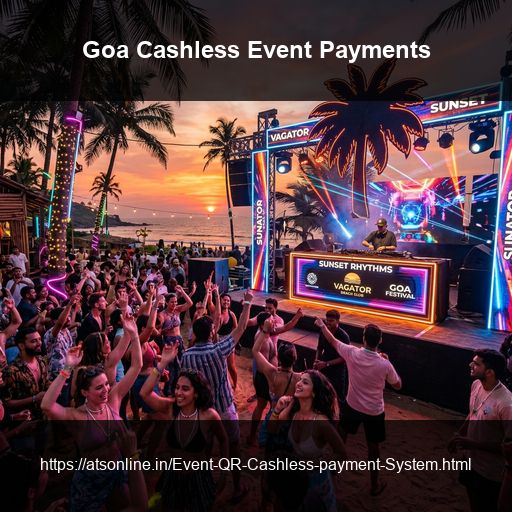
Goa's festival and beach club ecosystem — spanning large-scale EDM festivals on Vagator's cliffs, the dense beach party circuit across Anjuna and Candolim, and the New Year's Eve season that turns the entire coastline into a continuous celebration — is structurally suited to a zero-hardware, cloud-native QR cashless system. WalletQrPay deploys at outdoor beach venues with no infrastructure beyond standard 4G connectivity, handles the mixed domestic and international attendee base that defines Goa's festival crowds, and gives venue operators the pilferage visibility that high-volume beach bars and pop-up festival grounds desperately need.
This post is written for Goa-based festival promoters, beach club operators, and event production teams planning their next large-scale activation on the coast.
Goa's Event Ecosystem: Why Cashless Is Non-Negotiable
Goa hosts a festival and nightlife ecosystem unlike anywhere else in India. The state's December-to-March peak season brings a continuous calendar of major events — large-format EDM festivals drawing international lineups to beachfront venues, a dense network of beach shacks and clubs across Vagator, Anjuna, and Candolim running nightly programming, and a New Year's Eve period so significant that beach clubs, hilltop venues, and party cruises across North and South Goa all run simultaneous large-scale events.
This scale and density creates payment infrastructure challenges that are distinct even from other major Indian event markets.
Footfall is enormous and highly seasonal. Goa's flagship festivals draw crowds in the hundreds of thousands across a festival run, concentrated into a compressed peak season. Beach clubs and event grounds that operate with skeleton staff for much of the year suddenly need to process extremely high transaction volumes across a handful of critical nights.
The attendee base mixes domestic and international visitors. Unlike a Delhi or Mumbai food festival where the crowd is overwhelmingly local UPI users, Goa's festival audience includes a substantial proportion of international travelers and domestic tourists from across India — creating a payment environment where assumptions about universal UPI familiarity need to be handled carefully.
Venues are predominantly outdoor and temporary. Beach festival grounds, hilltop venues, and pop-up beach club setups are rebuilt and torn down repeatedly across the season, often with limited permanent infrastructure. A payment system that depends on fixed hardware installation is a poor fit for venues that exist for a matter of days or weeks before being dismantled.
Security and crowd-safety concerns make cashless particularly valuable. Large festival crowds in dense beach environments have historically experienced petty theft and pickpocketing — a well-documented concern at some of Goa's biggest events. Attendees carrying large amounts of physical cash are a more attractive target than attendees whose spending power exists as a QR-linked digital wallet balance that has no value to anyone except its rightful holder.
Against this backdrop, going cashless in Goa is less an operational nicety and more a structural necessity for any large-scale festival or beach club operation that wants to manage cash flow, security, and vendor accountability at the scale Goa's event calendar demands.
Unique Challenges: Outdoor Venues, Connectivity, and International Attendees
Deploying a cashless system in Goa requires accounting for three challenges that are less pronounced in more conventional Indian event markets.
Outdoor beach and hilltop venues. Many of Goa's most significant festival and beach club venues are genuinely outdoor — sand, open-air stages, hilltop clearings — without the fixed building infrastructure that an indoor exhibition hall or urban food festival venue provides. Payment infrastructure deployed at these venues needs to be weather-resilient, quick to set up and tear down, and not dependent on permanent electrical or network installations.
Connectivity varies by specific venue and time of year. While Goa's tourist-facing areas — Vagator, Anjuna, Candolim, Calangute, Baga — generally have solid 4G coverage given the density of tourism infrastructure, large festival crowds concentrated in one location can strain local network capacity during peak hours, exactly when transaction volume is highest. This is a connectivity planning consideration distinct from the venue's baseline coverage.
A significant proportion of attendees are international or unfamiliar with UPI. Unlike most Indian events where the overwhelming majority of attendees default naturally to UPI top-up, Goa's festival and beach club crowds include international travelers without Indian bank accounts or UPI access, alongside domestic tourists who may be less consistently UPI-active than urban metro residents. A payment system built exclusively around UPI top-up creates friction for a meaningful slice of Goa's typical attendee base.
WalletQrPay's architecture addresses each of these specifically, as detailed below.
WalletQrPay for Goa Festivals: Zero Hardware, Cloud-Native Reliability
The same zero-hardware advantages that make WalletQrPay effective across India's event market are, if anything, more valuable in Goa's specific operating conditions.
No fixed infrastructure to install at temporary venues. Because every vendor and top-up station operates on a standard smartphone or tablet, WalletQrPay deploys identically at a beach club that has operated for a decade and a pop-up festival ground assembled for a single weekend. There is no electrical wiring for card readers, no fixed network drops for POS terminals — just devices connecting over standard mobile data.
Rapid teardown matches Goa's temporary venue cycle. At the close of a festival or beach event, there is no hardware to dismantle, pack, and transport off-site. The payment system simply stops processing transactions when the event session closes, leaving nothing behind that needs physical removal from a beach or hilltop venue.
Weather and sand resilience. Standard smartphones used for QR scanning are inherently more weather- and sand-resilient in a beach environment than specialized RFID reader hardware, which can be more sensitive to environmental exposure. Vendors already protect their personal phones from sand and moisture as a matter of habit; this protection extends naturally to their use as a WalletQrPay scanning device.
Cloud-native reliability with planned connectivity backup. For high-density festival crowds where local network capacity could be a concern during peak transaction windows, ATS Online works with Goa-based organizers during pre-event planning to assess connectivity at the specific venue and recommend portable 4G hotspot backups where warranted — ensuring the system's cloud dependency does not become an operational risk during the festival's busiest hours.
Top-Up Flow for Beach Club Environments
Beach club and beachfront festival environments have a distinctive top-up flow consideration: attendees often arrive in swimwear or beach attire, frequently without a wallet or large amounts of cash on hand, and spend extended hours at the venue across an afternoon-into-evening session.
Position top-up stations at clear, accessible entry points. Given the open, sprawling nature of many beach venues, top-up stations should be positioned at obvious entry and gathering points — near the main entrance, the central bar, or a clearly signposted kiosk — rather than assuming attendees will seek out a top-up counter independently in an unfamiliar outdoor layout.
Support card and cash top-up alongside UPI for attendees without ready UPI access. While UPI remains the fastest top-up method for domestic attendees, beach club and festival top-up stations in Goa should be equipped to accept card payments and cash conversion as standard options, not exceptions — ensuring international visitors and attendees without immediate UPI access are not left unable to participate.
Enable roving top-up capability for sprawling beach layouts. For large festival grounds spread across significant beach or hillside terrain, a few roving top-up tablets — carried by event staff who circulate through the crowd — reduce the friction of attendees needing to walk back to a single fixed counter, particularly important in beach environments where walking on sand is more effortful than on a flat festival ground.
Account for extended dwell time with flexible balance management. Beach club attendees often spend many hours at a single venue across a full day or evening session. WalletQrPay's self-serve balance check (scanning their own QR with their personal phone) allows attendees to monitor their spending throughout an extended visit without needing repeated trips to a staffed counter.
Handling International Attendees and Non-UPI Top-Up Options
Goa's substantial international and domestic-tourist attendee base requires a more deliberate approach to top-up accessibility than a typical metro food festival, where UPI alone would cover the overwhelming majority of attendees.
Card payment as the primary alternative to UPI. International attendees without Indian bank accounts can top up their WalletQrPay wallet using an international credit or debit card at any top-up station, providing a payment path that does not depend on Indian banking infrastructure.
Cash conversion remains available and important. For attendees — domestic or international — who prefer or only carry physical currency, top-up stations accept cash conversion into the digital wallet, ensuring no attendee is excluded from participating in the venue's stalls and bars simply because they lack a preferred digital payment method.
Clear signage and instructions in multiple languages where appropriate. For large international festivals, top-up station signage explaining the wallet system in English (and, where the audience composition warrants it, additional languages) reduces confusion for first-time international attendees encountering a closed-loop event wallet system for the first time.
Refund flow accommodates both UPI and cash for departing attendees. At exit, attendees can receive their unspent balance refund via UPI (for those with Indian UPI access) or cash — ensuring international attendees without UPI are not left unable to retrieve their unspent balance before departing.
This multi-method approach ensures that while WalletQrPay's UPI-native top-up remains the fastest and most convenient option for the domestic majority of attendees, the system does not create a two-tier experience that disadvantages Goa's significant international and out-of-state visitor population.
Frequently Asked Questions
Does WalletQrPay work reliably at outdoor beach venues with no permanent infrastructure?
Yes. WalletQrPay requires only standard mobile internet connectivity at each device — there is no fixed infrastructure, wiring, or permanent installation required. This makes it well suited to Goa's temporary beach festival grounds and seasonal beach club setups, which are rebuilt each season without permanent payment hardware.
How does WalletQrPay handle large festival crowds that might strain local mobile network capacity?
ATS Online assesses venue-specific connectivity during pre-event planning and can recommend portable 4G hotspot backups or dedicated network solutions for very high-density festival crowds where standard mobile network capacity may be strained during peak hours. This planning step is particularly relevant for Goa's largest festival activations.
Can international tourists without UPI use WalletQrPay at a Goa event?
Yes. While UPI is the fastest top-up method for domestic attendees, WalletQrPay top-up stations also accept international credit and debit cards and cash conversion, ensuring international visitors can fully participate without needing Indian banking access.
Is WalletQrPay suitable for a multi-day festival with thousands of vendors and bar stations spread across a large venue?
Yes. WalletQrPay's cloud-native architecture scales to any number of simultaneous vendor and bar stations without performance degradation, and the organizer's dashboard aggregates data across the entire venue regardless of how spread out the physical footprint is — a relevant capability for Goa's larger multi-stage festival venues.
How does WalletQrPay help with security concerns around cash at large Goa festivals?
By moving attendee spending power into a QR-linked digital wallet rather than physical cash, WalletQrPay reduces the incentive and opportunity for theft that physical cash carries at dense festival crowds. A stolen or lost QR slip can be deactivated and reissued by the organizer's help desk using the attendee's registered mobile number, with no funds lost — a meaningful security improvement over carrying loose cash at a crowded beach event.
What is the typical setup timeline for a Goa beach festival or club event?
Following standard WalletQrPay deployment timelines, ATS Online recommends initiating setup planning at least 2 weeks before a beach club event and 3 weeks before a large multi-day festival, allowing time for vendor onboarding and connectivity assessment specific to the venue. Contact the team to discuss your specific event timeline.
Bring Cashless Payments to Your Goa Event
ATS Online supports festival promoters and beach club operators across Goa with WalletQrPay deployment, connectivity planning, and on-site support.
Or call us directly at: +91-9810078010
Conclusion
By moving to a secure, software-defined QR cashless wallet setup, organizers and businesses protect their event margins, eliminate manual reconciliation delays, and deliver a frictionless transaction experience aligned with India's UPI-first payment behaviors.
Switch to UPI-native QR payments and protect your margins. Visit www.atsonline.in, call us at +91-9810078010, or email ats.fnb@gmail.com to explore WalletQrPay.