Revenue Recovery: Auditing Vendor declarations, Coupon duplication, and Staff skimming
June 29, 2026 in Cashless Event Payments
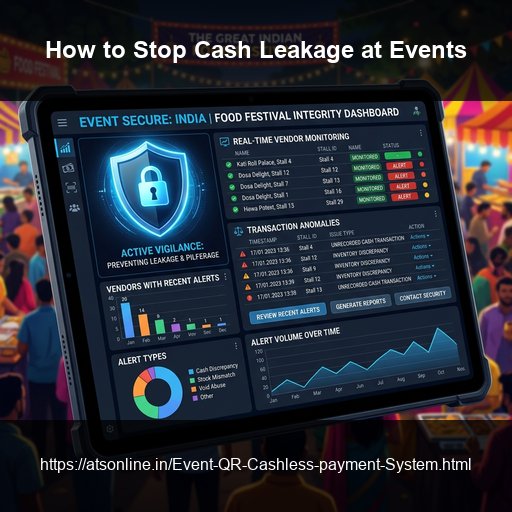
The most effective way to stop cash leakage and revenue pilferage at events is to eliminate physical cash and paper coupons entirely — replacing them with a closed-loop digital payment system that records every transaction in real time. With a QR cashless system like WalletQrPay by ATS Online, every rupee that enters the event ecosystem is tracked, attributed to a specific vendor and counter, and settled automatically at close. There is no gap between what is sold and what is declared. This guide identifies the six most common leakage points at Indian events, shows exactly how each one works, and explains how WalletQrPay shuts each one down.
How Much Money Is Your Event Actually Losing?
Most event organizers know, at some level, that their declared post-event revenue does not fully match what they expected. The stalls were busy. The crowds were large. The top-up counters had queues. Yet the final settlement figure is always lower than projections.
This gap is not accidental. It is structural.
Cash-based event systems contain multiple points where money can leave the ecosystem without being recorded — staff skimming, vendor under-declaration, and counterfeit coupons. Industry experience across food festivals, exhibitions, and nightclubs in India suggests that this leakage typically runs between 10% and 25% of total declared vendor revenue at cash-based events. For a food festival that declares ₹30 lakh in vendor sales, that represents between ₹3 lakh and ₹7.5 lakh that simply did not reach the organizer.
The 6 Major Cash Leakage Points at Indian Events
1. Vendor Short-Settlement
At the end of the event, each stall vendor declares their total sales and hands over the cash collection. In a busy multi-day food festival, the organizer has no independent record. A vendor who sold ₹80,000 but declares ₹65,000 pockets the difference and the organizer has no evidence to the contrary.
2. Staff Cash-Skimming
Cash collected at the stall counter passes through servers, cashiers, and floor runners. In a busy nightclub or bar with hundreds of cash transactions per hour, it is routine for some portion of that cash to be pocketed by staff before it is counted.
3. Counterfeit and Duplicate Paper Coupons
Paper coupon booklets can be duplicated with basic printing equipment. An insider with access to the original design files can print a second run of identical coupons. A counterfeiter with a high-resolution scanner can reproduce security features well enough to pass visual inspection at a busy stall.
4. Change Fraud at Busy Counters
In a busy food stall at peak hour, a server handling 20 customers per minute has numerous opportunities to shortchange customers by ₹10–₹50 per transaction. This leakage cuts both ways: it hurts attendees directly and creates accounting discrepancies.
5. Unaccounted Complimentary Passes and Comps
Almost every event runs a comp system. In a cash-based system, comps are typically managed through physical wristbands or verbal authorisations. None of these create a tracked record. Staff who control comp authorisations can exploit this ambiguity to provide unofficial comps.
6. Manual Reconciliation Errors
At close, every stall's cash collection must be manually counted, bundled, and matched against declarations. This process routinely takes 5 to 8 hours and involves dozens of people handling physical cash. Human counting errors contribute to discrepancy disputes.
How WalletQrPay Eliminates Each Leakage Point
Against Vendor Short-Settlement
WalletQrPay records every transaction at the moment it occurs. At close, the organizer downloads an automated counter settlement report showing each vendor's exact transaction count, total value, and time-wise breakdown. Payouts are made directly from this report, which eliminates declarations entirely.
Against Staff Cash-Skimming
No cash changes hands at vendor stalls. Attendees pay by QR scan. The amount deducted from their wallet is the exact amount charged. Every transaction is logged to a specific device, identifying staff-level anomalies immediately.
Against Counterfeit and Duplicate Coupons
WalletQrPay's QR codes are cryptographically encrypted and tied to a single cloud session. There is no physical token that can be duplicated or counterfeited. Screenshot sharing is rejected in under one second.
Against Change Fraud
No change is given. The vendor enters the transaction amount, the attendee's wallet is deducted by exactly that amount, and the confirmation is instantaneous.
Against Unaccounted Comps
WalletQrPay supports a designated comp wallet tracked through the same transaction system. Every comp transaction is logged, attributed to the comp wallet holder, and reported separately in the settlement.
Against Reconciliation Errors
Manual counting is replaced entirely by automated settlement reports. WalletQrPay generates a complete financial summary in minutes — total revenue, per-vendor breakdown, top-up volume, refund total, and net settlement value.
Case Scenario: What a 3,000-Person Food Festival Recovers
Consider a food festival with 3,000 daily attendees over three days, 40 vendor stalls, and an average spend of ₹600 per attendee. Total theoretical revenue: ₹54,00,000.
At a cash-based event with typical leakage of 15%, the organizer declares ₹45,90,000 — a loss of ₹8,10,000. After switching to WalletQrPay, the same event consistently returns a declared revenue figure that is 12–20% higher because the leakage simply stops.
Frequently Asked Questions
Can a vendor still cheat if we use a QR cashless system?
The mechanisms available to a dishonest vendor under a cash system — under-declaring sales, skimming cash, duplicating coupons — do not exist in a WalletQrPay environment. The vendor cannot alter their transaction log, because it is recorded in the cloud, not on their device. They cannot skim cash, because no cash changes hands at their stall. The only potential fraud vector remaining is collusion with an attendee to issue a comp transaction through an unofficial wallet — which the comp management system and transaction audit log are designed to detect.
What reports does WalletQrPay generate for settlement?
WalletQrPay generates automated counter settlement reports at close of event. Each report includes: total transaction count, total sales value, time-wise transaction breakdown (by hour), and average transaction value. A master settlement report aggregates all vendors for the organizer's overall financial summary. Reports are downloadable in standard spreadsheet formats.
Does WalletQrPay work as a long-term solution or just for one event?
Both. Many organizers use WalletQrPay for a single high-stakes event as a pilot and adopt it permanently after seeing the revenue recovery in the first settlement report. Others run it continuously across multiple annual events as their standard payment infrastructure. The system supports single-event and multi-event deployments.
What if I still want to offer a cash option to attendees who don't use UPI?
Cash is still supported — as a top-up method, not as a direct payment at stalls. Attendees who prefer or carry only cash can bring it to the top-up counter, where it is loaded into their digital wallet by the counter staff. From that point, all stall transactions are digital. The organizer still gets complete transaction visibility. The only cash in the system is at the top-up counter, where it is handled by a small, auditable team.
How soon after the event can I generate settlement reports?
Immediately. WalletQrPay settlement reports are generated in real time as soon as the event session is closed. There is no post-event data processing delay.
Conclusion
Stopping event revenue leakage requires eliminating cash-handling points. By replacing cash and paper coupons with WalletQrPay's closed-loop QR wallets, organizers can recover up to 25% of leaking revenues.
Stop cash pilferage and recover leaking event revenue. Visit www.atsonline.in, call us at +91-9810078010, or email ats.fnb@gmail.com to explore WalletQrPay.