Technology Selection: UPI Ecosystem Alignment vs Offline Local Chip Caching
June 29, 2026 in Cashless Event Payments
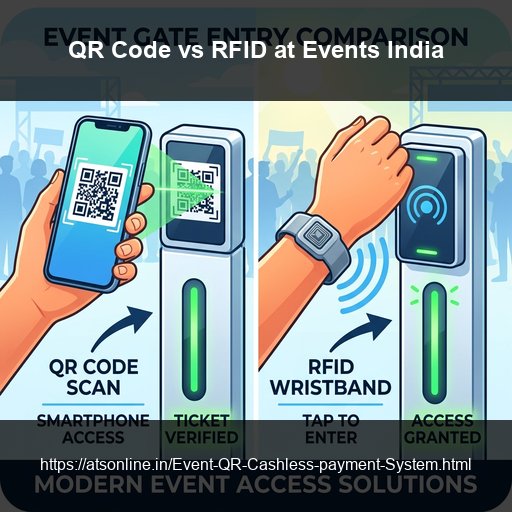
For the vast majority of Indian events in 2026, QR code cashless payment is the better choice over RFID. The reasons are structural, not preferential: India has the highest QR payment adoption in the world through UPI, while RFID requires expensive proprietary hardware that most Indian event organizers cannot justify for short-duration deployments. QR cashless systems like WalletQrPay by ATS Online set up in under 30 minutes on standard smartphones, cost nothing in hardware, and deliver an attendee experience that mirrors what Indians do every day. RFID's one genuine advantage — offline transaction capability — matters only at remote outdoor venues with no reliable internet, which represents a small minority of Indian events.
India's Event Payment Landscape in 2026 — Why This Choice Matters Now
The Indian live events industry has recovered strongly through 2025 and 2026. Food festivals, consumer exhibitions, nightclub events, college fests, and corporate gatherings are back at full scale. Three forces are reshaping event payments:
- UPI has made QR codes the universal Indian payment gesture: Every Indian with a smartphone uses QR codes daily. Any event payment system that aligns with that behaviour has a structural advantage.
- Hardware costs have become the critical objection: Organizers are increasingly resistant to per-event hardware rental costs for RFID readers, encoders, and terminal setups.
- Event durations in India skew short: Most Indian events run for 1 to 5 days, making the hardware economics of RFID hard to justify.
How RFID Works at Events: Strengths and Limitations
RFID (Radio Frequency Identification) event payment systems work by embedding a chip in a physical wristband or card. Attendees tap the wristband against an RFID reader at vendor stalls to pay.
Genuine strengths:
- Offline transaction capability: Readers store transactions locally when there is no internet connectivity, syncing when connection is restored. Useful for remote outdoor sites.
- Fast tap payment: Tapping a wristband takes under a second.
Real limitations:
- Prohibitive hardware cost: Sourcing reader terminals, encoders, and wristbands for 40 stalls can run into lakhs.
- Long setup times: Calibration and physical wiring take hours.
- Card loss and damage: Lost cards create a customer service bottleneck at gates.
How QR Cashless Works at Events: Strengths and Limitations
QR cashless systems issue attendees a unique encrypted QR code linked to a digital wallet. Attendees top up their wallet using UPI, card, or cash, and pay at vendor stalls by showing the QR for a vendor to scan.
Genuine strengths:
- Zero hardware cost: Runs on standard vendor smartphones. No readers to rent.
- Setup in under 30 minutes: Deployed instantly via cloud activation.
- UPI-native top-up: Load balances using PhonePe, Google Pay, or Paytm.
- No physical card to lose: Deactivate and reissue lost QR slips in 30 seconds.
Genuine limitations:
- Requires active internet: Cloud connectivity is needed for real-time transaction validations. For offline sites, check our RFID Cashless Event Cards.
5 Reasons QR Beats RFID for Most Indian Event Organizers
1. Zero Hardware Cost Changes the Economics Entirely
Sourcing cashless solutions with zero hardware cost eliminates variable rental fees, letting organizers protect event ticket margins.
2. Under-30-Minute Setup Fits Indian Event Production Realities
Setting up WalletQrPay takes minutes, which fits tight morning production windows on event day without competing for sound check or decor schedules.
3. UPI-Native Top-Up Drives Adoption Speed
Attendees do not need to learn a new payment flow; they top up using their familiar daily UPI apps, reducing onboarding queue bottlenecks.
4. No Physical Card Eliminates Support Overhead
Losing a printed QR slip does not lose the balance. re-issuing a new code from the dashboard takes under a minute, with no chip encoders required.
5. Instant Auto-Refund Builds Attendee Trust
Returning unspent balances to UPI at exit encourages guests to load higher initial amounts, which directly boosts total event sales.
Frequently Asked Questions
Is QR cashless better than RFID for food festivals in India?
Yes, for almost all food festivals. Food festivals typically run 1 to 5 days with 20 to 80 vendor stalls at venues with reliable mobile connectivity. In this context, QR cashless wins on hardware cost (zero vs. significant), setup time (under 30 minutes vs. hours), and vendor onboarding ease. RFID's offline capability is irrelevant at these venues.
Do RFID systems work with UPI in India?
RFID top-up terminals can accept UPI payments as one input method, but the flow is not UPI-native — it routes through a proprietary terminal interface rather than the attendee's own app. The result is a slower, less familiar experience than WalletQrPay's direct UPI top-up, where attendees open their own PhonePe, Google Pay, or Paytm app and scan normally.
Is it safe for attendees to store large wallet balances in a QR cashless system?
Yes. WalletQrPay's QR codes are encrypted at the session level and dynamically tied to a single cloud session. Screenshot duplication is rejected in under one second. This security model is equivalent to or stronger than the chip security used in RFID cards at standard Indian event deployments.
Can I switch from RFID to QR cashless easily?
Yes, and many organizers have. The transition requires no infrastructure change at the venue — you simply stop renting RFID hardware and activate WalletQrPay instead. The vendor workflow (scan, enter amount, confirm) takes a 5-minute orientation. The attendee experience is simpler than RFID because it uses UPI — which attendees already know.
Which system is better for a nightclub in Delhi or Mumbai?
QR cashless (WalletQrPay) is clearly better for nightclub deployments. Nightclubs operate in dark, high-traffic environments where RFID reader reliability and staff-assisted top-up are operational challenges. WalletQrPay's smartphone-camera scanning works in any lighting, creates a per-transaction audit trail at each bar station, and delivers the pilferage prevention that nightclub operators need. See: Cashless Payment System for Nightclubs and Bars in India.
How does WalletQrPay handle a venue with patchy internet?
The ATS Online team reviews venue connectivity before deployment and recommends the appropriate configuration. For most urban and semi-urban venues, standard 4G connectivity is sufficient. For venues with known connectivity challenges, a wifi hotspot backup or a hybrid deployment can be arranged. Contact the team to discuss your specific venue.
Conclusion
For most Indian event venues with reliable cell coverage, the zero-hardware, UPI-native QR payment system provides optimal cost efficiency and smoother gate flows.
Switch to UPI-native QR payments and protect your margins. Visit www.atsonline.in, call us at +91-9810078010, or email ats.fnb@gmail.com to explore WalletQrPay.