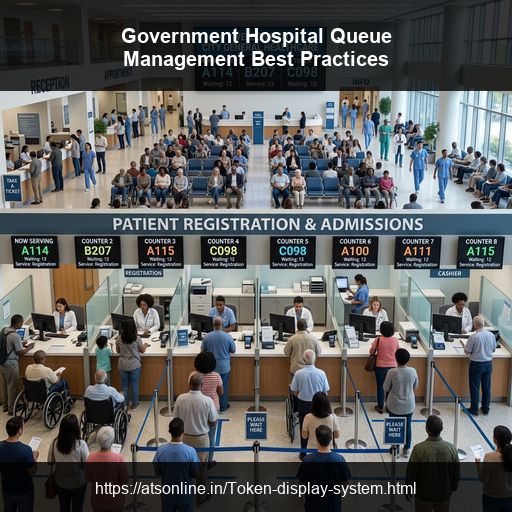
Government hospitals and public health centers represent the backbone of healthcare delivery in India. However, they are also synonymous with massive OPD crowds, chaotic waiting rooms, and hours-long physical lines. Standard commercial queue setups quickly break down under this sheer patient volume. Implementing a customized, high-capacity **Queue Management System (QMS)** guided by operational best practices is essential to bring order, dignity, and efficiency to public medical centers.
The Challenge of High-Volume Public Queues
On any given day, a major government hospital can receive thousands of outpatient department (OPD) patients. Patients travel long distances, often arriving before the hospital gates open. Managing registration, triage, consultation, billing, diagnostics, and pharmacy under such high-density conditions requires systematic queue routing rather than simple number displays.
Queue Management Best Practices for Government Healthcare
To successfully digitize and organize patient flow, public hospitals should implement these structural best practices:
1. Deploy Multi-Lingual Self-Service Kiosks
The registration desk is the primary bottleneck. Placing self-service token generation kiosks at the entrance allows patients to select their required department (e.g. Ophthalmology, Orthopedics) using a simple touch screen interface in local regional languages. Printing a physical token ticket immediately spreads the crowd away from registration desks and directs them to the correct waiting zone.
2. Segment Waiting Areas by Department (Zoning)
Avoid centralizing all patients in a single lobby. Instead, define departmental waiting zones. Each zone should have its own wall-mounted Smart TVs displaying token numbers specific to those cabins. Visual zoning prevents patients from wandering into other wings, reducing overall hallway congestion.
3. Utilize Voice Announcements in Local Languages
Public hospital demographics include patients from various educational backgrounds, including those who cannot read digital displays. Utilizing automated voice calling systems that announce numbers in local languages (such as Hindi, English, and regional dialects) ensures that no patient misses their turn. Cues like "Token Number 125, proceed to Counter 3" called aloud ensure accessibility for all.
4. Enable Cross-Department Token Routing
A major bottleneck occurs when patients must stand in new lines for X-rays, blood tests, and medication pickup after their consultation. A cloud-based QMS enables doctors to "transfer" the token directly to the lab or pharmacy queue on their system. The patient's token is automatically queued at the next counter, eliminating the need to wait in a new physical registration line.
5. Monitor Live Bottleneck Analytics
Hospital superintendents should have access to centralized dashboards showing active queue counts, average consultation times, and service rates. If a particular department experiences a spike in wait times, administrators can instantly allocate extra doctors or open additional counters to handle the load.
How ATSonline Simplifies Public Hospital Deployments
Legacy hardware queue systems are expensive to implement and maintain. Modern SaaS solutions like ATSonline MyTokenDisplay bypass these barriers by running on standard, budget-friendly Smart TVs over local Wi-Fi. Doctors call patients using standard tablets or phones, which are easy to maintain and replace, making it the ideal cost-effective solution for government medical institutions.
Frequently Asked Questions (FAQs)
Q1: Why do government hospitals need specialized queue management systems?
Government hospitals experience massive daily footfall (often thousands of OPD patients). Standard queue setups break down under this load. A high-capacity digital token display system is required to organize, pre-sort, and direct patients without physical crowd pile-ups.
Q2: What are the best practices for managing queues in a public hospital?
Key best practices include: deploying self-service ticketing kiosks with multi-lingual UI, utilizing multi-counter displays for different departments, implementing voice announcements in regional languages, and cross-routing tokens across consultations, labs, and pharmacies.
Q3: Can cloud queue systems function with poor internet connectivity in public hospitals?
Modern queue management systems like ATSonline support local intranet modes or hybrid offline synchronization, ensuring token calling and screen updates continue smoothly even if the external internet drops temporarily.