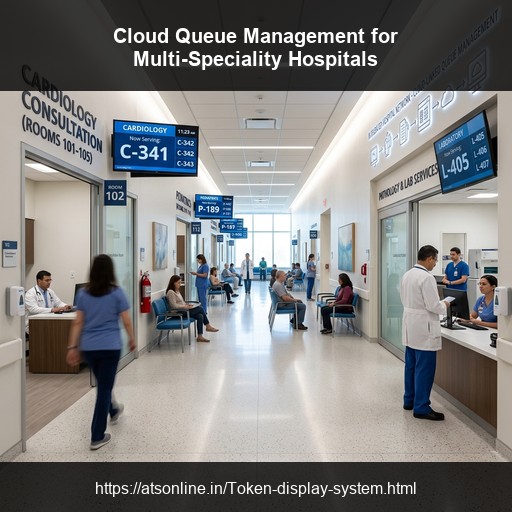
Managing patient queues in a single-doctor clinic is relatively straightforward, but in a large **multi-speciality hospital**, patient routing is highly complex. A single patient journey often spans registration, nursing triage, a specialist consultation, blood tests, X-rays, medical billing, and pharmacy pickup. Running isolated legacy token boards for each department leads to bottlenecks. A centralized **Cloud-Based Queue Management System** is essential for coordinating these complex, cross-department patient flows.
How Multi-Speciality Patient Routing Works in the Cloud
Unlike old-school wired LED boxes that operate in isolation, a cloud queue management system (QMS) runs a unified software instance across the entire hospital network. When a patient registers, they receive a single digital token ID. This token acts as a routing passport:
- Triage & Consultation: The token is first queued at the OPD ward (e.g. Cardiology).
- Diagnostic Transfer: After the exam, the doctor clicks "Refer to Lab" on their dashboard, automatically shifting the patient's token into the lab queue.
- Billing & Pharmacy: Once lab samples are collected, the token is routed to billing and then the pharmacy for medication pickup.
Operational Advantages of Cloud QMS in Large Hospitals
Implementing a SaaS-based cloud queue system provides significant operational benefits for large-scale medical centers:
1. Centralized Administrative Control
Hospital administrators can monitor the performance of all departments in real time. Through a central dashboard, they can see average wait times for Pediatrics vs. Orthopedics, identify current bottlenecks, and dynamically allocate extra staff or open additional billing counters to handle peak hours.
2. Low Total Cost of Ownership (TCO)
Legacy multi-department queue systems require dedicated servers, extensive data cables, and complex IT maintenance. A cloud-based token software operates entirely over your existing Wi-Fi network and standard Smart TVs, reducing installation costs and simplifying future expansions.
3. Seamless POS & EHR Integrations
A cloud queue software connects via APIs to your existing Hospital Information System (HIS), billing POS, or Electronic Health Record (EHR) software. When a doctor updates a patient's record or a cashier prints a receipt (for example, using integrated canteen software or hotel front desk systems), the queue status updates automatically, reducing double entry.
4. High Scalability
Adding a new consultation room, wing, or diagnostic center is simple. You do not need to lay cables or buy proprietary hardware. Just purchase a standard Smart TV, open the token display web app, register the new counter in the admin panel, and your new department is instantly live.
Modernize Your Hospital Queue Network
For multi-speciality hospital groups, standardizing operations across multiple branches is essential. Cloud queue networks allow you to implement standardized branding layouts, unified multi-lingual voice calling presets, and comparative branch wait-time analytics, ensuring a premium patient experience at every location.
With ATSonline's MyTokenDisplay SaaS system, your hospital can eliminate long wait queues and elevate patient satisfaction without investing in expensive, legacy hardware.
Frequently Asked Questions (FAQs)
Q1: How does a cloud-based queue management system work across multiple departments?
A cloud-based QMS connects all departmental screens, self-service kiosks, and calling interfaces to a central database. It allows staff to transfer a single token (e.g. Card A1) seamlessly from Consultation to Diagnostics, Billing, and Pharmacy.
Q2: What are the security benefits of using cloud queue management software?
Cloud systems are hosted on secure servers (like AWS or Azure) with HTTPS encryption. Patient data is tokenized, ensuring compliance with health information privacy standards (like HIPAA in spirit or local digital personal data protection acts).
Q3: Can a multi-speciality hospital monitor live wait times and service performance?
Yes, a cloud QMS offers centralized real-time dashboard analytics. Hospital administrators can monitor wait times, consultation durations, and staff service rates across all departments from a single remote location.