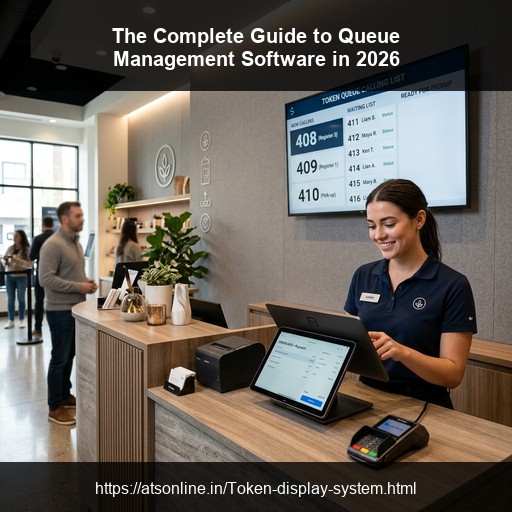
Queue management software (QMS) has evolved rapidly. In 2026, business owners are completely abandoning legacy hardware token machines—with their proprietary buttons and hardwired screens—in favor of cloud-hosted, device-responsive software. This guide explores the essential components, trends, and pricing models defining the QMS market in 2026.
Key Queue Software Trends in 2026
The queue management landscape in 2026 is defined by cloud accessibility, instant synchronization, and hardware-free setups:
- Zero-Hardware TV Displays: Modern setups do not require dedicated media players. Businesses connect a standard Smart TV to Wi-Fi and load a unique queue URL. The web page functions as a real-time, animated token calling screen.
- Direct POS Integration APIs: Rather than typing numbers manually, QMS tools integrate with cashier systems. For instance, billing a client on a canteen management software or a hotel software instantly triggers a token number queue.
- Smart Sound & Voice Calling: Modern calling systems utilize text-to-speech engines to speak the called number in multiple languages, making the environment accessible and professional.
- Responsive Dashboards: Counter staff can log in to their calling pads using any existing tablet, phone, or desktop browser, removing the need for physical counter keypads.
Important Features to Look for
If you are choosing a queue management system in 2026, ensure it includes:
1. Multi-Counter & Multi-Department Support
The software must allow you to run multiple counter lines on a single screen (e.g., Counter 1 calling Token 10, Counter 2 calling Token 12) to keep large facilities organized.
2. Offline Mode Backup
Broadband drops shouldn't stall your operations. Advanced QMS platforms (like ATSonline's wireless token display) run on local Wi-Fi networks in offline mode, ensuring 100% counter uptime.
3. Custom Layouts & Marketing Signage
Your screen shouldn't just show numbers. Choose a platform that lets you upload your logos, customize background colors, and display marketing slides or video loops beside the numbers to engage waiting customers.
Pricing Models for Queue Software in 2026
In 2026, SaaS subscription models dominate the market. Instead of paying thousands of dollars for proprietary hardware, businesses pay a small monthly or annual software fee. Pricing typically scales based on the number of counters or locations, making digital queue systems highly cost-effective for small clinics and large food courts alike.
Frequently Asked Questions (FAQs)
Q1: What are the latest trends in queue management software for 2026?
Key trends in 2026 include serverless cloud hosting, browser-based Smart TV displays that require zero local installs, direct POS API integrations, and WhatsApp/SMS token status updates.
Q2: How is queue software priced in India?
Modern SaaS queue software is priced on a subscription model based on counters or locations, making it highly affordable for small clinics and large food courts alike compared to legacy hardware machines.
Q3: Can queue management software run on tablets?
Yes, 2026 queue software is fully responsive and runs on any device with a browser, including Android tablets, iPads, smartphones, and POS desktop systems.