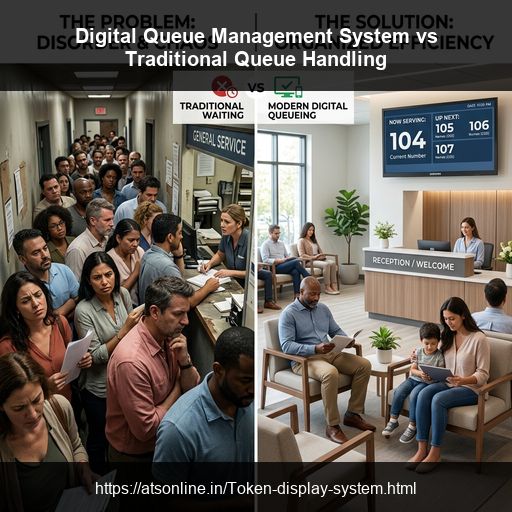
How businesses manage waiting customers directly influences brand perception. While some establishments rely on traditional physical queues with rope barriers or stanchions, others have transitioned to digital queue management systems. Understanding the comparative pros and cons of both methods highlights why digital token systems represent the modern standard.
Traditional Queue Handling: The Legacy Approach
Traditional queue handling is entirely physical. Customers stand in a single-file or multi-file line, physically moving forward as the person ahead is served. While simple to understand, physical lines introduce multiple pain points:
- Physical Strain: Forcing elderly patients or tired restaurant patrons to stand for 15-30 minutes creates discomfort and irritation.
- Visual Crowding: Physical queues crowd cashier desks and entryways. In high-volume locations like canteens (see our guide on canteen management), physical queues can block main walkways.
- Anxiety & Conflict: Physical lines invite anxiety over "queue jumping" or unfair counter switching, leading to conflicts between customers and staff.
- Zero Operational Data: Managers have no data on queue size, serving speeds, or average wait times, preventing process optimization.
Digital Queue Management: The Software Solution
A digital queue system replaces the physical line with an automated token calling process. Upon arrival, a customer receives a token number (via a ticket dispenser kiosk or cashier restaurant POS bill). The customer can sit down comfortably in a lobby area, keeping track of their turn on a wall-mounted Smart TV screen.
Key Advantages of Digital Queue Systems:
- Promotes Safe Distancing & Hygiene: Eliminating close physical lines creates a spacious, sanitary environment.
- Guarantees Fairness: The software calls numbers sequentially. A customer cannot skip ahead, which removes wait anxiety and creates a transparent environment.
- Multi-Tasking Lobbies: Modern Token Display Software runs on Smart TVs. Alongside token numbers, businesses can play promotional slides, menus, or news, occupying customer attention.
- Rich Staff Performance Analytics: Managers receive cloud reports details counter transaction times, helping identify bottleneck desks and optimize staffing schedules.
Digital vs. Traditional: Head-to-Head Comparison
| Feature | Traditional Queue Handling | Digital Queue Management |
|---|---|---|
| Customer Position | Standing continuously in a physical line | Sitting comfortably in a waiting lobby |
| Perceived Wait Time | Feels long, boring, and stressful | Feels shorter (distracted by TV media) |
| Counter Crowding | High crowding, blocking corridors | Zero crowding (customers called as needed) |
| Staff Fatigue | High (shouting names/numbers manually) | Low (automated chimes & voice announcers) |
| Analytics & Reports | None | Detailed cloud reports on wait/service times |
Which Option Offers a Better Business ROI?
Traditional stanchions are cheap upfront, but they cost you customers in the long run. High wait times and crowded counters lead to high walkaway rates. On the other hand, digital queue software speeds up service efficiency and keeps customers relaxed. Relaxed customers are more likely to stay, buy more, and return, making a digital queue system the clear winner for ROI.
Frequently Asked Questions (FAQs)
Q1: What are the disadvantages of traditional queue handling?
Traditional queue handling leads to visual crowding, customer anxiety over turn fairness, physical fatigue from standing, staff distraction, and complete lack of data on service efficiency.
Q2: How does a digital queue management system prevent queue jumping?
A digital queue system generates sequential token numbers at entry. Customers are called automatically by the software, which is shown publicly on TV screens, removing any subjectivity or chance of queue jumping.
Q3: Is a digital queue system more expensive than traditional stanchions?
While stanchions have lower upfront costs, the operational efficiency, reduced walkaway rates, and lower staff requirements of a digital system provide a far higher ROI, paying for itself in a few months.