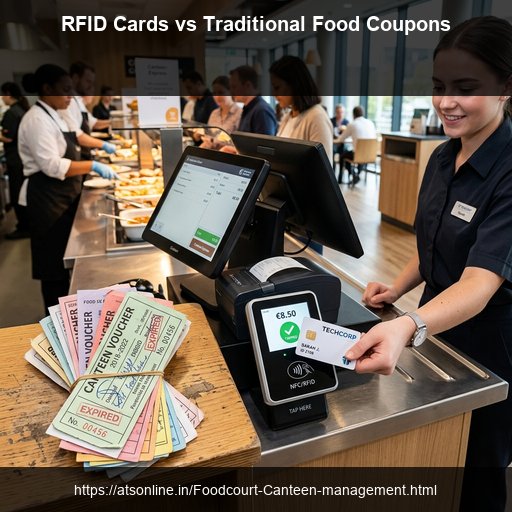
For decades, large-scale dining spaces like corporate cafeterias, school canteens, and food festivals relied on a simple mechanism to manage payments: the paper coupon booklet. Guests paid cash at a central ticket booth, received a strip of paper coupons, and exchanged those coupons for food at various stalls. While this model successfully kept cash out of the hands of multiple servers, it introduced a new set of serious operational challenges.
Today, modern food court and canteen operators are switching to secure, reusable RFID prepaid smart cards. Below, we analyze how these two methods compare and why RFID represents the future of cashless dining ecosystems.
The Bottlenecks of Traditional Food Coupons
While paper coupons seem simple, they introduce significant friction and hidden costs during busy hours:
- Slow Transaction Speeds: Tearing, counting, and verifying paper coupons takes time. During peak lunch rushes, this manual processing slows down food lines significantly.
- Ticket Printing Overhead: Printing high-security, sequential coupon booklets is expensive. Traditional printing methods do not easily allow for daily updates, leading to ticket waste.
- High Counterfeiting Risk: Simple paper coupons are extremely easy to copy, share, or reuse. Canteen operators frequently lose profits to fake or unauthorized coupon printing.
- Reconciliation Nightmares: At the end of the day, managers must manually count bags of greasy paper slips to calculate vendor payouts and total sales. This process is time-consuming and highly prone to human error.
Why RFID Prepaid Cards Win the Cashless Dining Battle
Prepaid RFID smart cards solve almost every limitation of the paper coupon model:
1. Lightning-Fast Transactions
Instead of counting coupons, guests simply tap their RFID smart card on a desktop or Android POS terminal. The transaction is verified, and the meal value is deducted in under two seconds. This speeds up queues, allowing staff to serve more guests during peak hours.
2. Reusable and Eco-Friendly
Unlike single-use paper coupons that end up in the trash, RFID cards are highly durable. They can be reused thousands of times, reducing printing costs and trash accumulation in the dining hall.
3. Secure Closed-Loop System
Each RFID card is encrypted and tied to a secure account in the database. This prevents ticket duplication and staff fraud. If a card is lost, it can be immediately blocked and its balance transferred to a new card.
4. Automated Real-Time Accounting
With an RFID cashless dining system, every transaction is digitally logged. Managers can access real-time dashboards to view sales, track inventory, and calculate multi-vendor payouts instantly without manual coupon counting.
Hybrid Solutions: When Coupon Printing Software is Still Useful
Is there still a place for coupons in 2026? Yes. For one-time events, exhibitions, or temporary visitors who do not require a permanent smart card, using instant coupon printing software connected to high-speed thermal receipt printers is a great option. Instead of using pre-printed booklets, the software prints secure thermal coupons with unique, scan-and-burn QR codes on demand. This hybrid approach ensures that even temporary guests enjoy a secure, cashless dining experience.
Summary: The Clear Winner
While paper coupon booklets served their purpose in the past, their security risks, high printing costs, and slow speeds make them obsolete for modern canteens. Transitioning to an RFID cashless dining system simplifies canteen management, secures your revenue, and provides a premium checkout experience for your diners.
Related Reading:
- RFID Card vs Paper Coupons: Cashless Edge in Event Management
- Why Pre-Printed Coupon Booklets Are Killing Event Profits
- EventCouponPrint vs Manual Booklets: Cost Comparison
- Canteen Management System with RFID Prepaid Cards
Streamline Your Dining Operations Today
Contact ATSonline to request a free demonstration of our RFID cashless dining software systems.
📞 Call us at +91 9810078010
✉️ Email us at ats.fnb@gmail.com