Navigating Event Payments: The Battle of Tech
June 19, 2026 in Event Solutions
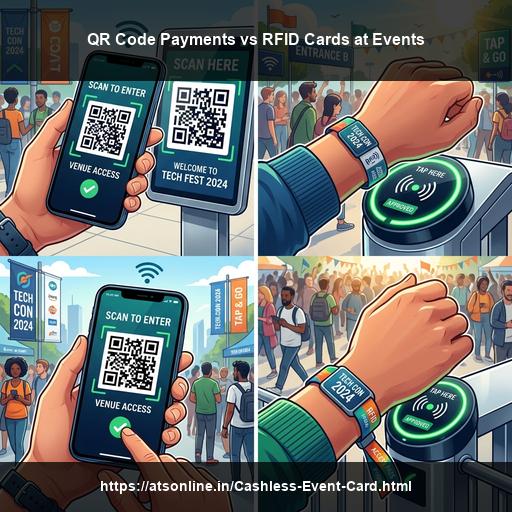
India's digital payment ecosystem is one of the most advanced in the world, largely driven by the spectacular rise of the Unified Payments Interface (UPI). Today, scanning a QR code to buy tea or street food is second nature to millions of Indians. Naturally, when planning a live event, concert, or food festival, many organizers assume that deploying UPI QR codes at stalls is the easiest way to go. However, as crowd sizes scale into the thousands, a critical debate emerges: is a qr code payment events india setup truly the best choice, or do closed-loop RFID cards offer a far superior solution? Let’s analyze these technologies head-to-head.
1. Transaction Speed: The Queue Killer
At any live event, the enemy is the queue. Long lines at food stalls or bars translate directly to lost sales and unhappy guests.
With a QR code payment setup, the typical transaction journey goes like this: the attendee unlocks their phone, opens a payment app (such as Google Pay, PhonePe, or Paytm), waits for the app to load, scans the stall's QR code, enters the transaction amount, enters their secure UPI PIN, waits for the bank server to process the payment, and finally shows the transaction confirmation screen to the cashier. In perfect conditions, this takes 30 to 45 seconds. If the customer has a weak signal or forgets their PIN, the time easily stretches to over a minute.
Contrast this with closed-loop RFID cards or wristbands. The attendee walks up, orders, and taps their card against a handheld POS terminal. The reader verifies the encrypted offline balance, deducts the amount, and prints a receipt. The entire transaction takes less than 0.5 seconds. When serving thousands of people, this massive speed difference allows vendors to double their throughput, resulting in a dramatic boost in sales volume.
2. Internet and Network Dependency
India's mobile internet infrastructure is robust, but it has a fundamental physical limitation: bandwidth density. When 20,000 people gather in a stadium or open festival ground, the local cell towers are immediately overwhelmed by the sheer volume of simultaneous connections. Mobile internet speeds drop, making it impossible to load payment apps, initiate UPI bank requests, or receive SMS payment alerts.
A QR-code-based payment system is entirely dependent on 100% active internet connectivity for both the buyer (to send the money) and the vendor (to verify the credit). If the network chokes, sales grind to a complete halt.
On the other hand, a dedicated RFID cashless system operates on a closed-loop, offline-first architecture. The balance is stored securely on the physical microchip of the attendee's card. The vendor's battery-powered POS terminal reads and updates this balance locally. No internet connection is required at the individual stalls. The system remains fully operational, immune to telecom dropouts or venue blackouts.
3. Revenue Security and Leakage Control
Organizing large-scale events in India is a major financial risk, and controlling revenue leakage is paramount, especially when working on a revenue-share model with vendors.
QR code systems are highly vulnerable to leakage. Because cashiers are rushed during peak hours, they often glance quickly at confirmation screens. This allows dishonest customers to bypass payments by displaying pre-recorded video loops of past transactions or fake UPI payment generator screenshots. More seriously, unscrupulous vendors can easily display their personal bank QR codes under the counter, pocketing cash directly from guests and bypassing the organizer's revenue-sharing agreements entirely.
An RFID card system eliminates these vulnerabilities. It is a closed system: vendors can only accept payments via the official, registered terminal provided by the organizer. The terminal only accepts the event's encrypted cards. There is no cash, no external QR codes, and no way to fake transactions. Every single rupee spent at the venue is tracked, logged, and reconciled automatically, securing the organizer's commission.
4. Operational Simplicity and Reconciliation
After a multi-day festival, the most exhausting task is vendor reconciliation. When using individual QR codes, payments are scattered across different merchant accounts, personal bank details, and cash boxes. Calculating the organizer's commission requires sorting through hundreds of bank statements and manually auditing individual vendor declarations—a process that takes weeks and is prone to disputes.
With an RFID system, all transactional data is consolidated on a single local or cloud server. The moment the event ends, the organizer can generate a unified vendor sales report with a single click. Payouts are calculated automatically based on the precise digital logs, and vendors can be paid out within hours rather than weeks.
5. Attendee Experience and Convenience
Using a smartphone for everything can be stressful at a festival. Phone batteries drain quickly from taking photos and videos, and holding a drink in one hand while trying to scan a QR code with the other is clumsy. If an attendee's phone dies, their ability to buy food or water is completely cut off.
An RFID card or wristband is lightweight, waterproof, and doesn't require a battery. It remains securely on the guest's wrist or in their pocket. It can be easily topped up at central booths using UPI or cash, combining the digital ease of UPI with the physical convenience of tap-and-go tech. It keeps attendees focused on enjoying the event, rather than worrying about phone signals or battery percentages.
Comparison Table: Quick Summary
| Feature | QR Code Payments (UPI) | Closed-Loop RFID Cards |
|---|---|---|
| Transaction Speed | Slow (30 - 60 seconds) | Ultra-Fast (Under 0.5 seconds) |
| Internet Dependency | High (Fails during network congestion) | None (100% offline transaction processing) |
| Leakage Prevention | Low (Vulnerable to fake screenshots / private QRs) | Absolute (Encrypted cards, single terminal control) |
| Reconciliation Time | Days or weeks (Manual statements audit) | Instant (One-click digital dashboard report) |
| User convenience | Requires charged phone & signal | Wearable, waterproof, battery-free |
The Verdict: Which is Better?
For small, low-traffic events like local flea markets, school fests, or small corporate workshops where queue management isn't a priority, a simple UPI QR code setup is cost-effective and sufficient.
However, for professional, high-volume events—such as large-scale music concerts, multi-day food fests, water parks, and stadium events—RFID cards and wristbands are the undisputed winners. The initial investment in RFID hardware is quickly offset by the massive reduction in queues, the complete elimination of fraud, and the substantial 20-30% increase in customer spending.
At Advance Technology Systems (ATS), we provide high-performance, offline-ready RFID cashless card solutions tailored for the Indian event market. Secure your profits and give your guests a world-class experience today.
You can reach us by phone at +91 9810078010 or by email at ats.fnb@gmail.com. Thank you for your interest in our services.
Ready to upgrade your venue security and sales? Visit www.atsonline.in, call us at +91-9810078010, or email ats.fnb@gmail.com for RFID event billing systems.