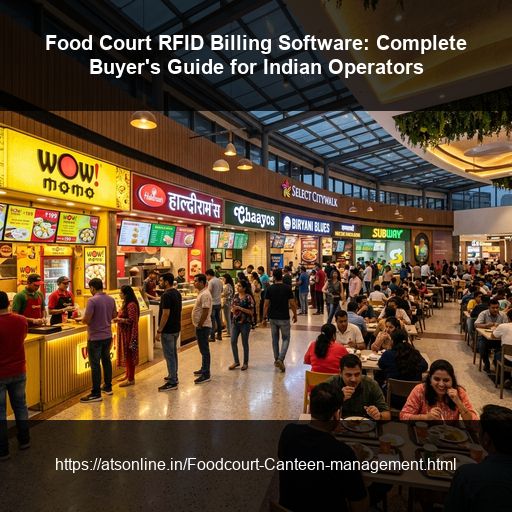
Operating a modern food court in India—whether inside a shopping mall, an IT park, a university campus, or a tourist attraction—comes with unique operational hurdles. Managing hundreds of transactions during peak lunch hours, preventing cash pilferage, and reconciling sales across multiple independent food vendors can quickly turn chaotic.
This is where a specialized Food Court and Canteen Management Software with RFID prepaid card technology becomes a game-changer. In this guide, we will break down everything Indian operators need to know to select, deploy, and profit from the right system.
1. The Problem with Cash and Manual Coupons
Historically, food courts relied on cash transactions at individual stalls or centralized cash counters issuing paper coupon booklets. Both models have severe flaws:
- Revenue Leakage: Cash transactions at individual stalls are hard to monitor. Unscrupulous staff can pocket cash without registering orders, causing up to 10% to 15% revenue leakage.
- Coupon Counterfeiting: Paper coupons are easy to copy, duplicate, or reuse. Dishonest vendors can collude with staff to print extra booklets, stealing profits directly from the operator.
- Slow Order Speeds: Waiting for cash change or searching for correct coupons slows down lines, frustrates customers, and limits order capacity during busy lunch hours.
2. How RFID Prepaid Card Systems Work
A closed-loop RFID prepaid system shifts the entire food court's economy onto secure smart cards. The process is straightforward for customers and operators alike:
- Card Purchase: The customer buys a branded RFID smart card at a central cash counter and loads it with a desired monetary balance.
- Tap & Pay: The customer visits any food vendor counter, selects their food, and taps the RFID card on the stall's card reader. The billing terminal instantly deducts the order amount from the card.
- Order Processing: The transaction prints a KOT (Kitchen Order Ticket) or sends it to a Kitchen Display System. Operators can also integrate a central Token Number Display System on a Smart TV to alert customers when orders are ready.
- Card Refund: Before leaving, the customer returns the card to the central counter to get a refund for any remaining balance, or they can choose to keep the card for future visits.
3. Essential Features of Food Court RFID Billing Software
When searching for the best billing system for your food court, ensure it contains these non-negotiable features:
A. Complete Offline Reliability
Internet connectivity in India can be unpredictable, especially inside crowded mall basements or large campuses. Your system must run on a local offline network. Sales terminals must process tap-and-go transactions instantly without internet, syncing the data to the central server when the connection is active. Look for solutions like Android Restaurant POS devices that can function offline.
B. Flexible Refund and Validity Rules
Different operators have different refund policies. For example, amusement parks might charge a non-refundable entry card fee, while IT park cafeterias might offer unlimited validity. The software should support customizable card expiry, activation fees, and refundable deposit settings.
C. Multi-Stall Accounting & Revenue Share
Reconciling sales at the end of the day is a major headache. The billing software must automatically track which card tapped at which stall. At the end of the day or week, the operator can generate stall-wise sales reports and automatically calculate rent deductions or revenue-share percentages without discrepancies.
4. ROI & Cost Analysis for Indian Operators
A high-quality RFID cashless card system represents an upfront investment in hardware (RFID readers, cards, POS terminals) and software licensing. However, the ROI is usually achieved within the first 3 to 6 months:
- Leakage Control: By eliminating cash at stalls, operators immediately stop under-the-table sales, increasing recorded revenues by 10% or more.
- Increased Spending: Studies show that customers spend 15% to 20% more when using prepaid cards compared to paying with physical cash, as the friction of cash payments is removed.
- Administrative Savings: Manual reconciliation, printing paper booklets, and sorting out vendor disputes can take hours of labor. RFID automates this instantly, reducing admin costs.
If you run a food court that also caters to large corporate groups or events, check out Cashless Event Solutions to see how RFID cards scale up for exhibitions and food festivals.
5. Conclusion — Making the Switch
Ditching cash and coupons for a modern RFID billing solution is the most effective operational decision an Indian food court operator can make. It protects your revenue, delights customers with faster checkout lines, and keeps your vendors happy with automated, transparent payouts.
Related Reading:
- Offline Cashless Card Food Court System
- Prepaid Card Software for Canteens & Food Courts
- Enhancing Food Court Efficiency with Prepaid Cards
- How Cashless Dining Works in Food Courts
- Reliable Cashless Billing Software
Ready to Modernize Your Food Court?
Contact ATSonline to set up your RFID prepaid card billing system and streamline your operations.
📞 Call us at +91 9810078010
✉️ Email us at ats.fnb@gmail.com