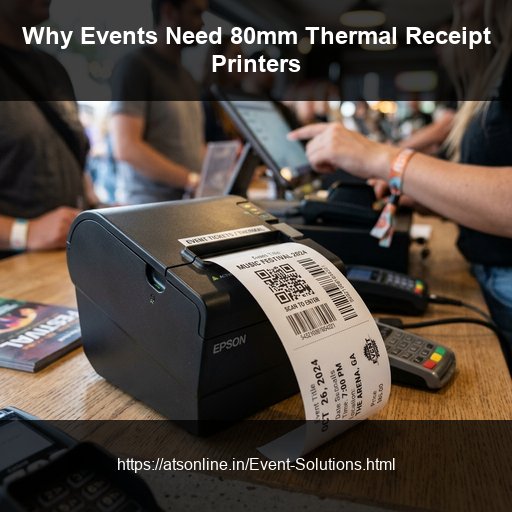
If you have ever purchased groceries at a supermarket, bought a movie ticket at a multiplex, or picked up a fast-food order, you have interacted with the output of a thermal receipt printer. They are the ubiquitous, unsung heroes of the global retail industry.
However, when organizers plan food festivals, college fests, or local exhibitions, they often overlook this critical piece of hardware, defaulting instead to expensive pre-printed paper booklets or slow, standard office inkjet printers. This is a massive operational mistake.
In this guide, we will explain exactly what an 80mm thermal receipt printer is, the fascinating "inkless" science behind how it works, and why pairing one with software like ATSonline EventCouponPrint is the single best operational decision you can make for your next event.
How Does a Thermal Printer Actually Work?
The most surprising fact about thermal receipt printers is what they do not have. If you open one up, you will not find an ink cartridge. You will not find a toner drum. You will not find a ribbon.
So, how does the text get on the paper?
The secret lies in the paper itself, not the printer. Thermal receipt printers use highly specialized thermal paper. This paper is coated with a chemical layer (a mixture of a dye and a matrix material). Under normal room temperatures, this coating is completely transparent, and the paper appears blank white.
Inside the printer, there is a stationary "printhead" containing hundreds of microscopic heating elements. When the paper is fed past the printhead, the printer sends precise electrical pulses to specific heating elements. These elements get hot instantly. When the heat hits the chemical coating on the paper, it triggers a reaction that turns the coating black.
It doesn't "print" ink onto the paper; it burns the image into the paper using localized heat.
Why the "80mm" Standard?
When shopping for thermal printers, you will predominantly see two sizes: 58mm and 80mm. This refers to the width of the paper roll.
- 58mm Printers: Often used in small handheld devices, parking ticket machines, or very small retail shops. The paper is narrow, limiting how much information you can print legibly.
- 80mm Printers: This is the global standard for professional Point of Sale (POS) systems. The wider 80mm format provides enough real estate to print clear company logos, detailed itemized lists, large denominations, and most importantly, high-resolution scannable barcodes.
For event ticketing and food coupons, an 80mm thermal printer is universally recommended.
Why Event Counters Desperately Need Thermal Printers
Event ticketing counters—especially at food festivals or exhibitions—are extreme environments. You have hundreds of impatient people waiting in line, volunteers or temporary staff operating the machines, and zero tolerance for hardware failure. Here is why thermal printers dominate in these scenarios:
1. Blistering Speed
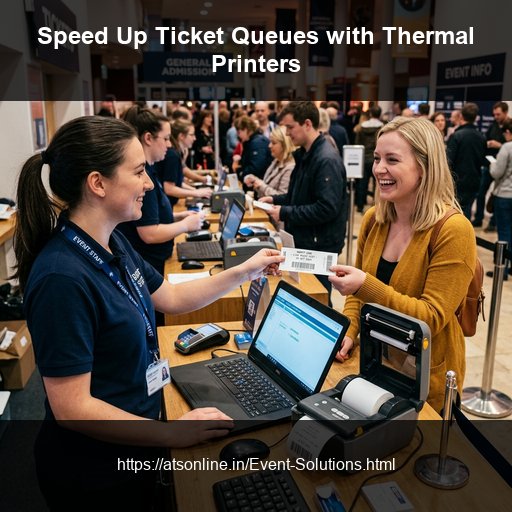
An office inkjet printer might take 10 to 15 seconds to slowly drag a printhead back and forth across a page. A modern 80mm thermal receipt printer is a beast of efficiency. Because the printhead does not move left-to-right (it spans the entire width of the paper and simply flashes heat as the paper rolls past), they are incredibly fast.
Most standard thermal printers operate at speeds of 200mm to 300mm per second. This means a standard 4-inch event coupon is generated and cut in less than half a second. When you are trying to clear a queue of 50 hungry attendees, that speed is the difference between a successful event and a chaotic disaster.
2. Zero "Out of Ink" Emergencies
Imagine managing the main ticketing counter at a college fest at 8:00 PM on a Saturday. The crowd is peaking. Suddenly, your standard printer flashes a "Low Ink Cartridge" error and stops working. You cannot buy an ink cartridge at 8:00 PM. The queue stops. Revenue stops.
With a thermal printer, you literally never run out of ink. The only consumable is the paper roll itself. Changing a thermal paper roll takes approximately 3 seconds: pop the lid open, drop a new roll in, and snap the lid shut. There is nothing to calibrate and nothing to align.
3. The Built-in Auto-Cutter
Standard 80mm thermal POS printers come equipped with an internal auto-cutter mechanism. When the software sends the print command, the printer generates the ticket and instantly slices the paper cleanly (often leaving a tiny 1mm tab so the ticket doesn't fall on the floor). Staff members do not need to manually tear coupons against a sharp edge, saving precious seconds per transaction and presenting a much more professional-looking ticket to the customer.
4. Unmatched Reliability (MTBF)
Because thermal printers do not have complex moving print carriages or liquid ink delivery systems, their internal mechanics are incredibly simple. This simplicity leads to massive reliability. Industrial thermal printers boast an MTBF (Mean Time Between Failures) of hundreds of thousands of hours, and printhead lifespans rated for millions of inches of paper. They are workhorses built to survive the dust, heat, and non-stop usage of an outdoor event.
Pairing Hardware with the Right Software
A thermal printer is just a piece of hardware; it is only as powerful as the software driving it. To truly harness its potential at an event, you must pair it with dedicated digital ticketing software like ATSonline EventCouponPrint.
Here is what the combination of an 80mm thermal printer and EventCouponPrint achieves:
- On-Demand Denominations: The cashier types "₹350" into the software. The thermal printer instantly outputs a custom ticket for exactly ₹350.
- Cryptographic Security: The software generates a unique barcode for that specific transaction. The thermal printer outputs the barcode with crisp, high-contrast black edges, ensuring it can be scanned flawlessly by food vendors using Android smartphones.
- Fraud Prevention: Because the ticket is generated on demand with a unique barcode, attendees cannot photocopy or forge coupons. Vendor revenue leakage is reduced to absolute zero.
Conclusion
If you are organizing an event and still relying on pre-printed paper booklets, you are leaking revenue. If you are trying to use a standard office printer to generate passes, you are creating massive bottlenecks.
The 80mm thermal receipt printer is the ultimate ticketing hardware. It is fast, reliable, inkless, and when paired with ATSonline's event software, provides total financial security for your event.
Frequently Asked Questions
Deploy Thermal Ticketing at Your Next Event
Combine the blistering speed of an 80mm thermal printer with the security of ATSonline EventCouponPrint. Eliminate fraud and destroy long queues.