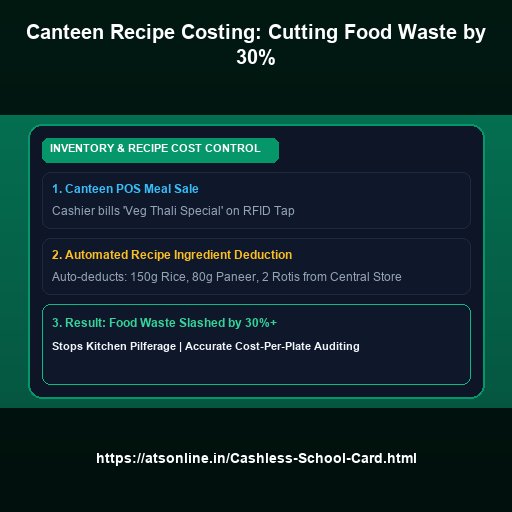
Key Takeaway (Direct Answer):
Automated canteen inventory and recipe costing links every POS meal sale directly to backend kitchen raw ingredient stocks. When a cashier bills a meal (e.g., 'Veg Thali'), the system automatically deducts the exact recipe bill of materials (150g rice, 80g paneer, 2 rotis) from central store inventory. Powered by ATS Cashless School Card (₹48,000 one-time), cafeteria caterers cut food spoilage by over 30% and eliminate kitchen ingredient pilferage.
The Hidden Profit Drain in School Canteen Kitchens
Managing an educational dining facility is an exercise in thin profit margins. With fixed meal prices set by school boards to keep food affordable for families, catering contractors and cafeteria managers cannot easily raise prices to absorb losses. Yet behind the kitchen doors, massive financial leakage occurs daily.
Without automated recipe inventory tracking, kitchen managers rely on guesswork when ordering perishable raw ingredients. Over-purchasing leads to spoiled vegetables, curdled dairy, and stale bread tossed into dumpsters. Under-purchasing leads to lunch shortages, leaving students hungry. Even worse, unmonitored kitchen store rooms suffer from internal ingredient pilferage. Overcoming this requires Integrated Canteen Inventory and Recipe Cost Control.
How Automated Recipe-Level Ingredient Depletion Works
The ATS platform bridges the gap between front-of-house cashier registers and back-of-house raw inventory storerooms:
- Bill of Materials (BOM) Setup: For every menu item, the catering manager defines exact component ingredients. For example, a 'Deluxe School Thali' maps to: 150g basmati rice, 100g dal, 80g mixed vegetables, 2 chapattis, and 1 yogurt cup.
- Instant Point-of-Sale Trigger: When a student taps their RFID smart card at the counter, the sale is recorded instantly.
- Real-Time Stock Deduction: The central inventory database automatically depletes the exact grammage of raw ingredients from the central store room in real time.
- Automated Low-Stock Thresholds: When flour, cooking oil, or milk dips below minimum safety thresholds, the system alerts managers to reorder, preventing unexpected midday shortages.
- Variance & Theft Auditing: At the end of the week, physical store counts are compared against theoretical software consumption. Any discrepancy immediately exposes kitchen shrinkage, over-portioning, or pilferage.
Operational Comparison: Manual Canteen Kitchen vs. ATS Automated Recipe POS
| Operational Parameter | Manual Spreadsheet / Guesswork | ATS Recipe-Linked Canteen POS |
|---|---|---|
| Perishable Food Spoilage | 15% to 25% waste from over-purchasing | Reduced to < 4% through precise prep forecasting |
| Kitchen Pilferage & Shrinkage | Unchecked; raw ingredients vanish without audit trail | Eradicated; every gram mapped to billed student sales |
| Cost-Per-Plate Accuracy | Vague estimations; contractors lose money blindly | Exact Rupee & Paisa Accuracy per plate |
| Stock Reordering Efficiency | Emergency high-cost rush orders during stockouts | Automated low-stock threshold alerts |
| Contractor Profit Margin | Compressed by waste and rising food prices | 18% to 24% increase in net catering margins |
Optimizing Meal Preparation Using Historical Consumption Analytics
One of the greatest advantages of a closed-loop digital canteen system is predictive analytics. The software tracks historical meal preferences by day of the week, weather conditions, and academic calendar cycles (e.g., examination weeks vs. sports days).
Kitchen chefs know in advance that Tuesdays require 120 pasta meals while Fridays demand 280 burger sets. Preparing the exact required meal volume dramatically slashes over-cooking waste, lowers utility and gas consumption, and ensures food is served at peak nutritional freshness.
Enterprise Back-of-House Control at ₹48,000 One-Time Investment
Eliminating kitchen food waste protects both the environment and your bottom line. The complete ATS Cashless School Card System with built-in raw inventory management and recipe costing is available for a one-time price of ₹48,000. It provides catering contractors and school administrations with total operational clarity and superior financial control.
Upgrade Your Campus to ATS Cashless School Card System
Eliminate cash handling, stop lunchline bullying, and give parents 100% live balance transparency with receipt slip QR codes. Complete offline POS reliability designed for schools and universities.
Frequently Asked Questions
Q: How does recipe-level costing work in a school canteen?
A: Every menu item is assigned a specific Bill of Materials (BOM) in the software. When an item is sold at the POS counter, the corresponding quantities of raw ingredients (rice, dal, oil, flour) are automatically subtracted from stock.
Q: Can the software help caterers predict how much food to prepare daily?
A: Yes! The system analyzes historical sales trends by day of the week and school calendar events, allowing chefs to prepare accurate food quantities and cut kitchen waste by over 30%.
Q: Does the system alert managers when raw ingredients run low?
A: Yes. You can configure minimum reorder thresholds for every raw ingredient. When stock reaches that level, the system triggers automated low-stock warnings.
Q: Can we track vendor purchase orders and raw material costs?
A: Yes. The ATS inventory module allows you to log vendor invoices, track purchase rates, and calculate the exact cost-per-plate for each dish served.
Q: Is the inventory management module included in the ₹48,000 price?
A: Yes! Complete backend recipe costing, raw ingredient stock management, and variance reporting are 100% included in the ₹48,000 one-time system package.
For on-site school demonstrations, multi-campus deployments, or custom ERP integrations, contact Advance Technology Systems at +91-9810078010 or email ats.fnb@gmail.com.