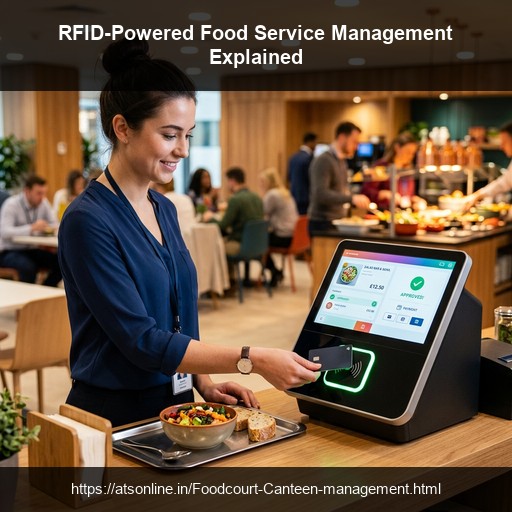
Managing large-scale dining services in corporate canteens, university campuses, and industrial cafeterias has traditionally been complex. Manual reconciliations, payment delays, and cash leakage present constant challenges. However, the introduction of RFID food service solutions is transforming this landscape. By using a smart, closed-loop canteen billing system, organizations can automate transactions, optimize inventory, and deliver a superior dining experience.
What is RFID Food Service Management?
RFID (Radio-Frequency Identification) food service management utilizes smart cards, key fobs, or wristbands embedded with RFID chips to securely store and process user credentials. Instead of exchanging physical cash or swiping magnetic stripe cards, users simply tap their RFID card on a reader at the Point of Sale (POS) terminal to pay for their meals.
This closed-loop system is highly secure because it operates within a private, centralized database managed by the canteen administration software. It bypasses external bank networks, ensuring that transactions are finalized in milliseconds without external dependency.
How a Smart Canteen Billing System Works
The workflow of an RFID-powered canteen billing system is straightforward, yet incredibly efficient:
- Card Issuance: Each employee or student receives a personalized corporate smart card linked directly to their profile.
- Prepaid Recharge: Users load funds onto their cards online, through mobile apps, or at a dedicated physical kiosk.
- Instant Billing: At the food counter, the cashier selects the meal items on an Android POS terminal, and the user taps their card to complete the purchase instantly.
- Real-Time Analytics: Every transaction is automatically synced to the central database, giving administrators instant reports on sales, consumption trends, and stall-wise collections.
Key Benefits of Smart Food Service Management
1. Complete Elimination of Cash Leakage
Traditional cash-based canteens suffer from pilferage, manual billing errors, and complicated ledger reconciliations. Closed-loop payments eliminate cash handling entirely at individual food counters. Canteen managers can easily audit billing activities through real-time dashboard tracking.
2. Unprecedented Transaction Speed
During rush hours, a standard cash transaction or credit card swipe can take up to a minute. In contrast, tapping an RFID smart card takes less than a second. This significant reduction in transaction time prevents bottlenecks, allowing canteens to handle double the guest volume in the same lunch window.
3. Advanced Multi-Vendor Settlement
For canteens that host multiple independent food vendors, reconciling daily sales is a massive chore. RFID food service management software automates this process. The system tracks exactly which items were purchased at which stall and simplifies revenue distribution among vendors.
4. Enhanced Safety and Hygiene
Handling physical currency is inherently unhygienic, especially in a food service environment. A touch-free RFID system ensures that food-handlers and diners do not exchange physical coins or paper bills, maintaining a sanitary and modern environment.
Integrating RFID with Canteen Infrastructure
Implementing an RFID-powered solution does not require replacing your entire setup. Modern food court and canteen management software integrates seamlessly with existing restaurant POS terminals, gate entries, and self-service kiosks. By linking your billing software with a wireless token display system, you can further streamline order collection and pickup processes.
Frequently Asked Questions (FAQs)
Q1: What is closed-loop payment in food service management?
A closed-loop payment system allows users to pay for meals using a pre-loaded, proprietary smart card or digital wallet that can only be redeemed within the organization's specific canteen or food court ecosystem.
Q2: How does an RFID canteen billing system handle connectivity failures?
Advanced RFID canteen systems support offline operations, storing tap transactions locally on the POS terminal and syncing them with the central server when the connection is restored.
Q3: Can multiple food stalls be integrated into a single RFID smart card system?
Yes, a smart food service management system supports multi-vendor environments, allowing employees to tap at different stalls while automatically reconciling accounts for each independent vendor.