Key Takeaway (Direct Answer):
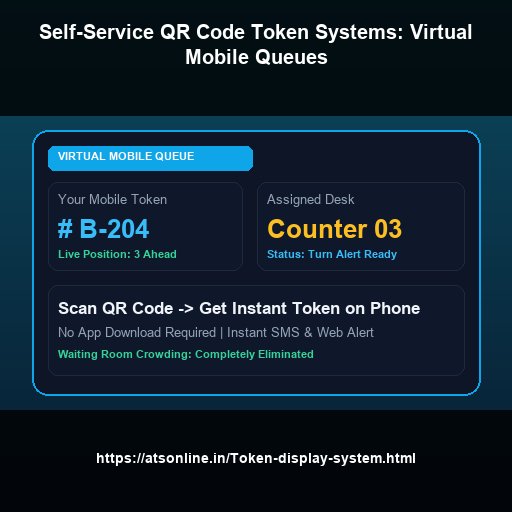
A self-service QR code token system eliminates waiting room crowding by allowing visitors to scan a printed QR standee with any smartphone camera to receive an instant, sequential digital token. Operating 100% in the cloud without app downloads, customers track their real-time queue position (e.g., '3 people ahead of you') and receive vibration and sound alerts when their turn arrives. Paired with ATS Wireless Token Display System (₹6,950/counter/year), businesses eliminate lobby congestion and front-desk friction.
The High Cost of Physical Waiting Room Congestion
In high-footfall environments such as multi-doctor healthcare clinics, diagnostic laboratories, bank branches, and busy quick-service restaurants, physical waiting room crowding creates operational chaos. When visitors are forced to stand shoulder-to-shoulder around reception counters, customer anxiety skyrockets, staff face constant repetitive interruptions asking "How much longer will it take?", and social friction rapidly escalates.
Traditional queue management relies on physical paper ticket dispensers or manual shouting. Visitors are chained to uncomfortable waiting chairs, terrified that if they step outside for fresh air, visit the restroom, or grab a coffee, they will miss their call. This outdated experience can be completely modernized using ATS Wireless Token Display System with built-in Self-Service QR Token Generation and Live Mobile Queue Tracking.
How Self-Service QR Token Generation Works: Step-by-Step
The beauty of a modern cloud-powered virtual queue lies in its frictionless, app-free visitor onboarding. The complete visitor journey requires zero technical training:
- Scan at Entrance: Visitors arrive and scan a high-visibility branded QR standee placed at the facility entrance or reception desk using their standard phone camera.
- Instant Digital Slip: A lightweight, responsive web page loads instantly (no Google Play Store or Apple App Store download required). The visitor selects their requested department or service counter and receives a sequential digital token number (e.g.,
Token #B-204). - Live Queue Telemetry: The mobile screen continuously updates in real-time, displaying live telemetry: current token being served, number of patients/customers ahead in line, and estimated wait duration.
- Vibration & Audio Turn Alert: When the counter operator calls the token from their browser keypad, the customer's smartphone buzzes with a high-priority push vibration and pleasant audio alert instructing them: "Please proceed to Counter 3".
- Simultaneous TV Display Sync: At that exact millisecond, the main Smart TV in the lobby flashes the token with a resonant polyphonic chime and natural voice announcement.
Virtual Mobile Queue vs. Traditional Paper Ticket Dispensers
| Operational Parameter | Legacy Paper Ticket & LED Board | ATS Self-Service QR Virtual Queue |
|---|---|---|
| Visitor Mobility | Locked to the waiting room within earshot of staff shouting | Total freedom to wait in cafeteria, car, or outdoor garden |
| Hardware Investment | ₹30,000–₹60,000 for thermal kiosk, RS485 wires, LED digit boxes | Zero dedicated kiosks; standard QR standee + any Smart TV |
| Annual Software Cost | Expensive proprietary AMC fees & printer paper jams | ₹6,950 per counter / year transparent cloud license |
| Live Queue Visibility | Blind waiting; visitors have no clue when they will be called | Exact real-time position updates ("3 people ahead of you") |
| Lobby Crowding | Severe bottleneck around receptionist and front counter | Dispersed, calm, socially-distanced waiting environment |
Why Eliminating Proprietary Kiosks Saves Thousands in CAPEX
Older queue management vendors force businesses to purchase heavy, expensive metal kiosks with touchscreens and internal thermal printers costing anywhere from ₹40,000 to ₹1,50,000 per entrance. These physical kiosks regularly suffer from jammed mechanical cutters, paper roll runouts, and touch sensor failures during peak Monday morning surges.
By shifting token issuance directly to the customer's personal smartphone via QR codes, businesses completely eliminate hardware depreciation, electrical installation costs, and paper consumable expenses. If an elderly visitor or child arrives without a smartphone, receptionists can still issue a traditional sequential slip or add them to the virtual queue with a single tap on the ATS universal web keypad from any mobile phone, tablet, or desktop computer.
Real-World Impact: How Virtual Queues Transform OPD Clinics and Service Centers
Facilities that have upgraded to virtual mobile queues report dramatic improvements in customer satisfaction and staff efficiency:
- 90% Reduction in Front-Desk Inquiries: Because visitors see their exact queue standing on their phone screen, receptionists no longer spend hours answering repetitive queue status questions.
- Zero Missed Calls: With coordinated phone vibration alerts and loud, multi-room Smart TV voice announcements, patients never sleep through or miss their turn.
- Reduced Infection Transmission: In hospital outpatient departments (OPDs) and diagnostic labs, keeping waiting rooms empty significantly reduces airborne pathogen cross-infection risks among vulnerable patients.
Upgrade to ATS Wireless Token Display System
Turn any Smart TV or monitor into a high-visibility wireless token calling screen with natural human voice announcements, self-service QR queues, and multi-counter routing. Zero proprietary hardware required.
Frequently Asked Questions
Q: Do customers need to download a mobile app to use the QR code token system?
A: No. The ATS QR token system runs 100% in any mobile browser (Safari, Chrome, Firefox). Visitors simply point their phone camera at the QR code, tap the banner, and receive an instant digital token slip with real-time tracking.
Q: What happens if a patient does not have a smartphone?
A: Staff members or receptionists can manually issue tokens using any connected mobile phone, tablet, or PC browser. The system can also link with standard USB or Bluetooth thermal slip printers to generate a physical token ticket with a printed queue number.
Q: How does the customer know when it is their turn?
A: The customer's phone screen automatically updates with an audible alert and vibration notification indicating their assigned counter. Simultaneously, the main lobby Smart TV flashes the token number and plays a clear human voice audio announcement.
Q: How much does the ATS QR token system cost?
A: The ATS Wireless Token Display System with integrated Self-Service QR Token Generation costs just ₹6,950 per counter per year. There are zero proprietary hardware lock-ins or hidden maintenance fees.
Q: Can the QR token system handle multiple doctors or departments?
A: Yes. Upon scanning the QR code, visitors can select from multiple configured departments (e.g., General Physician, Pediatrics, Pathology Lab, Billing Desk). Each counter operator manages their respective departmental queue independently.
For live demos, multi-branch deployments, or enterprise custom setups, contact Advance Technology Systems at +91-9810078010 or email ats.fnb@gmail.com.