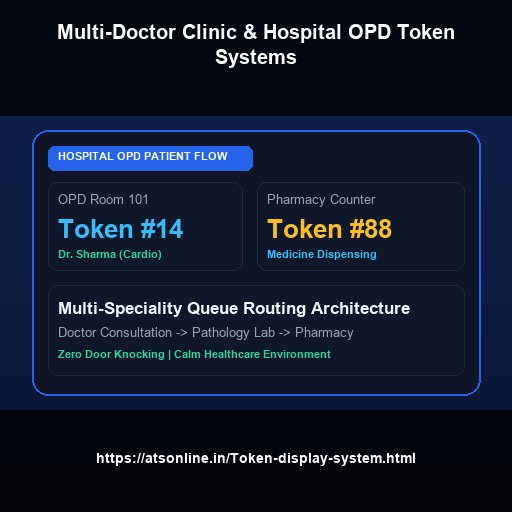
Key Takeaway (Direct Answer):
A hospital OPD token display system manages the end-to-end patient journey by assigning a single digital identifier at triage reception and routing patients smoothly across multiple doctor consultation rooms, sample collection labs, and the pharmacy. Powered by ATS Wireless Token Display (₹6,950/counter/year) on standard waiting room Smart TVs, hospitals eliminate noisy door-knocking, maintain patient privacy, and reduce perceived waiting times by over 40%.
The Patient Journey Bottleneck in Outpatient Departments (OPD)
Hospitals and multi-speciality polyclinics face unique operational complexities that standard retail queues never encounter. A single patient visit is rarely linear: it involves initial registration, nursing vitals assessment, physician consultation, diagnostic pathology or radiology tests, a second review consultation, and finally medication dispensing at the hospital pharmacy.
Without an integrated Hospital OPD Token Display System, this multi-step journey degenerates into chaos. Anxious patients crowd outside doctor consultation chambers, repeatedly knocking on doors or peeking through frosted glass. Overburdened nurses act as security guards rather than caregivers, shouting patient names over crowded lobbies while privacy-sensitive health records risk public exposure.
The Connected 4-Stage Clinical Workflow Architecture
Modern healthcare facilities replace chaotic waiting areas with a connected, cloud-synchronized patient routing workflow:
- Stage 1: Central Registration & Triage: Upon arrival, the reception desk generates an OPD token (or the patient scans a self-service QR standee). The system assigns the token to the appropriate speciality doctor queue (e.g., Cardiology, Pediatrics, Orthopedics).
- Stage 2: Doctor Chamber Calling: Inside the consultation room, the physician views their live patient list on their laptop, tablet, or smartphone. With a single tap on the "Next Patient" button, the lobby TV calls the patient by token number with a clear human voice announcement: "Token 14, please enter Room 102 - Dr. Sharma".
- Stage 3: Diagnostic Lab & Radiology Routing: If the physician orders blood tests or an X-ray, the patient's token is digitally transferred to the Pathology Queue without issuing new paperwork. The laboratory screen calls the patient when the phlebotomist is ready.
- Stage 4: Pharmacy Dispensing Handoff: Once prescriptions are entered, the hospital pharmacy's multi-counter display alerts the patient when their medications are packaged and ready for collection at Dispensing Counter 2.
Departmental Routing Matrix for Multi-Speciality Clinics
| Hospital Department | Display Configuration | Staff Calling Device | Patient Experience Benefit |
|---|---|---|---|
| Central OPD Waiting Lounge | Large 55" Smart TV running Multi-Counter Matrix + Health Tips | Central Reception Desk (PC/Tablet) | Consolidated view of all active doctor rooms; eliminates hallway crowding |
| Doctor Chamber Entrance | 32" Smart Monitor or Tablet displaying current & next patient | Doctor's desk PC or smartphone browser | Guarantees 100% patient confidentiality; eliminates door knocking |
| Pathology & Sample Collection | Counter-wise Token Screen with polyphonic chime | Phlebotomist mobile phone or barcode scanner | Organized, hygienic blood drawing queues without standing lines |
| Pharmacy & Billing Counter | Split-screen: Ready for Pickup Tokens + Medicine Tips | Pharmacist billing terminal browser | Patients sit comfortably while prescriptions are prepared |
Enhancing Patient Privacy and Compliance (NABH Standards)
Healthcare accreditation bodies like the National Accreditation Board for Hospitals & Healthcare Providers (NABH) emphasize patient dignity, confidentiality, and infection control. Shouting out full patient names, diagnoses, or personal details across a crowded hospital corridor violates basic privacy expectations.
By shifting to an anonymized numeric or alphanumeric token system (e.g., Token A-105), healthcare facilities uphold patient confidentiality while maintaining flawless operational flow. Furthermore, because patients can track their queue progress on their own smartphones via ATS virtual queue QR integration, immune-compromised patients can wait outdoors or in open-air hospital cafeterias, dramatically lowering hospital-acquired infection (HAI) risks.
Trusted by Healthcare Leaders: Apollo Pharmacy, Godrej Hospital & More
ATS queue management technology is deployed in leading clinical facilities across India, including Apollo Pharmacy and Godrej Hospital. At an accessible price point of ₹6,950 per counter per year, hospitals replace high-maintenance legacy hardware with an enterprise cloud solution that requires zero on-premise server maintenance, supports unlimited TV screens, and deploys across the entire hospital in under an hour.
Upgrade to ATS Wireless Token Display System
Turn any Smart TV or monitor into a high-visibility wireless token calling screen with natural human voice announcements, self-service QR queues, and multi-counter routing. Zero proprietary hardware required.
Frequently Asked Questions
Q: Can one central waiting room TV display multiple doctors at once?
A: Yes. The ATS Multi-Counter Matrix display mode divides the Smart TV screen into dedicated panels, showing each doctor's chamber number, doctor name, and current patient token simultaneously.
Q: Can doctors call patients directly from their personal mobile phones?
A: Yes. Doctors can access the lightweight calling keypad in any browser on their mobile phone, iPad, or desktop computer. Calling or recalling a patient requires just a single tap.
Q: Does the system support natural voice calling in Indian languages?
A: Yes. The software features natural human speech announcements in English, Hindi, and regional languages, ensuring patients of all literacy levels understand their turn instructions.
Q: Can tokens be transferred from a doctor to the pharmacy without re-registering?
A: Yes. Staff can transfer tokens seamlessly between departments (e.g., Doctor Room -> Diagnostic Lab -> Pharmacy) with complete historical wait-time tracking.
Q: What is the annual software licensing cost for a clinic?
A: The ATS Wireless Token Display System costs ₹6,950 per counter per year. For a 4-doctor clinic with a pharmacy, licenses are simple, transparent, and include all cloud updates and support.
For live demos, multi-branch deployments, or enterprise custom setups, contact Advance Technology Systems at +91-9810078010 or email ats.fnb@gmail.com.