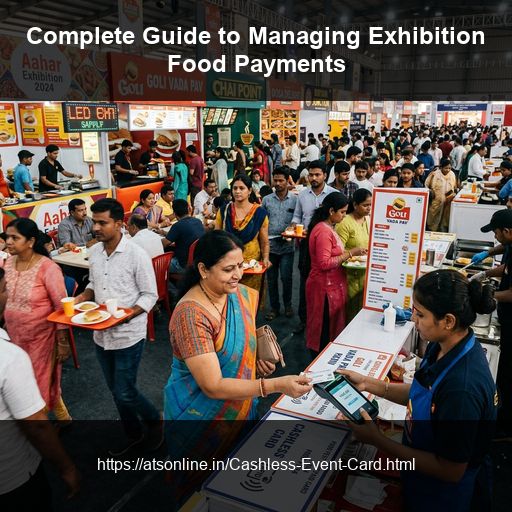
Managing food stall payments at a large-scale exhibition is one of the most operationally intense challenges an event organizer can face. When thousands of attendees converge on a food court featuring dozens of independent vendors, traditional payment methods simply collapse under the pressure.
Cash transactions lead to cripplingly slow queues, hygiene concerns, and widespread revenue leakage. UPI and mobile wallets, while modern, frequently fail due to network congestion when thousands of smartphones compete for the same cellular towers. Paper coupon booklets—long considered the standard alternative—are plagued by theft, forgery, and nightmare reconciliation scenarios at the end of the event.
In 2026, the industry standard for exhibition food courts has decidedly shifted toward Cashless Prepaid RFID Cards. This technology centralizes cash collection, accelerates stall operations, operates completely offline, and provides organizers with absolute financial control. This guide will walk you through the entire lifecycle of managing exhibition food payments using a cashless prepaid system.
1. The Architecture of a Cashless Exhibition
Before diving into the operational flow, it is essential to understand the architecture of a cashless payment system. The ATSonline Cashless Event System relies on three primary pillars:
- The Central Top-Up Counters: This is the only place in the entire exhibition where actual money (cash, credit cards, or UPI) changes hands. Here, visitors exchange their funds for a loaded RFID smart card.
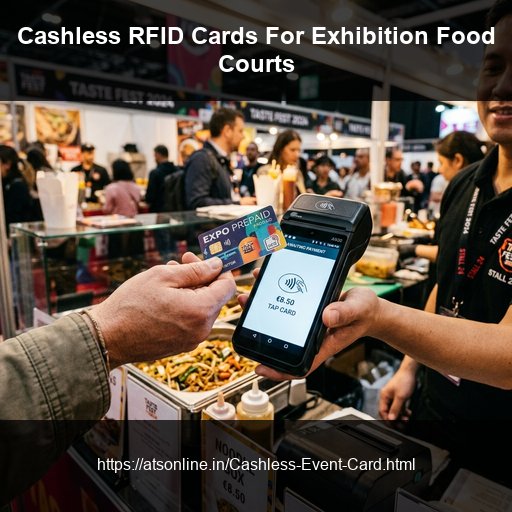
- The Food Stalls (Vendor Endpoints): Independent food vendors are stripped of cash-handling responsibilities. Instead, they are equipped with an Android POS terminal or a mobile device paired with an NFC/RFID reader. Their only job is to serve food and tap the visitor's card to deduct the purchase amount.
- The Local Server / Master Control: A central laptop or PC acts as the brain of the operation. Connected via a local, offline wireless network (WLAN), it tracks every rupee loaded, every tap made, and the real-time revenue of every single vendor.
2. The Visitor Experience: From Entry to Meal
A cashless system dramatically improves the visitor experience by eliminating the friction of payment at the actual point of food service. Here is how the flow looks from the perspective of an attendee:
Acquiring the Card
Upon entering the exhibition or the designated food court area, the visitor approaches a Top-Up Counter. They hand the cashier ₹1,000. The cashier taps a blank, branded RFID card on a reader, instantly loading it with ₹1,000 worth of digital credits, and hands it to the visitor. This process takes less than 15 seconds. The visitor can now put their physical wallet away for the rest of the day.
Purchasing Food
The visitor walks up to a busy biryani stall. They order a plate for ₹250. Because the vendor does not need to calculate change, handle dirty currency notes, or wait for a slow UPI confirmation text, the service is incredibly fast. The vendor enters "250" on their Android POS, the visitor taps their smart card against the back of the terminal, and a green light instantly confirms the transaction. The visitor's card balance is now ₹750.
Topping Up and Refunds
If the visitor runs out of funds, they simply return to any Top-Up Counter, hand over more cash or make a UPI payment, and the cashier taps their card to instantly add the new balance. At the end of the exhibition, if the visitor has a remaining balance (e.g., ₹150), they can return the card to the counter for an instant refund. The organizer can also choose to make the cards non-refundable, depending on the event policy.
3. The Organizer's Advantage: Total Financial Control
While visitors enjoy the speed and convenience, the true power of the Cashless Prepaid Card system lies in the control it grants the exhibition organizer.
Eliminating Vendor Fraud and Leakage
In a traditional cash or direct-UPI setup, organizers rely on the honesty of independent vendors to report their sales accurately, especially if the organizer is taking a percentage cut of the revenue. Vendor underreporting is rampant. With a cashless system, the organizer holds 100% of the funds in a centralized account. Vendors cannot process a transaction without it being recorded in the central database. Revenue leakage drops to absolute zero.
100% Offline Reliability
Large exhibitions often suffer from severe network congestion. When 10,000 people are in a single hall, public 4G/5G networks crawl to a halt, causing UPI payments to fail and POS machines to time out. The ATSonline Cashless System operates on a closed, local area network. It does not require an active internet connection to process transactions between the stalls and the master server. Payments are processed in milliseconds, guaranteed, regardless of outside network conditions.
Instant Reconciliation and Payouts
When the exhibition closes for the day, the historical nightmare of counting paper coupons or matching hundreds of vendor cash boxes is eliminated. The organizer simply clicks a button on the master server to generate the "End of Day Report." This report breaks down the exact sales volume of every vendor, the total money loaded, and the total money refunded. Payouts can be calculated and distributed immediately, minus the organizer's commission, ensuring total transparency and vendor trust.
4. Setup and Implementation Best Practices
Implementing a cashless system requires minimal hardware but careful logistical planning. Follow these best practices for a seamless exhibition:
- Ratio of Top-Up Counters: Do not underestimate the initial rush. A general rule of thumb is to have one Top-Up cashier for every 500 expected daily visitors to prevent bottlenecks at the entrance.
- Branding: Use the RFID cards as a marketing asset. Print the exhibition logo, sponsor branding, and basic instructions on the cards. Many visitors will keep them as souvenirs, providing lasting brand exposure.
- Staff Training: The system is designed to be highly intuitive, but brief training is essential. Ensure Top-Up cashiers understand the refund process, and ensure stall vendors know how to quickly check a visitor's balance before attempting a transaction.
- Network Infrastructure: Invest in high-quality, enterprise-grade Wi-Fi routers to blanket the food court area. Even though the system is offline, a strong, stable local wireless connection between the stalls and the master server is vital for real-time synchronization.
5. Why Cashless is the Future of Exhibitions
The transition to cashless payments is no longer a luxury for premium events; it is a fundamental requirement for operational efficiency. By centralizing the money flow, organizers reduce their security risks, eliminate the hygiene issues of handling cash near food, and gain access to incredibly detailed analytics regarding visitor spending habits and popular stalls.
If you are managing an exhibition, food festival, or large-scale corporate event, transitioning to a Cashless Prepaid Card system will be the single most impactful operational upgrade you can make.
Frequently Asked Questions
Upgrade Your Exhibition Payments
Eliminate fraud, speed up queues, and take total financial control with ATSonline's Cashless Prepaid Card System. Built specifically for high-volume exhibitions and food festivals.