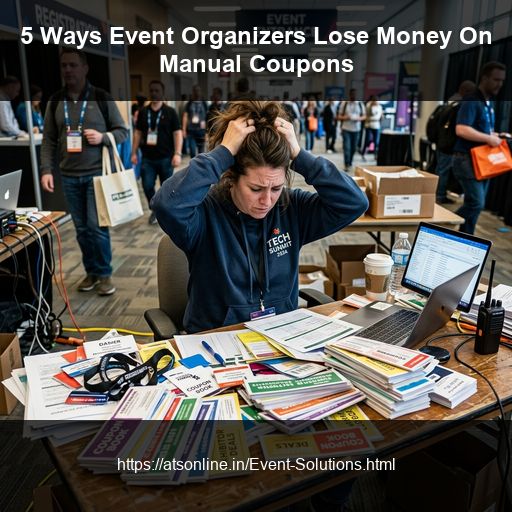
If you are still using pre-printed paper coupon booklets for your food festival, college fest, or exhibition, you are almost certainly losing money. You might not see it on the balance sheet explicitly labeled as "Losses," but it is there, quietly eroding your profit margins.
For decades, the event industry in India relied on manual coupon booklets because there was no better alternative. However, treating paper slips as equivalent to cash comes with intrinsic risks. From the moment you send the design to the printing press to the exhausting hours spent counting slips at the end of the night, revenue leakage is happening at every step.
Here are the 5 critical ways manual coupons are costing you money, and how switching to an ATSonline digital ticketing system stops the bleeding instantly.
1. Wasted Pre-Printing Costs
The financial drain of paper coupons begins weeks before your event even starts. Organizers must estimate footfall and order booklets from a printing press in advance. Because running out of coupons mid-event is a logistical nightmare, organizers naturally over-order.
If you expect 2,000 visitors, you print 3,500 booklets "just in case." If the weather is poor and only 1,500 people show up, you are left with 2,000 completely useless booklets. That is thousands of rupees in sunk printing costs sitting in a cardboard box, destined for the recycling bin. Because booklets often have dates or specific event branding, they cannot even be saved for the next year.
The Solution: On-Demand Printing
With an EventCouponPrint Thermal System, you print exactly what is purchased, the exact moment it is purchased. You load a generic roll of thermal paper, and the software dynamically prints your logo, the denomination, and the date onto the slip. Zero wasted inventory, zero over-ordering.
2. Staff Theft and Counterfeiting
A printed coupon booklet worth ₹500 is fundamentally a ₹500 currency note that lacks Reserve Bank security features. If a box of 100 booklets goes missing from the ticketing booth, you have just lost ₹50,000 in revenue value.
Worse than physical theft is the risk of counterfeiting. It is incredibly easy for unscrupulous staff members or attendees to take a generic coupon design to a local print shop and run off hundreds of duplicates. During the chaos of a busy food festival, food stall vendors do not have the time to inspect the paper stock or the ink quality of every ₹100 slip handed to them.
The Solution: Unique Barcodes & RFID
Digital systems eradicate counterfeiting. In an ATSonline thermal setup, every printed coupon features a cryptographically unique barcode. When the vendor scans it, the central database marks it as "Used." A duplicate photocopy will instantly trigger an "Invalid/Already Used" alert on the vendor's scanner. Alternatively, using Cashless RFID Cards completely removes paper from the equation, locking funds securely behind encrypted smart chips.

3. Revenue Leakage During Vendor Reconciliation
At 11:00 PM, after a grueling 14-hour event, the nightmare of reconciliation begins. Event organizers must sit down with every food stall vendor and manually count thousands of sticky, torn, food-stained paper coupons to determine how much the vendor is owed.
Human error in this environment is unavoidable. Slips stick together, tallies are miscalculated, and vendors frequently dispute the final count. "I had 500 coupons, not 480," is a common argument. In the interest of maintaining relationships, organizers often absorb these discrepancies, paying out more than they actually collected.
The Solution: Automated End-of-Day Reports
Digital ticketing systems calculate payouts automatically. Because every scan at a vendor stall is recorded in the central server, the organizer simply clicks "Generate Report" at the end of the night. The software instantly produces a PDF detailing exact revenue per vendor, down to the single rupee. Disputes are eliminated by mathematical certainty.
4. Lost Sales Due to Slow Queues
Revenue is a function of throughput. The faster you can process transactions, the more money you make. Manual coupon booklets are inherently slow.
Consider a visitor who wants to buy ₹350 worth of coupons. The cashier must physically tear out a ₹100 booklet, a ₹200 booklet, and a ₹50 booklet, calculate the total, take the cash, and return change. This takes 45 to 60 seconds per customer. When queues grow excessively long, frustrated attendees simply give up and leave the food court, resulting in direct lost sales.
The Solution: Rapid Digital Transactions
Whether you use thermal printing or cashless RFID cards, the transaction speed drops to under 5 seconds. The cashier types "350" into the POS software, takes the cash, and either hits "Print" to instantly generate a single ₹350 barcode slip, or taps an RFID card to load the balance. Faster queues equal happier visitors and significantly higher overall event revenue.
5. Zero Post-Event Analytics
When you use paper coupons, the data ends when the coupon is thrown away. You have no idea which food stalls were the most popular at 1:00 PM versus 8:00 PM. You don't know the average spend per visitor. You don't know the peak transaction times at the entry gate.
Without data, you are flying blind when planning your next event. You cannot negotiate better vendor commission rates because you don't have hard proof of their sales volume. You cannot optimize your staff shifts because you don't know exactly when your peak hours occurred.
The Solution: Comprehensive Data Dashboards
ATSonline systems provide a wealth of analytics. Organizers gain access to dashboards showing hourly sales trends, top-performing vendors, average load amounts, and exact refund metrics. This data is invaluable for scaling your business, optimizing marketing spend, and securing high-profile vendors for future events.
Frequently Asked Questions
Stop the Revenue Leakage Today
Upgrade from risky paper booklets to an ATSonline Digital Ticketing System. Choose between secure on-demand thermal printing or seamless cashless RFID cards.