The Architect's Recommendation
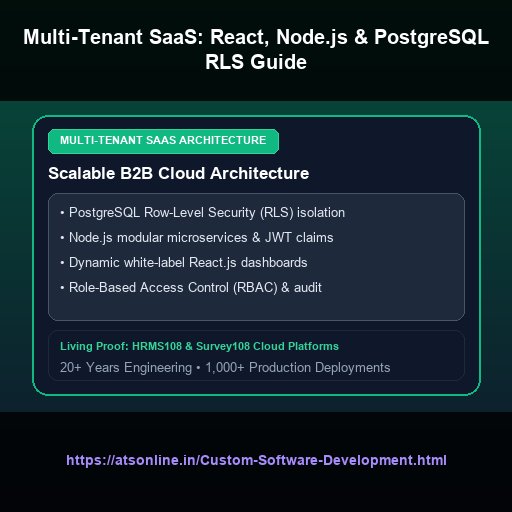
Building an enterprise B2B SaaS platform requires solving the fundamental tension between infrastructure cost efficiency and strict data security. While isolated databases per customer provide maximum isolation, they create massive operational overhead when scaling to hundreds of tenants. The gold standard for modern B2B SaaS is PostgreSQL with native Row-Level Security (RLS), paired with Node.js AsyncLocalStorage tenant context and a modular React component library supporting dynamic theming.
1. Comparing the 3 Database Tenancy Models
Every multi-tenant software system begins with a core database design decision: how to keep Customer A's private records completely segregated from Customer B's records.
Model 1: Database-per-Tenant (Silo Architecture)
Each customer receives their own distinct database instance.
- Pros: Absolute isolation; simplest disaster recovery per client.
- Cons: Prohibitive cloud infrastructure costs, complex schema migrations across hundreds of databases, and inefficient database connection pooling.
- Best For: Highly regulated banking or healthcare clients willing to pay 5x-10x premium hosting fees.
Model 2: Schema-per-Tenant (Bridge Architecture)
A single database contains individual PostgreSQL schemas for each tenant.
- Pros: Moderate isolation; shared database hardware resources.
- Cons: Running
prisma migrateor SQL migrations across 500 schemas can take hours; connection pool exhaustion still looms. - Best For: Platforms with 10 to 50 large enterprise accounts.
Model 3: Shared Database with PostgreSQL RLS (The Production Gold Standard)
All tenants share common tables containing a indexed tenant_id column, enforced by the database kernel via Row-Level Security.
- Pros: Lowest hosting cost per tenant; instant single-command schema migrations; massive scale capability; zero risk of developer-induced query leaks.
- Cons: Requires disciplined database security setup and session variable binding.
- Best For: High-growth B2B SaaS platforms targeting hundreds or thousands of corporate clients.
2. Implementation Blueprint: PostgreSQL Row-Level Security (RLS)
With RLS, the database engine enforces tenancy rules automatically. Even if a junior developer writes SELECT * FROM invoices without a tenant filter, PostgreSQL intercepts the query and strictly returns only the rows permitted for that authenticated session.
3. The Node.js Tenant Context Middleware
In a Node.js microservice architecture, handling concurrent requests from different tenants requires foolproof session tracking. We utilize Node's native AsyncLocalStorage to maintain tenant context across asynchronous call stacks:
4. React White-Label Theming & Dynamic Branding
Enterprise B2B clients demand custom corporate identities. The React frontend reads tenant branding metadata upon login and dynamically injects CSS root properties:
- Dynamic CSS Variables: Brand colors (
--brand-primary,--brand-accent), button radius, and typography apply instantly across UI components. - Custom Domain Routing: Automated SSL certificate provisioning via Let's Encrypt / Cloudflare for custom client CNAME domains (e.g.
portal.clientname.com). - Granular Role-Based Access Control (RBAC): Hierarchical permissions defining what administrators, managers, and frontline employees can view or edit.
5. Living Proof: ATS Multi-Tenant Platforms
Advance Technology Systems has engineered multi-tenant software platforms serving high-volume production operations:
Multi-Vendor Food Court POS
Multi-tenant vendor settlement engine isolating sales ledgers, commission cuts, and menu items across 50+ independent food brands in a single mall.
Enterprise Feedback Engine (Survey108)
Multi-tenant client survey platform processing high-throughput customer satisfaction ratings with automated analytics dashboards.
Architect Your B2B SaaS Platform with Confidence
Avoid costly database rewrites and security breaches before you launch. Partner with senior enterprise architects who have delivered scalable multi-entity systems for over 20 years.
Recommended Architecture Reading
SaaS Architecture Tenets
- PostgreSQL Row-Level Security (RLS)
- AsyncLocalStorage Tenant Context
- Zero-Cross-Tenant Query Bleed
- White-Label React Component System
- 100% Client Source Code Ownership