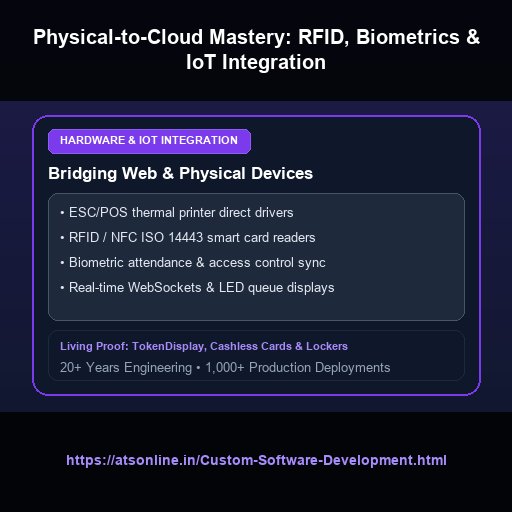
The Engineering Solution
Most web development agencies struggle with hardware integration because browser runtimes deliberately prevent direct access to OS-level serial ports (RS-232, COM) and raw USB sockets. ATS solves this by employing a hybrid architecture: a lightweight local Node.js driver daemon that interfaces with native hardware drivers and streams bidirectional events to React.js frontends via secure WebSockets. For controlled modern browsers, we leverage the native Web Serial and WebUSB APIs for driverless peripheral integration.
1. The Architectural Challenge: The Browser Sandbox Barrier
When migrating business applications from legacy Windows desktop forms to cloud web apps, the biggest stumbling block is almost never business logic—it is physical peripherals. In physical point-of-sale, industrial warehousing, and corporate attendance, software must talk directly to:
- Mifare RFID smart card reader/writers over USB or serial COM.
- High-speed ESC/POS thermal receipt printers that must print silently without triggering operating system print dialogs.
- Industrial digital weighing scales streaming weight measurements continuously at 9600 baud.
- Biometric fingerprint and facial recognition scanners communicating over TCP/IP sockets.
- Electronic LED token displays and queue buzzers.
2. The 3 Proven Integration Topologies
Topology A: The Local Node.js WebSocket Bridge (Recommended)
A lightweight Node.js executable runs as a local background Windows Service or systemd daemon. It utilizes native Node packages (such as serialport, node-printer, or net.Socket) to interact with the device drivers. The React frontend maintains a persistent WebSocket connection to ws://127.0.0.1:port.
Benefits: Zero browser permission prompts, sub-10ms response latency, cross-browser compatibility, and completely silent background thermal printing.
Topology B: Native Web Serial & WebUSB APIs
In Chromium-based browsers (Chrome, Edge), web applications can request direct device pairing using navigator.serial.requestPort() or navigator.usb.requestDevice().
Once approved once by the operator, the JavaScript thread reads raw Uint8Array byte buffers directly from the serial stream and sends command sequences without any local middleware installed.
Benefits: Zero client installation; ideal for managed Chromebooks, touch POS terminals, and modern laptops.
Topology C: Network Socket & MQTT Broker Architecture
For distributed hardware—such as multiple biometric gate turnstiles, IoT token displays, or kitchen display screens—devices connect directly to the local LAN via Ethernet or Wi-Fi. A central Node.js backend maintains persistent TCP sockets or an MQTT message broker, instantly dispatching events across all screens.
3. Deep-Dive: Integrating Specific Peripherals
A. RFID & Smart Card Integration (Mifare 1K / Desfire)
In corporate food courts, sports clubs, and cashless campuses, software cannot afford 3-second payment latencies. ATS engineers low-level card protocols that authenticate cryptographic sector keys, read the encrypted customer wallet balance, decrement the meal amount, and write back the cryptographic checksum in less than 50 milliseconds.
B. ESC/POS Silent Thermal Receipt Printing
HTML printing produces blurry barcodes, inconsistent margins, and unwanted page headers. Our printing microservice formats raw binary ESC/POS streams directly:
0x1B 0x40- Hardware Initialize.0x1D 0x6B- Native 2D QR Code Generation for digital payment verification.0x1B 0x70- Cash Drawer Kick Pulse triggering instantaneous solenoid release.0x1D 0x56 0x01- Automated partial or full paper knife cut.
C. Continuous Weighing Scale Parsing
In retail and food production, weighing scales stream ASCII packets continuously (e.g. ST,GS,+001.450KG\r\n). A naive implementation floods the UI thread. ATS implements regex debounce buffers inside Node.js worker threads to isolate stable readings before updating the React billing state.
4. Living Proof: ATS Production Hardware Deployments
Advance Technology Systems has pioneered hardware-software integration across India since 2000. Our production platforms bridge hardware and software every single day:
Cashless Food Court POS
High-concurrency RFID reader integration processing hundreds of orders per minute across multi-vendor counters.
IoT Token Display System
Microcontroller-driven electronic token boards and audio voice synthesis modules linked to POS billing terminals.
HRMS108 Biometric Suite
Automated TCP/IP log harvesting from biometric fingerprint and face scanners directly into central payroll engines.
Electronic Locker Management
Relay controller integration managing digital solenoids for automated secure locker access via RFID cards and QR codes.
Need Custom Software That Talks to Physical Hardware?
Do not let hardware constraints stop your web migration. Discuss your RFID, serial device, biometric terminal, or weighing scale integration directly with ATS senior engineers.
Recommended Architecture Reading
ATS Hardware Engineering
- RS-232 & USB Serial Protocol Specialists
- Sub-50ms RFID Cryptographic Validation
- Silent ESC/POS Thermal Printing
- TCP/IP Biometric Attendance Integration
- 100% Client Source Code Ownership