The Architect's Summary
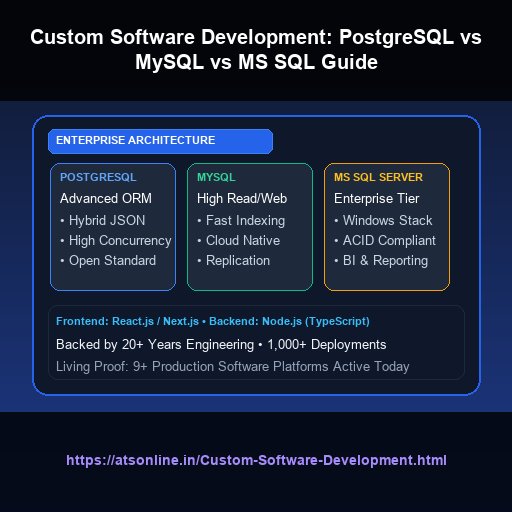
Building enterprise custom software with React.js and Node.js requires a rock-solid relational database. Selecting the wrong engine leads to transaction deadlocks, high licensing overhead, or painful schema redesigns. PostgreSQL is the premier choice for complex schemas, JSON/relational hybrids, and multi-tenant isolation. MySQL excels in high-read throughput and rapid horizontal scaling. Microsoft SQL Server dominates corporate enterprise ecosystems requiring tight Windows, Azure, and legacy .NET integration.
1. The Real-World Flaw of Trendy Tech Stacks
Over the last decade, junior development studios have pushed pure NoSQL (e.g. MongoDB) for every project, claiming schema-less agility. In real business operations—such as multi-lane retail billing, statutory payroll calculations, inventory batch depletion, and financial invoicing—this approach frequently ends in disaster.
When handling transactions, taxes, and ledgers, mathematical consistency is non-negotiable. You cannot tolerate phantom reads, split-brain records, or missing foreign key constraints. That is why mature custom software development teams anchor mission-critical platforms in battle-tested relational databases.
2. The 3 Enterprise Database Giants Compared
PostgreSQL: The Open-Source Powerhouse
PostgreSQL is often hailed as the world's most advanced open-source database. It combines standard relational tables with native JSONB indexing, allowing you to store unstructured documents alongside strictly typed financial ledgers.
Ideal For:
- Multi-tenant enterprise SaaS applications with row-level security (RLS).
- Complex analytical queries, window functions, and recursive Common Table Expressions (CTEs).
- Geospatial tracking and fleet logistics via PostGIS.
- Zero-licensing cost deployments on AWS RDS, Azure Database, or bare-metal Linux.
MySQL: High-Read Velocity & Ubiquity
MySQL powers the vast majority of web infrastructure worldwide. With the InnoDB storage engine, it delivers high-velocity read performance, straightforward read-replica replication, and universal cloud support.
Ideal For:
- Read-heavy portals, consumer-facing ordering systems, and high-traffic catalogs.
- Straightforward horizontal scale-out with read replicas.
- Projects requiring universal developer familiarity and widespread tool support.
Microsoft SQL Server: Corporate Enterprise Integration
Microsoft SQL Server remains the backbone of medium-to-large corporate IT environments. It offers unmatched diagnostic profiling, Always On availability clusters, and seamless integration with Active Directory and enterprise ERPs.
Ideal For:
- Legacy desktop modernization projects where existing data resides in MS SQL.
- Corporates requiring official Microsoft enterprise support agreements.
- Native interoperability with PowerBI reporting suites and SSIS data warehouses.
3. Why Full-Stack React & Node.js Unlocks Maximum ROI
Pairing either PostgreSQL, MySQL, or MS SQL Server with a React.js frontend and Node.js backend creates an extraordinarily cohesive engineering environment:
- Zero Context Switching: Developers write TypeScript from database models through API contracts to UI components.
- Asynchronous Connection Pools: Node.js handles incoming HTTP, WebSocket, and IoT events concurrently without blocking database transactions.
- Lightweight Deployments: Dockerized Node.js containers boot in seconds, dramatically reducing AWS or Azure infrastructure bills compared to legacy application servers.
4. Living Proof: How ATS Engineers Production Database Reliability
Our database design principles aren't theoretical. Over 20 years, ATS has built systems that process millions of rupees in daily transactions:
- Our Cashless Canteen Engine processes thousands of sub-second RFID transactions per hour without locking table rows.
- Our HRMS108 Suite computes complex tax slabs, deductions, and attendance reconciliation for hundreds of employees simultaneously.
- Our Legacy Modernization Practice safely migrates decades-old databases to modern relational engines without losing a single record.
Need Help Choosing the Right Architecture?
Schedule a technical discovery session with our senior database architects. We will evaluate your data models, query patterns, and budget to design an optimal, future-proof stack.
About ATS
Advance Technology Systems (ATS) delivers bespoke enterprise software engineering, cloud architecture, and legacy modernization. Operating continuously since 2000.
ats.fnb@gmail.com