Executive Summary: The Modernization Imperative
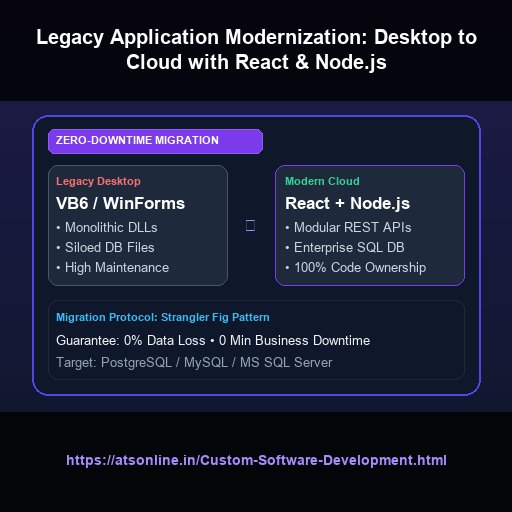
Legacy desktop systems built on Visual Basic 6, Visual FoxPro, Delphi, or early .NET WinForms hold decades of customized company rules. However, they trap organizations in on-premise hardware silos, lack mobile accessibility, and face severe security risks. Modernizing these systems into a React.js frontend and Node.js microservices backend on an enterprise relational database (PostgreSQL, MySQL, or MS SQL Server) unlocks instant scalability—provided you use the Strangler Fig incremental migration pattern to eliminate downtime and prevent data loss.
1. Why Complete "Big Bang" Rewrites Fail
When non-technical leadership decides to modernize an aging enterprise tool, their first impulse is often to hire an agency to "rewrite the whole thing from scratch." Almost 70% of these big-bang rewrites collapse before reaching production.
Why? Because 15 to 20 years of operational reality have introduced hundreds of undocumented edge cases: specialized tax handling, custom discount overrides, branch-specific inventory reconciliations, and vendor-specific invoice formatting. When junior developers build a greenfield application, they inevitably miss these subtleties. When cutover day arrives, the business grinds to a halt.
2. The Solution: The Strangler Fig Modernization Pattern
At Advance Technology Systems (ATS), having built software since the year 2000, we follow the Strangler Fig architectural pattern. Named after vines that gradually envelop and replace a host tree, this methodology ensures safe, risk-free transformation:
The 4-Stage Zero-Downtime Migration Architecture
- Reverse Engineering & Logic Audit: We decompile/inspect legacy source binaries and database procedures to document all active business rules.
- Dual-Run Database Synchronization: We establish a real-time CDC (Change Data Capture) bridge between your legacy tables and a modern PostgreSQL, MySQL, or MS SQL Server database.
- Incremental React & Node.js Module Deployment: We build new modules (e.g., Reporting, Order Entry, Dispatch) in React and Node.js that read and write to the synchronized database alongside the legacy desktop client.
- Gradual User Migration: Users transition department by department to the cloud web interface. Once 100% of workflows operate on the new stack, the legacy client is decommissioned.
3. Why React.js & Node.js Are the Gold Standard for Modernization
Legacy desktop interfaces were prized for their keyboard shortcuts, rapid grid data entry, and snappy responsiveness. Moving to a sluggish, poorly-optimized web app frustrates operators.
By combining React.js on the frontend with Node.js on the backend:
- Sub-Millisecond UI State Updates: React's virtual DOM and modern component libraries replicate desktop grid editing speeds with full keyboard navigation support.
- Unified TypeScript Language: Data types, validation schemas, and calculation engines are shared seamlessly between frontend forms and backend Node.js APIs.
- Asynchronous High Concurrency: Node.js handles thousands of concurrent requests across multi-branch operations without the memory bloat of legacy thread-per-client architectures.
- Device Agnostic: Operators can access the system from Windows PCs, MacBooks, tablets, and smartphones without installing client software.
4. Enterprise Database Migration: Preserving Historical Data
Your historical database contains years of customer transaction records, GST tax filings, inventory histories, and audit ledgers. A flawed migration can lead to devastating legal and operational liabilities.
We implement automated migration scripts with automated reconciliation checks. Before cutover, automated suites compare account totals, trial balances, and inventory counts between legacy and modern tables down to the exact paisa. Whether targeting PostgreSQL, MySQL, or Microsoft SQL Server, your data integrity is mathematically verified.
5. The ATS Advantage: 20+ Years of Systems Evolution
Unlike new design agencies that have only ever seen cloud dashboards, ATS lived through the desktop software era. We engineered and deployed early desktop billing and POS systems in the early 2000s, and successfully evolved them into the modern cloud platforms running today across 1,000+ facilities—such as our HRMS108 Suite and Cashless Canteen Management Systems.
Ready to Audit & Modernize Your Legacy Software?
Schedule a confidential, direct technical consultation with our senior software architects. We will evaluate your codebase, identify bottlenecks, and outline a zero-disruption migration roadmap.
Frequently Asked Questions
Can we keep using our existing barcode scanners, thermal receipt printers, and RFID cards?
Yes! Drawing from 20+ years of hardware integration experience, ATS creates background communication bridges that connect modern React web applications directly to your existing ESC/POS thermal printers, USB barcode scanners, RFID readers, and digital displays.
What is the typical timeframe for a legacy modernization project?
Initial discovery, schema architecture, and high-priority pilot modules are typically delivered within 6 to 10 weeks. Complete enterprise cutovers depend on the size of the codebase, with working modules deployed every two weeks.
About the Author
Advance Technology Systems (ATS) is a pioneer in enterprise software engineering with 20+ years of continuous innovation and over 1,000 installations across India and international markets.
ats.fnb@gmail.com