The Pragmatic Truth
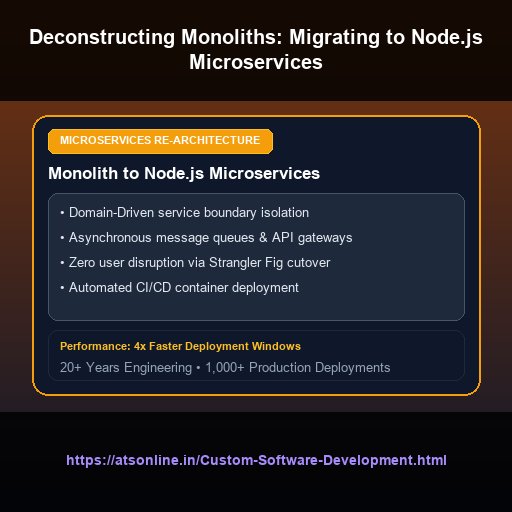
The biggest mistake development teams make when modernizing legacy systems is immediately splitting everything into dozens of tiny microservices. This introduces severe network latency, distributed transaction bugs, and massive DevOps friction. At ATS, our pragmatic strategy is: first organize your code into a disciplined Modular Monolith using Domain-Driven Design (DDD), and only then extract services that genuinely require independent scaling (such as high-volume report generation, SMS/email notifications, or billing webhooks) into decoupled Node.js services powered by background event queues.
1. The Trap: The "Distributed Monolith"
When organizations announce a rewrite from a monolithic application to microservices, excitement runs high. Yet within 12 months, development often grinds to a halt. Teams find themselves dealing with:
- Chatty Synchronous HTTP Calls: A single user action triggers 8 internal REST calls between services. When one service times out, the entire request fails.
- Distributed Data Inconsistency: Without database foreign keys, customer orders exist without matching invoice records or orphaned inventory reservations.
- Deployment Lockstep: Despite claiming independent microservices, teams cannot deploy Service A without coordinating releases with Service B and Service C.
2. The 3-Step Pragmatic Migration Blueprint
Step 1: The Modular Monolith (Establish Clean Bounded Contexts)
Before splitting repositories or deploying multiple servers, reorganize your single codebase into strictly bounded domain modules:
Rule: Modules can never reach directly into another module's database tables. Communication must pass through explicit public TypeScript service interfaces.
Step 2: Decouple with Asynchronous Message Queues
Replace slow synchronous operations with event-driven background job queues. When an order is placed, the billing module writes the transaction to the relational database and immediately emits an event to a Redis-backed queue (such as BullMQ):
Step 3: Extract True Microservices (Targeted Carve-Out)
Now that bounded contexts and event queues exist, carving out a specific bottleneck service into an independent Dockerized Node.js microservice takes days rather than months. Deploy only the extracted service behind an API gateway (e.g., NGINX or Traefik) without touching the rest of your business core.
3. Database Migration: Keeping Relational Integrity Intact
In mission-critical enterprise software, transactions cannot be compromised. Rather than breaking databases into separate physical servers overnight, ATS uses logical schema separation within a single relational database (PostgreSQL or MS SQL Server):
core_authschema owns user logins, security roles, and audit trail logs.sales_opsschema owns quotes, orders, and fulfillment pipelines.finance_ledgerschema enforces strict double-entry debits and credits.
This allows your engineering team to enforce cross-table integrity checks while writing code with clean service boundaries that are ready to spin out if high transaction volumes ever demand it.
4. Living Proof: ATS Architectural Evolution
Advance Technology Systems has managed the architectural lifecycle of production software across 20+ years. Our engineering team has transformed core platforms into modern modular systems:
HRMS108 Modular Payroll
Separated heavy statutory computation routines and bulk pay-slip rendering into isolated worker queues, keeping the React HR dashboard lightning fast.
Food Court Cashless Billing
Decoupled RFID balance validation from kitchen token routing and nightly financial settlement ledgers, ensuring sub-second counter checkouts.
Need to Refactor a Tightly-Coupled Legacy Monolith?
Do not risk a catastrophic rewrite failure. Partner with senior architects who specialize in safe, zero-downtime modular refactoring with 100% intellectual property delivery.
Recommended Architecture Reading
Refactoring Principles
- Modular Monolith First, Microservices Second
- Zero-Downtime Strangler Fig Migrations
- Strict ACID Financial Database Guarantees
- BullMQ / Redis Asynchronous Processing
- 100% Client Source Code Ownership