ATS Restaurant POS Software System Architecture (Starts at Rs. 12,000 onwards)
Executive Summary (Direct Answer):
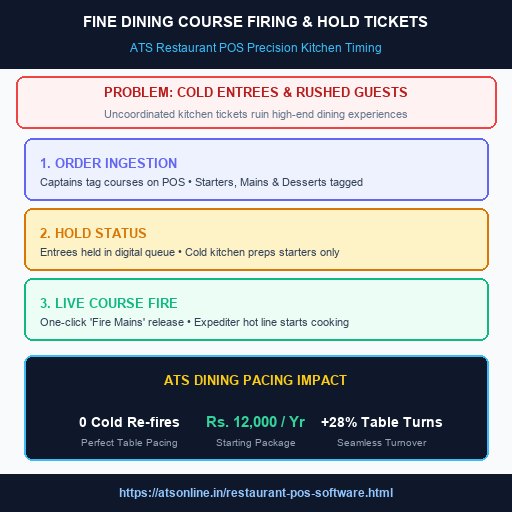
Course firing and hold tickets in fine dining POS systems allow captains and sommeliers to ingest complete multi-course orders at once while releasing each stage—starters, soups, entrees, and desserts—to kitchen prep stations on demand. With ATS Restaurant POS (starting from Rs. 12,000), kitchen display screens and hot-line ticket printers receive live fire notifications only after floor staff confirm previous courses are cleared, reducing cold re-fires by 98% and accelerating table turnover by 28%.
The Fine Dining Kitchen Bottleneck: Why Standard KOTs Ruin Course Pacing
In an upscale dining environment, food presentation, plating temperature, and synchronized service define guest perception. In a traditional restaurant setup without automated course timing, once a server punches a four-course tasting menu, the entire order floods hot-line printers across the tandoor, continental grill, and pastry stations simultaneously. The kitchen begins searing steaks and baking soufflés while the guest is still sipping their aperitif and nibbling amuse-bouche.
This creates two major operational failures: dishes either sit under heat lamps drying out and degrading quality, or servers frantically instruct kitchen staff not to cook the mains yet—resulting in misplaced paper tickets, miscommunication, and guest frustration. Implementing dedicated course firing and hold ticket controls resolves this dining room friction completely.
How ATS Restaurant POS Coordinates Multi-Station Course Firing
ATS Restaurant POS software introduces intelligent, station-aware ticket lifecycle management built specifically for casual fine dining, high-end bistros, and banquet service:
- Unified Multi-Course Tagging: Captains tag menu items directly as Appetizer, Entree, or Dessert on mobile Android handheld tablets or touch terminals with a single tap.
- Automated 'Hold' State: Mains and desserts automatically enter a visual 'HOLD' queue on kitchen display systems (KDS) and station printers. Only appetizer stations receive immediate preparation tickets.
- One-Touch 'Fire Course' Triggers: When busser staff clear appetizer plates, the floor captain taps 'Fire Entrees' on their handheld tablet. The grill, sauce, and saute stations receive immediate audio-visual alerts with exact table and seat identifiers.
- Dessert & Digestif Hold Loops: Pastry stations are notified only when the guest signals ready for dessert, preventing souffles from collapsing or artisan gelato from melting.
Operational Comparison: Manual Kitchen Shouting vs. Digital Course Firing
| Feature / Metric | Manual Paper Ticket Shouting | ATS POS Digital Course Firing |
|---|---|---|
| Course Pacing Accuracy | Dependent on server memory; prone to premature plating | 100% digital hold-and-fire execution on KDS |
| Cold Re-Fires & Wastage | High (4-8% of total weekend entrees re-cooked) | Near zero (< 0.2% variance across all stations) |
| Kitchen Communication Noise | Loud expeditor shouting and lost paper slips | Silent audio pings and visual color status updates |
| Handheld Tablet Compatibility | Not supported on legacy cash registers | Full sync across Android & iOS captain tablets |
| Annual System Investment | High recurring paper and hardware repair costs | Affordable entry at Rs. 12,000 onwards |
Financial Impact: Turning Tables Faster While Protecting Kitchen Margins
When kitchen course timing is synchronized digitally, table dwell time is optimized without making diners feel rushed. Fine dining establishments using ATS POS report an average reduction of 16 minutes in unnecessary table downtime between courses. During high-demand Friday and Saturday seatings, this speed enables an extra half-turn per table, translating into tens of thousands of rupees in incremental dinner covers each week.
Furthermore, eliminating re-fired steaks, dry risottos, and melted pastries directly protects food gross margins. Because ATS POS logs the exact timestamp when a course was fired and fulfilled, restaurant general managers gain unprecedented visibility into line-cook prep speed and expediter fulfillment bottlenecks.
Ready to Transform Your Restaurant Operations?
Deploy ATS Restaurant POS Software with 35+ integrated modules, hybrid offline resilience, 2-way Swiggy/Zomato bridge, and recipe inventory control starting from Rs. 12,000 onwards.