ATS Restaurant POS Software System Architecture (Starts at Rs. 12,000 onwards)
Executive Summary (Direct Answer):
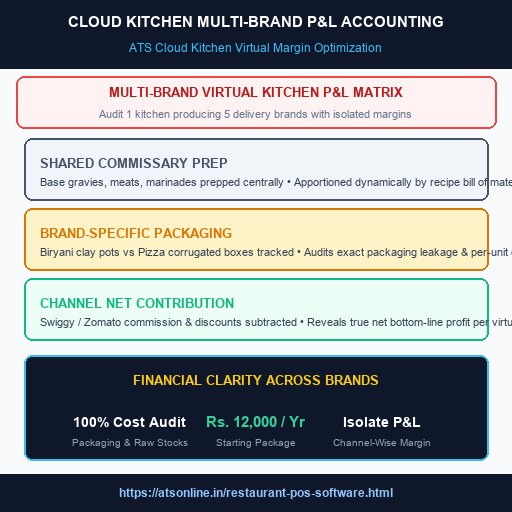
Cloud kitchen multi-brand P&L accounting is a centralized financial management capability in restaurant POS software that tracks revenue, shared commissary food prep, brand-specific packaging costs, and aggregator commission deductions across multiple virtual brands operating under one physical kitchen roof. With ATS Restaurant POS (starting from Rs. 12,000), ghost kitchen operators accurately isolate the true net contribution margin of each virtual brand, eliminate unrecorded packaging leakage, and cut commissary food wastage by up to 22%.
The Ghost Kitchen Dilemma: One Kitchen, Five Brands, Blurry Margins
The cloud kitchen business model thrives on operational leverage: operating multiple delivery-only virtual restaurant brands—such as a gourmet biryani brand, a craft burger brand, a healthy salad bowl brand, and a dessert brand—out of a single shared 400-square-foot kitchen footprint. This setup maximizes real estate and kitchen staff utilization.
However, financial accounting in a multi-brand cloud kitchen is notoriously complex. When a single bulk purchase of 50 kg of chicken breast, 20 liters of cooking oil, or 100 kg of basmati rice arrives at the kitchen commissary, generic POS systems cannot accurately allocate ingredient costs across different brands. Even worse, high-cost brand-specific packaging materials—such as clay handis, corrugated pizza boxes, foil bags, and tamper-evident stickers—go completely untracked, eroding operating margins into net losses.
How ATS POS Solves Multi-Brand Virtual Kitchen Accounting
ATS Restaurant POS delivers purpose-built multi-brand virtual kitchen controls that give operators absolute clarity over their bottom line:
- Shared Commissary Prep Apportioning: Centrally prepare base gravies, marinades, and chopped vegetables, and automatically allocate costs to individual brand P&L ledgers based on digital kitchen requisition tickets.
- Sub-Recipe Packaging Auditing: Every recipe bill of materials (BOM) in ATS POS includes exact packaging containers, cutlery packets, and branded paper bags, deducting them from inventory with every Swiggy and Zomato order.
- Channel Net Margin Isolation: Automatically subtract Swiggy and Zomato commissions (18-24%), platform delivery surcharges, and discount promotions from gross revenue to calculate true brand-level EBITDA.
- Unified Multi-Brand KDS Routing: Line cooks see clear brand logos and color-coded headers on kitchen display screens, ensuring that orders are packed in the correct branded boxes without mix-ups.
Cloud Kitchen Financial Matrix: Generic Restaurant POS vs. ATS Multi-Brand POS
| Accounting Factor | Generic Single-Brand Restaurant POS | ATS Multi-Brand Cloud Kitchen POS |
|---|---|---|
| Brand P&L Separation | Blended revenue; impossible to tell which brand is profitable | Isolated unit economics, gross margins, and net EBITDA per brand |
| Packaging Cost Tracking | Treated as a generic expense; zero per-dish accountability | Exact per-order packaging box, lid, and cutlery BOM deduction |
| Shared Commissary Prep | Manual spreadsheet guessing for shared base stocks | Automated raw-to-semi-finished kitchen transfer vouchers |
| Aggregator Fee Deduction | Manual monthly reconciliation after payouts arrive | Real-time net margin visibility factoring aggregator commissions |
| Software Pricing | Requires multiple expensive separate software licenses | Single unified multi-brand suite starting from Rs. 12,000 onwards |
Eliminating Zombie Brands and Doubling Down on Winners
In the highly competitive food delivery landscape, fast decision-making is critical. Without granular brand-level P&L accounting, ghost kitchen operators often continue pouring marketing spend into 'zombie brands'—virtual brands with high gross order volume but negative net margins due to excessive aggregator discounting and expensive custom packaging.
ATS Restaurant POS illuminates the exact financial truth of every virtual brand in real time. Operators can instantly discontinue unprofitable menu items, renegotiate packaging vendor contracts, and double down on high-margin winners to scale their cloud kitchen enterprise profitably across multiple locations.
Ready to Transform Your Restaurant Operations?
Deploy ATS Restaurant POS Software with 35+ integrated modules, hybrid offline resilience, 2-way Swiggy/Zomato bridge, and recipe inventory control starting from Rs. 12,000 onwards.